An old refrigerator needs more preparation than ordinary furniture: its food, water, power connection, doors, weight and building route all affect collection. Choose an eligible official bulky-waste route or a properly scoped appliance collection, then follow the appliance’s instructions and the collector’s preparation requirements before it moves.
Choose the collection route first
Dubai Municipality’s service directory lists household appliances and furniture under its bulky-waste service. The directory describes it as free, gives a three-working-day service time and excludes investment zones. Check current eligibility and instructions on the official Dubai Municipality services page.
Dubai Municipality has separately stated that the service includes used electrical and electronic appliances and is available to Dubai residents outside real-estate development zones and free zones. Its official service announcement provides that scope.
Where the address is excluded, timing is fixed or carrying from inside is needed, a paid collection may be appropriate. Confirm that the provider accepts the appliance and understands its location, size and condition.
If a retailer is delivering a replacement, read its written removal terms. Do not assume delivery includes old-appliance collection, disconnection or movement from another room.
Identify the appliance accurately
State whether it is a refrigerator, fridge-freezer, side-by-side unit, chest freezer or commercial appliance. Photograph the front, sides, rear where safely visible, connections and route.
Measure width, depth and height, including handles and hinges. Check whether doors or drawers can be removed under the manufacturer’s instructions if clearance is tight.
Record the floor level, stairs, lift and carry distance. Mention water dispensers, ice makers, visible leaks, damaged doors, broken glass shelves or unstable feet.
Do not move the appliance simply to improve the photos if its condition or connection is uncertain. Share what can be seen and request guidance.
Empty food and personal contents
Remove all food, ice trays, medicines, documents and small items. Check drawers and door shelves. Arrange food storage before switching off the appliance according to the applicable instructions.
Do not expect the collector to handle food waste. Clean spills and remove loose residue using the manufacturer’s care guidance. Keep the floor dry.
Take out loose shelves and drawers if the collector requests it, or secure them so they cannot shift. Wrap glass shelves separately and identify them.
If the appliance contains spoiled food or contamination, disclose it before booking. That condition may change preparation or acceptance.
Follow safe disconnection instructions
Use the appliance manufacturer’s instructions for switching off, defrosting and movement. If the unit has a fixed water connection, inaccessible plug, damaged cable or other uncertain connection, arrange competent help rather than forcing it.
Do not cut pipes, open sealed systems or remove rear components. A general removal appointment is not appliance repair or technical decommissioning.
Allow defrost water to be managed without flooding cabinets or the carry route. Use stable containers and towels, and keep them clear of electrical points. Finish preparation early enough for surfaces to dry.
Tell the collector whether disconnection is complete. A team arriving to a live water connection or inaccessible plug may be unable to begin as planned.
Prepare doors and internal parts
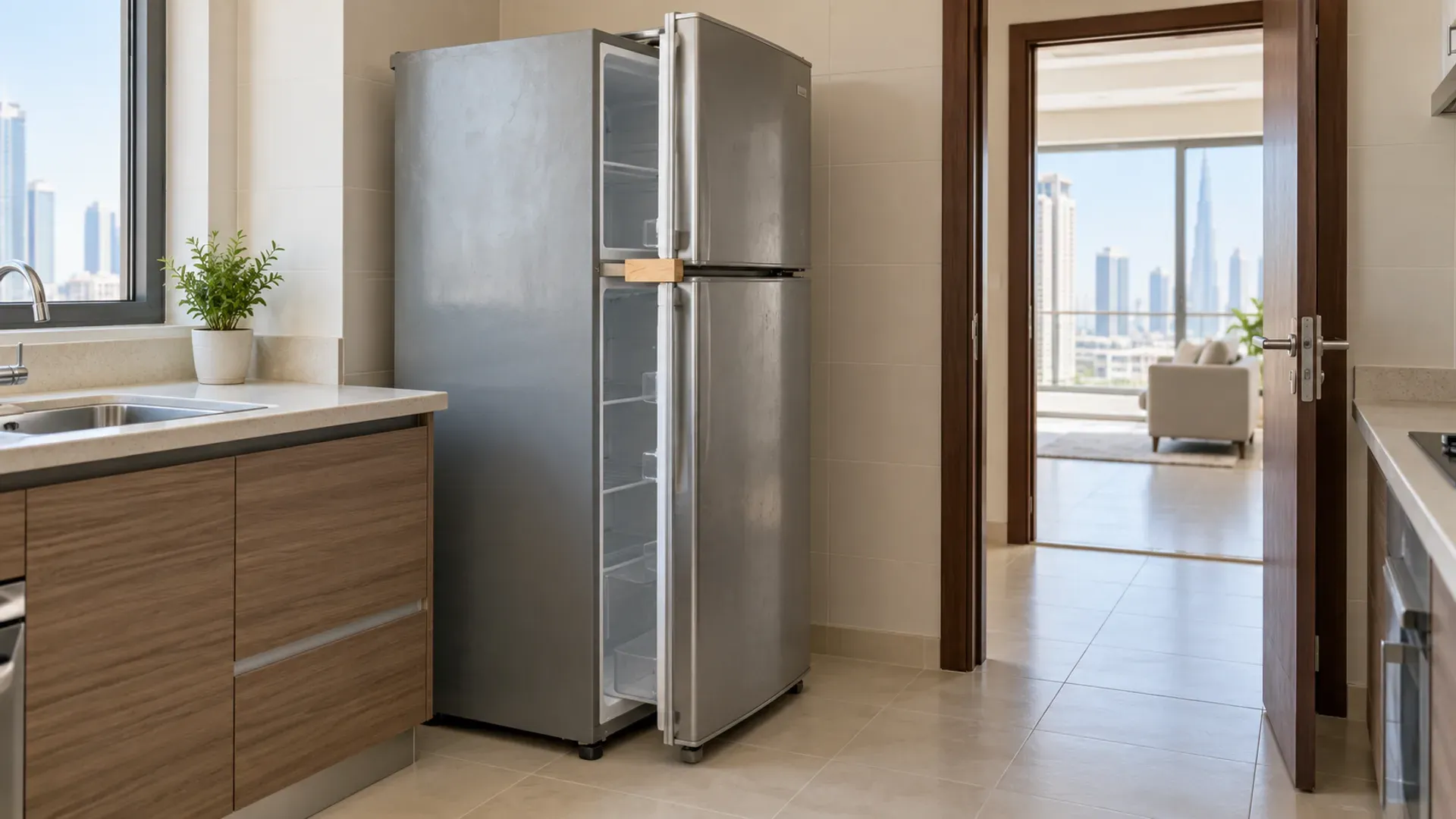
Confirm the collector’s preference for doors. Keeping them closed during movement prevents swinging, while long-term unattended storage may require a different safety approach. Use a non-damaging restraint suitable for the short collection process.
Remove or secure loose shelves, trays and drawers. Do not overload the empty cavity with other objects. Added contents shift weight and may break interior fittings.
Protect sharp or cracked edges. Report damaged glass and do not hide it behind tape or wrap. Contain small fragments safely.
Keep keys for lockable commercial or specialist units with the responsible owner unless the collector requests otherwise.
Measure the complete route
Walk from the appliance position to the vehicle. Measure the kitchen doorway, corridor turns, apartment door, lift opening and loading entrance. Check height around door closers and ceiling features.
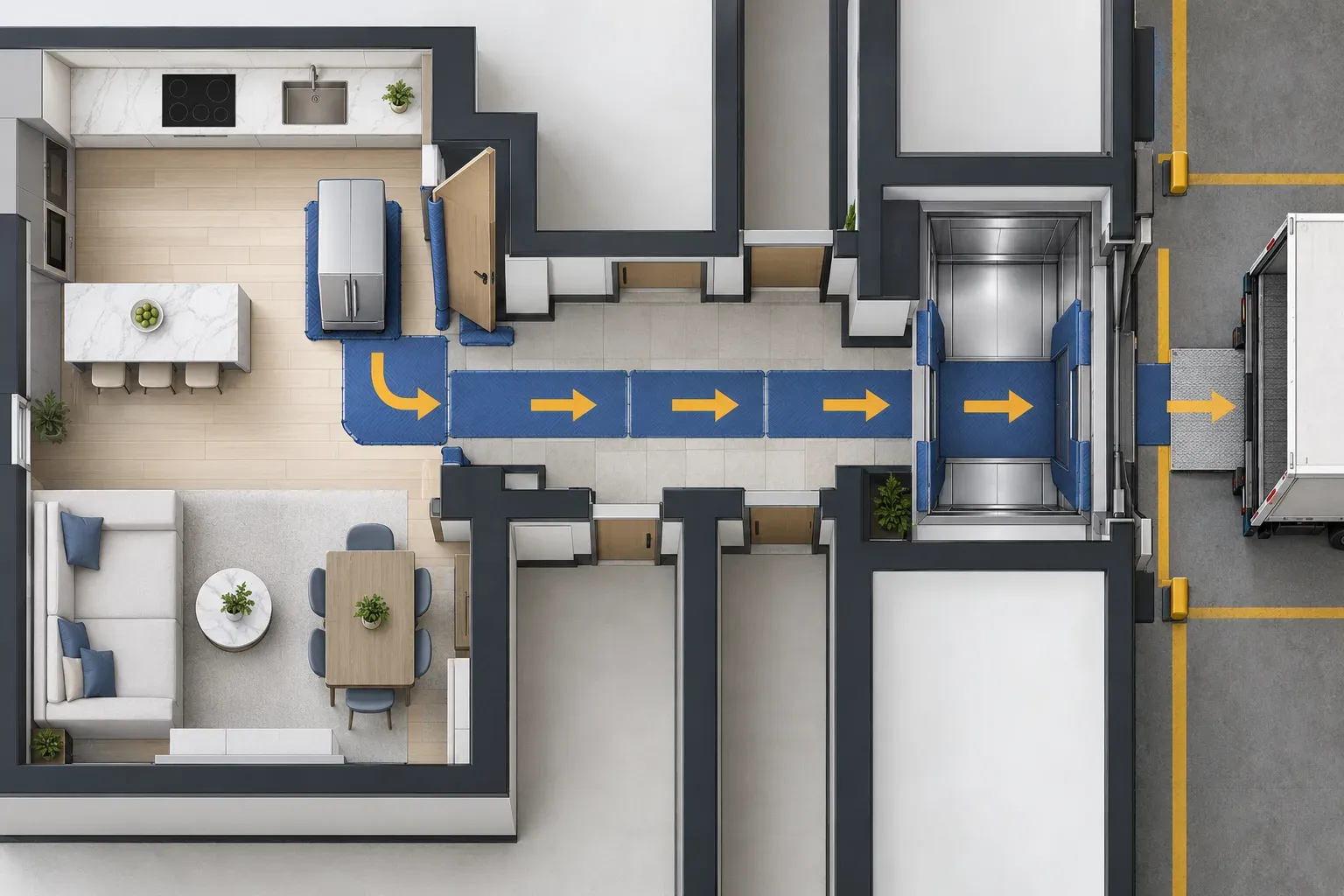
Account for the trolley and handlers. A gap equal to the refrigerator width is not necessarily enough for hands, protection and turning. Share narrow points in photos.
Look at the starting position. Recessed refrigerators may have little side clearance. Built-in panels, trim or cabinetry should be handled according to the property and appliance requirements before removal.
Keep the route dry and remove rugs, stools, bins and cables. Do not drag the appliance across flooring.
Protect floors, walls and lifts
The appliance is heavy and concentrated on small feet or wheels. Use appropriate handling equipment and route protection. Avoid improvised tilting or sliding.
Ask building management what protection it requires in common areas and lifts. Keep fire doors, lift sensors and controls accessible.
Take condition photos if the building requires them. Report existing damage or leaks before movement starts.
After collection, inspect the kitchen recess, corridor and lift for water, packaging or marks. Dry any residual moisture promptly.
Arrange tower access
Book the service lift where required and confirm the permitted window. Provide contractor or vehicle details by the building’s deadline.
Tell the provider about the floor, lift dimensions, loading bay, basement limit and distance from lift to vehicle. Security check-in and lift collection consume part of the appointment window.
Do not place the refrigerator in a lift lobby before the team arrives. Keep common routes clear and the appliance stable in its normal position.
If the passenger lift is the only possible route, obtain management’s instruction before booking. Do not assume permission.
Arrange villa access
Clear the doorway, gate and driveway. Move cars that block the loading position and secure pets. Check steps and narrow side passages.
If the refrigerator sits in an external kitchen or store, mention uneven surfaces, heat and distance. Keep the route free of hoses, pots and loose gravel.
Confirm community entry details for the vehicle where applicable. Send the approved gate and map pin.
Do not leave the appliance on the road or outside the property while waiting for collection. Follow the confirmed staging instruction.
Coordinate replacement delivery
Read the delivery terms for the new refrigerator. Confirm whether old-unit removal is included, whether the old unit must be disconnected and where it must be positioned.
Measure the route for both appliances. Removing the old unit proves only that its dimensions worked; the replacement may be larger or use different door clearances.
Schedule old-fridge removal before delivery when the retailer does not collect it. Leave time to clean, inspect connections and address damage in the recess.
Avoid overlapping two crews in the same lift or kitchen. Separate windows reduce congestion and uncertainty.
Request an accurate paid quote
Send appliance type, dimensions, photographs, floor and access information. Include stairs, long carries, lift bookings and parking restrictions.
State whether the unit is disconnected, empty, dry and damaged. Mention glass, water connections or a tight recess. Ask what carrying and basic preparation are included.
The appliance disposal service should be booked from the real item and route rather than a generic “one fridge” description.
Ask how additions are handled. A second appliance or furniture item changes the scope and vehicle plan.
Avoid unsafe shortcuts
Do not tip or drag a refrigerator without appropriate equipment and a planned route. Do not use its doors, handles or shelves as lifting points.
Do not cut cables or pipework. Do not puncture panels or rear components to reduce size. If the appliance cannot clear the route, ask about manufacturer-appropriate door removal or another controlled method.
Do not conceal a leak or broken glass. Keep people away from the work path and let the crew control movement.
Do not leave the unit beside a communal bin. Use the official service where eligible or an agreed collector.
Combine it with other bulky items carefully
List every additional item. A washing machine, cooker, mattress or sofa affects vehicle space and carrying order. Do not assume small furniture can be added without notice.
Keep appliance preparation separate. Each unit must be empty and ready under its own instructions. Loose furniture should not be stored inside the fridge.
If old furniture is part of the same clearance, the old-furniture disposal guide compares reuse, recipient transfer, Municipality service and paid collection.
Agree the complete load before dispatch. This gives the provider a chance to plan crew, trolley, protection and vehicle space.
What the official service does and does not answer
The official pages verify that household appliances fall within Dubai Municipality’s bulky-waste service and identify a general service time and area exclusions. They do not replace the current instructions for a particular building, appliance or request.
Check the live service page at booking. Confirm how to apply, whether the exact address is covered, where the appliance should be presented and what preparation is required.
Building management may impose separate access conditions even when the address is eligible. Obtain both service confirmation and property approval.
If the official route does not fit, choose another lawful option rather than placing the appliance outside without confirmation.
Collection-day sequence
Check that the appliance is empty, prepared under its instructions and ready for the agreed route. Remove obstacles and keep floors dry. Keep building approval and access cards available.
Walk the crew through the appliance condition and route. Point out connections, broken parts and narrow turns. Confirm the full scope before movement.
Keep other people and pets away. Let the team choose equipment, orientation and loading order.
After departure, inspect the recess and route. Retain any property keys, manuals or components that belong with the replacement.
Refrigerator-disposal checklist
- Confirm the correct official or paid collection route.
- Check current address eligibility from the official source.
- Identify appliance type and dimensions.
- Remove all food and personal contents.
- Follow manufacturer instructions for shutdown and defrosting.
- Arrange competent help for uncertain connections.
- Secure or remove loose internal parts as agreed.
- Measure every doorway, turn and lift.
- Confirm building and vehicle access.
- Keep the route dry and shared spaces clear.
- Disclose leaks, glass and damage.
- Inspect the property after collection.
Questions people ask about refrigerator removal
How early should I empty the fridge?
Work from the manufacturer’s shutdown and defrosting instructions and the collector’s requirements. Arrange safe food storage first and leave enough time for ice and water to be managed before the route is used. The exact timing depends on the appliance.
Can the collection crew disconnect it?
Confirm this before booking. A simple accessible plug and a fixed water or electrical connection are different scopes. When a connection is inaccessible, damaged or uncertain, use competent help and tell the collector when the appliance is ready.
Must the doors be removed?
Usually only when the route or collector requires it and the manufacturer’s method permits it. Measure first. Removing doors changes handling, exposes fittings and may need organised hardware, so it should not be an automatic preparation step.
Can a refrigerator travel with food or boxes inside?
It should be empty for collection. Contents add shifting weight, hide spills and can damage shelves. Remove food, medicines, trays and personal objects, then secure or remove loose internal parts as instructed.
What if it leaks during preparation?
Stop the leak from reaching electrical points or the carry route, without opening technical systems. Isolate the area, tell the provider and obtain appropriate appliance help when the source is uncertain. Keep the floor dry before movement.
Can it be collected with furniture?
It may be part of the same agreed load if the chosen service accepts both. List every item, confirm preparation and provide enough vehicle and access information. Do not assume an appliance can be added to a furniture booking on arrival.
Final readiness check
Immediately before collection, confirm that food and personal items are gone, loose internal parts are controlled and preparation matches the appliance instructions. Check the floor for moisture and keep towels or containers away from the carry path.
Confirm the lift, gate or loading access and keep the contact phone available. Show the crew any damaged edge, uncertain connection or route restriction before the appliance moves.
If the unit is not safely disconnected or the route has changed, pause the movement and update the plan. The appointment should begin only when the refrigerator and property are both ready.
Fridge disposal becomes manageable when the appliance and route are prepared together. Verify the collection option, follow appliance-specific instructions, disclose connections and damage, and give the collector enough access detail to move it without improvisation.