Empty the tank before you call the room clear. A dehumidifier left in a shut room is one machine: a tank or a hose, a cord, and a door that has been closed on it. A booking that says “the spare room” will be read as boxes and a chair. If the object is this unit, the note has to name the unit and show that the water is out.
This page is that one unit. It is not a refrigerator. Food, a defrost and a sealed cabinet belong on the fridge guide. Stay on that page when the appliance is a fridge or a freezer. It is not a list of unlike machines sharing one morning. The old-appliance register is that list. Come back here when the only machine is a dehumidifier and the open question is the tank. It is not a leak, a wet floor, or furniture that got wet. Those questions are not answered on this page.
Empty the tank before the room is called clear
Open the door of the room before you decide the tank is empty. A shut door hides a full tank, and a full tank spills once the unit tilts on a stair or over a threshold.
Look for a tank that slides out. If it slides, carry it to a sink or a drain you already use in that home, tip the water out, and put the tank back empty. Wipe the lip so a photo can see the inside. If the tank will not slide, and the unit has a bung or a small tap you can open by hand, empty it into a bucket and then empty the bucket. Do not drill the tank. Do not tip the whole unit to pour it. Water then runs toward the cord and across the floor you still have to walk.
A bucket already sitting beside the unit is not the tank. If the bucket is leaving, empty it and say “bucket, empty, leaving”. If you are keeping the bucket, empty it and move it out of the photograph. A tray under the unit is the same kind of water. Empty the tray before anyone lifts the machine. A lift with a full tray underneath sends the water onto the floor at the first tilt.
If you cannot get the water out, write “tank still holding water” on the note and do not describe the unit as empty. Say where the water is: in the tank, in a tray, or in a bucket you have not emptied. A later message that it was “mostly empty” is not a photo of an empty tank.
A hose that pulls off the back of the unit, and is not fixed into a wall pipe, comes off. Coil it with the cord. A hose that disappears into a wall, a floor waste or a fitting you did not put there stays put. Do not cut that pipe. Do not cut the hose at a fitting you cannot undo by hand. Write “hose still on a pipe” and leave the unit where it stands until the person who may release that connection has done so. Do not ask for that pipe to be cut as part of the collection.
A drinking-water cabinet on a supply pipe is a different machine. Isolating that pipe and emptying that reservoir is the plumbed-dispenser note. Do not use this page to cut a drinking-water line, and do not rename a dehumidifier as a cooler because both hold water. A hot-water tank is not this unit either. That job stays on the water-heater guide.
A filter or a small cartridge that lifts out by hand can come out so the tank opening is visible. Bag it if it is leaving, and write “filter, separate” where a photo can read the words. If a label on the cartridge is readable, leave the label readable. Do not call the cartridge a hazard you have not identified, and do not hide it in a sack of mixed rubbish to make the unit look bare. If the filter will not lift, leave it and write “filter still in”. Do not lever a grille off with a screwdriver.
Some units send water out of a spout instead of into a tank you can slide. If you can see the spout and it is dry, say “spout, no tank in the photo”. If water is still sitting in a well under the spout, empty that well the same way you would empty a tank you can reach. If you cannot see where the water collects, write “water point not seen” and do not claim the unit is dry.
Unplug the cord and leave the casing shut
Find the plug. If you can see it and reach it, switch the unit off and take the plug out of the socket. Coil the cord so it is not under a foot and not hanging into the path of the door. Tape it to the side, or lay it on top, so the next person can see that it is free.
Some leads unplug at the unit as well as at the wall. If both ends are ordinary plugs you can see, unplug both. If the lead is fixed into the casing with no plug at the machine, unplug only the wall end you can see, and say “lead fixed at the unit”. Do not cut that lead to make a second end.
If the plug is behind the unit and you cannot reach it without dragging a machine that is still switched on, do not drag it. Write “plug not seen”. Move whatever is keeping you from the socket — a box, a drying rack, a case — if that object is yours to move. Then unplug. If you still cannot reach the socket, the photo shows the back as far as you can see it, and the words “plug not seen” stay in the note. Do not cut the cord to finish the photo.
Do not open the casing. Do not unscrew a panel to look at a fan, a coil or a tray you cannot see from the tank opening. A sealed part stays sealed. Do not puncture a pipe on the machine. Do not “just loosen” a fitting because the unit seems heavy.
If the side of the unit is hot because it was running when you opened the room, leave it unplugged and do not send the photo of a finished unit until you can rest a hand on that side. There is no minute count on this page. Touch the side. If you pull your hand away, it is not ready.
An air conditioner fixed to a wall, or a split system with an indoor unit and an outdoor unit, is not this machine. Who disconnects that system is the AC guide. A portable box with a tank and a domestic plug is this page. If you cannot tell which you have, photograph the front and the back. Look for a tank or a hose, and look for a wall bracket or a pipe that leaves the room. Do not write “dehumidifier” until you can see the tank or the hose and you cannot see a bracket holding the unit to the wall.
A unit that is still in a sealed carton is not a machine left running in a shut room. If you have not opened the carton, do not claim the tank is empty. Write “boxed, tank not checked”. Open it if the carton is yours to open, do the tank check, and then decide. A carton you must not open stays a carton. Say so, and do not list it as an emptied unit.
Wheels and a handle change the carry, not the tank check. If the handle folds, fold it only if it folds without a tool, and measure the height with the handle in the position it will travel. If the wheels are locked by a pedal you can press, say whether they are locked or free. If a wheel is off, put the wheel in the photo or write “wheel missing”. Do not book a rolling unit that no longer rolls unless you have said so.
A remote, a small leaflet and a loose adapter are not the unit. If you are keeping them, move them out of the frame. If an adapter is the only way the lead meets the socket, and it is leaving with the unit, unplug it and coil it with the cord. Say “adapter with the cord”.
A shut room is a location, not a drying job
The room was shut. That is why the first view from the corridor is a door, and why the tank may be full. Open the door. Use the light that room already has. If that light does not work, say “no working light” and use a light you can hold. Do not drag the unit across the room to chase a socket that still has the plug in it.
This page does not tell you how to dry a room, how to treat a smell, or what to do with furniture that got wet. If the floor is wet from a leak, the dehumidifier is still only the dehumidifier. Name the unit. Leave the wet furniture off this note. A decision about damaged furniture is not made here, and this page will not invent one.
Do not switch the unit on “once more” to dry a carpet and then call the tank empty. If it has been running, switch it off, unplug it, empty the tank after it has stopped, and photograph that empty tank. A tank you emptied the day before can hold water again if someone turned the unit back on overnight.
Water you can smell in the tank is still water to empty. Empty it. Do not add a claim about what the smell means. The photo of the empty tank is the record. A sentence about the smell is not a substitute for that photo.
Personal things in the room stay out of the unit’s photograph, or you say they are staying. A box on top of the machine is not part of the machine. Lift it off. A chair you are keeping moves off the path to the door. A suitcase against the tank door means you have not seen the tank. Move the suitcase, then look.
If the unit stands in a wardrobe, a store or behind a door that opens only part of the way, open that door as far as it goes and photograph the gap. Do not describe a clear path you have not opened. If a shelf holds the unit, say “on a shelf” and do not pull it off the shelf while the tank is full. Empty the tank first, or write that you could not.
A second dehumidifier in the same home is a second tank check, not a reason to change pages. Name each one: “bedroom unit” and “store unit”, with its own empty-or-not line. If the booking also has a fridge, a washer or a cooker, those machines go on the old-appliance register. This page still owns only the dehumidifier line inside that larger list. Do not let the word “appliances” put the water back inside the tank.
If a tenancy list or a written note names the unit as something you may not send, leave it off the booking. Age and a shut door are not permission. The person who may release it writes that release. This page does not interpret a contract.
The acceptance list is the wider question of what a mixed load can include. A single unit with a tank to empty is narrower than that list. Use the list when you are still asking whether a machine can go at all. Use this page when you already know the object is one dehumidifier and the work left is the tank, the cord and the shut door.
Photos of the tank, the cord and the open door
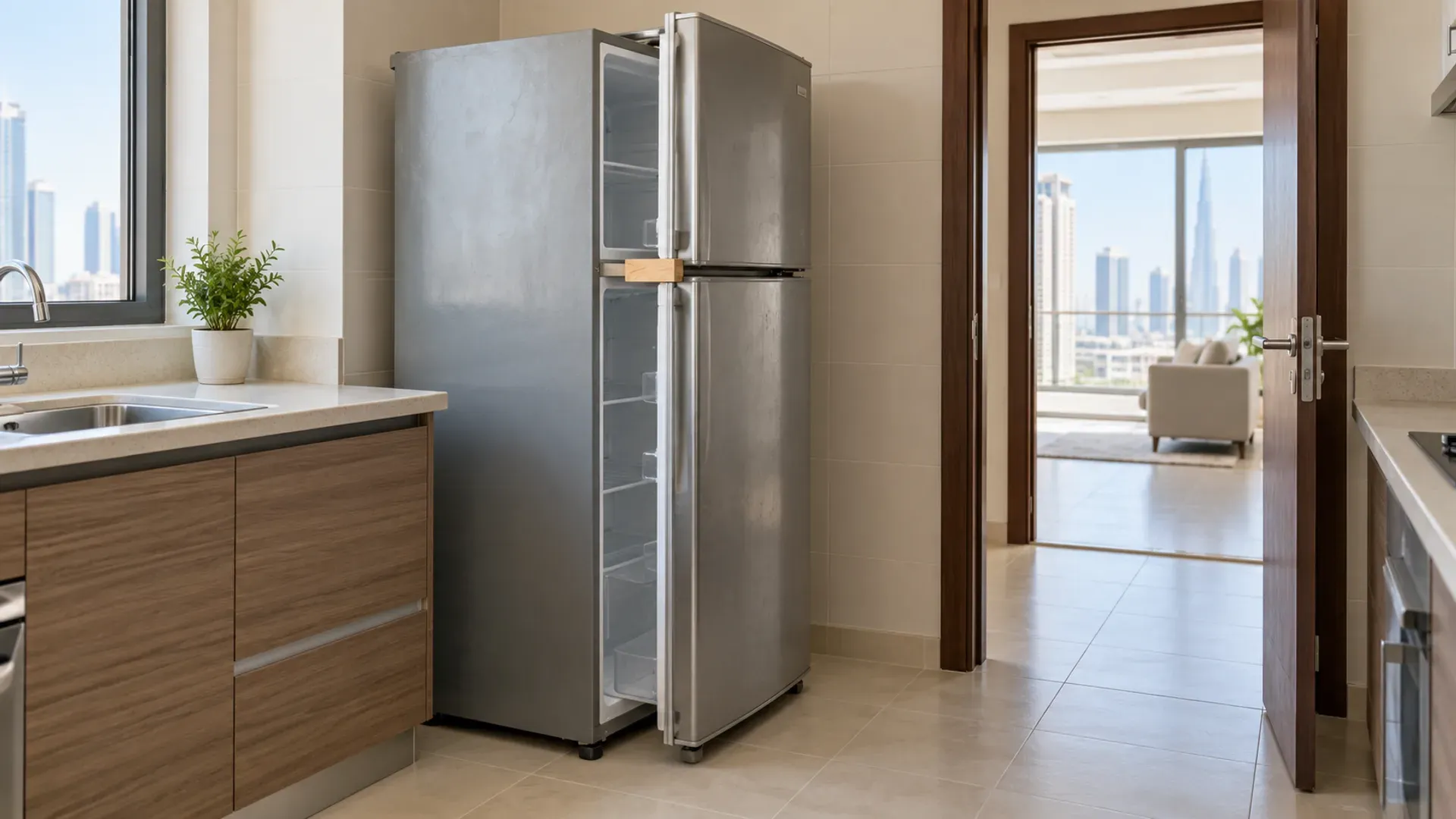
The picture is a refrigerator by a kitchen door. It does not show a dehumidifier, a tank, a hose or a room that was shut. Use it only as a reminder that a kitchen appliance in a photograph is not this unit unless the unit is the one in your own photos. Your photos still have to show the tank and the open door.
Send these views.
- The unit from the front, in the room, with the room door open in that frame or in the next one.
- The tank out, or the tank in place with the opening toward the camera, so the inside reads as empty. If it still holds water, photograph the water and do not write “empty”.
- The plug out of the socket, and the cord coiled. If the plug is not reachable, the back as far as you can see it, with “plug not seen”.
- The hose, either coiled and off the unit, or still entering a pipe, with the words you wrote.
- The doorway the unit has to pass, from the room to that door, with items you are keeping moved off that path.
- A side view that shows the handle up or folded, and whether the unit is on wheels.
Add the room name, the floor, and a lift or loading note you have already been given. If you have no lift note, write “no lift instruction yet”. Add that the casing was not opened and the cord was not cut. Add whether the filter came out. Add “not a fridge” only if you have checked and it is not a fridge. If you have not checked, do not add that line.
Measure the unit only as it will travel: height with the handle in its travelling position, width, depth. Then measure the clear opening of the door you will use, height and width, with that door as open as it goes. Write both pairs of figures. Do not replace them with “it should fit”. A handle that stands above the casing is part of the height. A hose you left on is not part of the height, but it is part of the note, because the unit is not free while the hose is on the pipe.
Take the photos with the room light on, or say that the light does not work. A flash of a closed door from the corridor does not show the tank.
One line in the booking
You can add it to the junk pickup when the tank is empty or honestly marked as still holding water, the plug is out or marked unseen, and the hose is either coiled off or still on a pipe you have named. That page is a one-off load from the room. It is not a bin round, and it is not a visit to dry the flat.
In the message, say that there is one dehumidifier, and name the room. Say whether the tank is empty or still holding water. Say whether the plug is out or still unseen. Say what the hose is doing. Say that the casing stayed shut and the cord was not cut. Say that wet furniture and a leak are not part of this booking. Say the floor, the door, and the lift note you have, or “no lift instruction yet”. If a second unit exists, give it a second line with its own tank result. If the unit is on a shelf or in a wardrobe, say that in the same message.
Do not write “spare room” as the only line. A shut door is not an emptied tank. A fridge in the kitchen is not this line. An air conditioner on a bracket is not this line. A hose you cut is not a prepared unit.
If the tank photo still shows water, you are early. Empty it, or change the note, before you ask for a collection time. A booking made from a photo of a closed door cannot see the tank.
The fridge page remains the refrigerator. The old-appliance page remains unlike machines on one list. The acceptance list remains the wider yes-and-no. The AC page remains a fixed cooling unit. The plumbed-dispenser page remains a drinking-water pipe. This page remains one dehumidifier that does not leave with a full tank and a shut door.
The morning the unit leaves
Open the room door before anyone is at it. Look in the tank again. If the unit was switched on after your photos, empty it and photograph it again. Check the plug is still out, or that the “plug not seen” line is still true. Check the hose is still coiled off, or still on the pipe you named. A hose pushed back onto a pipe overnight is a different unit from the one in the photo.
Move a box you put back on top. Move a rack you folded into the doorway. Point at the unit as the line this page covers. Point at a second unit only if you wrote a second line. Leave a fridge, a washer and a wet sofa out of the gesture.
Do not stand the unit in the corridor the night before to “save the room”. The corridor is not the location you photographed, and a tank that still has water does not belong on a shared landing. If the only place it can wait is the room it is already in, leave it there with the door open enough that it can be seen.
When it has gone, look at the patch of floor. A tray you forgot is still water. A filter you meant to bag is still a separate object. The useful record is the sentence from the first check: one dehumidifier, tank empty or honestly not empty, cord unplugged or marked unseen, casing shut, hose described, and the shut room opened so the unit can be seen.