Every professional junk removal service in Dubai operates within a clear boundary defined by three practical realities: what fits safely inside a commercial collection vehicle, what a two- or three-person crew can physically and safely lift, and what municipal transfer facilities and licensed recyclers are legally permitted to accept. When homeowners, tenants, and business managers book a clearance, uncertainty about whether specific items can be removed often causes unnecessary stress or delayed handovers. In practice, the vast majority of non-hazardous household, office, and garden items can be collected, loaded, and transported in a single visit without requiring the customer to separate, pack, or drag items to the kerb.
Understanding the difference between standard bulky waste, specialized recyclable streams, and strictly regulated hazardous materials is the most reliable way to plan an efficient collection. While standard household clearance covers almost everything from a broken three-seater sofa to a room full of neglected moving boxes, certain dangerous items are prohibited by Dubai waste regulations and transport safety rules. Knowing these boundaries in advance ensures that collection day proceeds without surprises, price disputes, or leftover items that building security will not allow you to abandon.
Household furniture from every room
Furniture forms the core volume of most residential clearances in Dubai. Whether an expatriate tenant is preparing for an end-of-tenancy inspection, a villa owner is refurnishing a living room, or a landlord is clearing abandoned belongings, professional collection crews handle virtually all standard residential furnishings regardless of size, age, or structural condition.
Living room furniture represents the most common category. Crews regularly collect fabric sofas, leather couches, sectionals, L-shaped corner units, armchairs, recliners, coffee tables, television consoles, media wall units, bookshelves, and decorative sideboards. Because large lounge pieces frequently exceed the dimensions of standard apartment doorways and passenger lifts, experienced teams carry the hand tools required to remove sofa legs, detach sectional brackets, or take down modular cabinetry. You do not need to dismantle a living room set before the team arrives; professional crews evaluate the piece inside the room and dismantle only what is strictly necessary to clear interior frames and common corridors without scuffing walls.
Bedroom furniture constitutes another major segment. This includes wooden and upholstered bed frames, headboards, slatted bases, box springs, mattresses of all sizes, bedside tables, dressing tables with mirrors, and multi-door freestanding wardrobes. Mattresses receive dedicated handling because their flexible internal spring structure makes them awkward to maneuver through tight tower stairwells and service corridors. Wardrobes, especially large flat-pack units from popular retailers, are typically dismantled directly in the bedroom because attempting to carry a fully assembled two-meter wardrobe whole risks buckling the joints, cracking the particle board, and damaging apartment walls.
Dining room and home office furniture are equally eligible for full collection. Solid timber dining tables, glass-top tables, dining chairs, barstools, display cabinets, study desks, ergonomic office chairs, filing drawers, and metal shelving are collected daily. For glass-top tables and mirrored furnishings, crews apply protective blankets or stretch wrap to prevent shattering during transit through building elevators and shared loading docks. Outdoor and patio furnishings—including weathered rattan sofas, aluminium loungers, balcony bistro sets, sun umbrellas with concrete bases, and heavy wooden garden benches—are also collected without hesitation, even when suffering from intense sun bleaching or surface corrosion caused by Dubai’s summer heat.
Large domestic appliances and white goods
Kitchen and laundry white goods require specific handling due to their considerable weight, sensitive internal components, and the presence of electrical and plumbing connections. A specialized junk removal service in Dubai collects all standard household white goods, provided the appliances have been cleanly disconnected from utility supplies before the crew begins loading.
Refrigeration units are among the heaviest single appliances collected from Dubai apartments and villas. These include freestanding upright refrigerators, compact under-counter fridges, large side-by-side American-style fridge-freezers, and chest freezers. Because refrigeration units contain chemical refrigerants and compressor oils, they cannot be mixed with general municipal waste or abandoned in residential refuse rooms. They must be strapped upright onto heavy-duty pneumatic-wheeled trolleys to protect building floor tiles and service lift thresholds. Customers must empty all food contents and disconnect the unit from power well ahead of time to allow the internal freezer compartments to defrost naturally.
Laundry appliances present a similar mechanical challenge. Washing machines, front-load and top-load washers, condenser dryers, vented tumble dryers, and integrated washer-dryer combinations contain heavy internal concrete counterbalance weights designed to stabilize the spinning drum. Carrying these appliances down stairs or through tight laundry closets requires two crew members using reinforced lifting straps. To prevent water damage to hallway carpets and common corridors, appliances must be fully drained of residual water from the bottom drain filter and disconnected from the water supply tap and wall waste outlet before the team arrives.
Cooking appliances and dishwashers are also standard collection items. Freestanding electric cookers, ceramic hobs, built-in electric ovens, microwave ovens, cooker extraction hoods, and standard dishwashers are accepted. However, safety protocols require that electric cookers wired directly into high-amp cooker isolation switches be safely disconnected by a qualified electrician prior to removal. Crews cannot cut live high-voltage cables or disconnect active gas pipework. Once safely isolated from power and gas supplies, these appliances are loaded onto collection trucks and routed to approved electrical waste processing facilities where metals, copper wiring, and recyclable plastics are reclaimed.
Air conditioning units represent a distinct category within Dubai’s domestic appliance landscape. Window AC units, portable air conditioning units, and split-system indoor and outdoor condenser units can be collected once they have been professionally decommissioned and uninstalled from the walls. As covered in our regulatory guide on what Dubai bins won't take, units containing pressurized refrigerant gases must have their refrigerant safely recovered by certified HVAC technicians before scrap disposal to comply with UAE environmental protection standards. Once detached from wall brackets and refrigerant lines, the physical units are fully eligible for junk collection.
Electronics, computing equipment, and residential e-waste
Small and medium electrical items accumulate rapidly in modern households. Upgrading home entertainment systems, replacing office computers, and clearing out broken gadgets creates a steady stream of electronic waste that Dubai Municipality strictly prohibits from entering general municipal landfills. Professional junk collection provides a compliant, centralized route for disposing of all domestic electronics.
Entertainment electronics of every generation are accepted. This includes modern flat-panel smart televisions, older liquid-crystal display units, oversized projection monitors, home theater soundbars, audio receivers, surround-sound speakers, subwoofers, gaming consoles, set-top streaming boxes, DVD players, and obsolete stereo systems. Large televisions with fragile glass screens require careful wrapping before they are moved through elevators to prevent glass fragments from scattering across building access routes.
Personal computing and home-office equipment constitute another significant portion of electronic junk. Desktop computer towers, computer monitors, all-in-one desktop machines, laptops, keyboards, computer mice, external hard drives, desktop printers, multi-function scanners, photocopiers, uninterrupted power supply battery backups, and tangled boxes of obsolete charging adapters and network cables can all be hauled away. Customers are always advised to remove or securely overwrite internal hard drives and storage cards prior to collection to safeguard their personal data, as collection crews transport the physical hardware directly to licensed material recovery yards.
Small kitchen gadgets and personal care appliances are also fully accepted as part of any general household load. Vacuum cleaners, microwave ovens, blenders, food processors, air fryers, toasters, coffee machines, electric kettles, hair dryers, clothing irons, garment steamers, and electric heaters can be grouped into boxes or bags for easy removal. Instead of sitting indefinitely in storage cupboards or occupying valuable wardrobe shelves, these items can be handed over to the crew during a broader room or home clearance.
Household bric-a-brac, storage clutter, and textiles
Beyond large furniture and heavy appliances, typical Dubai home clearances involve dozens of smaller miscellaneous items that do not fit into standard building trash chutes. Over months and years of living in a home, storage cupboards, balconies, and maid rooms fill with items that need to go all at once.
Packed moving boxes, cardboard cartons, plastic storage bins, and suitcases are completely acceptable. Whether these containers hold forgotten kitchen utensils, mismatched chinaware, old glassware, decorative ornaments, photo frames, or surplus holiday decorations, crews carry the containers out directly. You do not need to unpack or sort through sealed boxes if your decision is to discard the entire contents. The crew will load the boxes intact and transport them to the sorting depot where cardboard and paper packaging are separated for recycling.
Home textiles and soft furnishings represent another major category. Mattresses, bulky synthetic duvets, bed pillows, bedspreads, blankets, bath towels, and curtains are collected alongside hard furniture. Area rugs, Persian wool carpets, runners, and foam floor mats can be rolled, bound with tape, and carried out quickly. If a tenant has removed fitted carpet from a bedroom or office during a restoration project, rolled carpet lengths and carpet underlay are accepted, provided they are tied into manageable rolls that two workers can carry through building corridors.
Fitness equipment and sporting goods are notoriously heavy and awkward for residents to discard independently. Junk removal crews regularly haul away motorized treadmills, elliptical cross-trainers, stationary exercise bikes, rowing machines, weight benches, free-weight dumbbell sets, barbell bars, weight plates, boxing punching bags, yoga mats, and bicycles. Treadmills and multi-gym structures frequently require partial unbolting to pass through interior door openings, which the collection team handles as part of the loading process.
Children’s toys, outdoor play structures, and nursery equipment are also standard items. Dismantled wooden cribs, nursery changing tables, baby cots, prams, strollers, plastic toy storage chests, ride-on toys, and modular plastic outdoor playhouses from villa gardens can all be cleared. Discarding these bulky plastic and timber items in one collection frees up immediate living space when children outgrow their nursery furniture.
Garden trimmings, outdoor waste, and green materials
Villa living in communities like Arabian Ranches, Jumeirah, The Springs, and Dubai Hills generates continuous outdoor waste that standard municipal residential bins cannot accommodate. While landscaping maintenance companies often manage routine weekly grass clippings, extensive garden cleanups, branch pruning, and seasonal replanting require specialized junk removal support.
Natural organic green waste is fully accepted. This includes cut palm fronds, pruned tree branches, trimmed shrubbery, dead hedge cuttings, garden leaves, and pulled lawn turf. To allow efficient loading into collection trucks, long palm fronds and thick branches are typically cut down into manageable lengths of one to two meters. Bagged garden waste—such as autumn leaves and dry grass cuttings packed into heavy-duty plastic sacks—can be tossed directly into the vehicle bed.
Garden accessories and hard landscaping items are also handled by removal teams. Empty plastic flowerpots, ceramic planters, terracotta pots, garden hose reels, broken plastic garden storage sheds, outdoor lighting poles, timber trellises, wooden deck tiles, and garden fencing can be loaded. However, there is a critical distinction regarding soil and masonry: while empty pots and small quantities of potted plant soil are readily accepted, massive volumes of loose ground excavation soil, wet mud, or heavy landscape gravel require weight verification. As detailed in our breakdown of how much fits in one load, heavy soil and masonry quickly reach the maximum legal payload weight of a three-ton truck long before filling its physical volume.
Outdoor leisure items from villa backyards can also be removed. Dismantled timber pergolas, freestanding barbecue grills, outdoor smokers, patio gas heaters (with gas cylinders detached and removed beforehand), above-ground swimming pool frames, plastic pool loungers, and broken garden trampolines are routinely cleared. For oversized trampolines and wooden pergolas, crews disassemble the structural metal frames and unbolt the timber posts on site before carrying the sections to the truck.
Commercial spaces, office strip-outs, and retail fixtures
Junk removal services in Dubai are not confined to residential homes. Commercial tenants, corporate offices, retail shop managers, and warehouse operators frequently require fast clearances to meet lease expiry deadlines, accommodate renovations, or prepare spaces for new commercial handovers.
Commercial office furniture represents a significant volume of daily collections. This includes modular workstations, cubicle partition screens, executive managerial desks, conference room meeting tables, rolling ergonomic task chairs, visitor seating, metal filing cabinets, tambour storage units, whiteboards, presentation screens, and reception counter desks. When businesses downsize or relocate to new commercial towers in Business Bay, DIFC, or Downtown, crews can clear dozens of identical workstations overnight or during scheduled weekend building service windows to minimize business disruption.
Retail store clear-outs and hospitality refurbishments generate diverse commercial items. Display shelving, metal clothes racks, glass display showcases, wooden retail gondolas, mannequin displays, point-of-sale checkout counters, storage racking, dining tables from decommissioned restaurants, commercial banquet chairs, and outdoor terrace seating are accepted. For glass display cabinets and fragile showcases, teams disassemble the glass shelves and secure the panels to prevent breakages during transit down service elevators.
Warehouse clearance materials and post-event exhibition waste can also be removed. Pallet racking uprights, wooden shipping pallets, heavy corrugated shipping cartons, shrink wrap rolls, event exhibition backdrops, printed banner stands, and temporary staging platforms can be cleared rapidly. To understand the overall commercial pricing structure for multi-load corporate and office clear-outs, review our comprehensive analysis of junk removal cost in Dubai.
Strictly excluded items: hazardous chemicals, solvents, and flammables
While the list of accepted household and commercial junk is extensive, the line between general bulky waste and prohibited hazardous materials is absolute. Dubai environmental legislation, worker safety regulations, and transport laws strictly forbid standard junk removal vehicles from carrying hazardous chemicals and flammables.
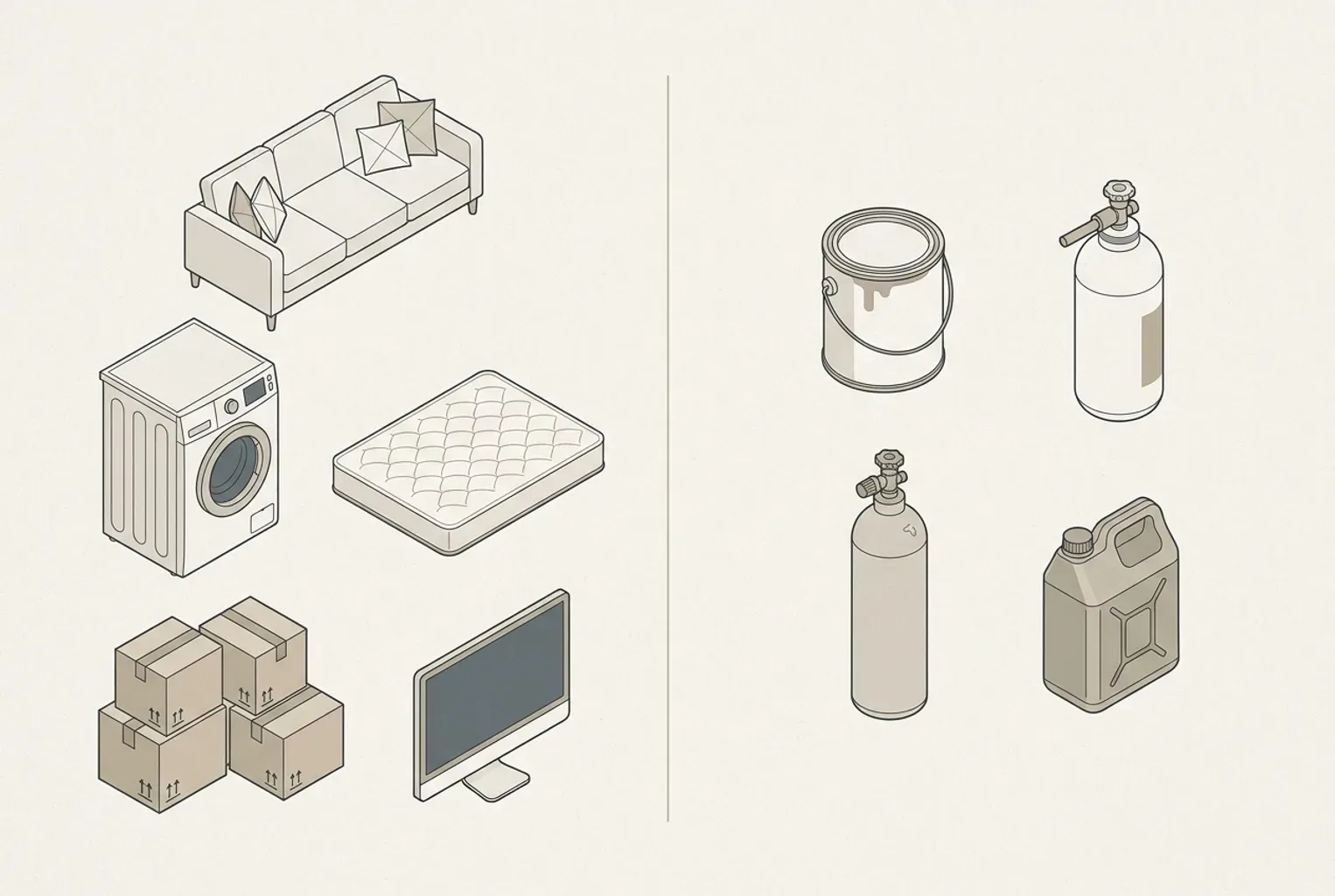
Liquid chemicals and industrial solvents cannot be collected under any circumstances. This exclusion includes leftover cans of liquid wall paint, wood stains, varnish, chemical paint thinners, turpentine, acetone, strong chemical drain unblockers, concentrated pool chlorine tablets, hydrochloric acid for pool cleaning, household pesticides, and garden weedkillers. These substances pose immediate toxic exposure risks to collection crews who handle bags and boxes manually. Furthermore, if a plastic bottle or paint tin ruptures inside the truck bed during transit, chemical fumes can overwhelm the driver or react unpredictably with other discarded items, creating hazardous chemical spills or fire hazards on public highways.
Automotive fluids and mechanical fuels are equally prohibited. Engine motor oil, used transmission fluid, brake fluid, radiator antifreeze coolant, gasoline, diesel fuel, and automotive car batteries filled with liquid sulfuric acid cannot be loaded into general clearance trucks. Dubai Municipality maintains strict regulations governing automotive waste streams; these fluids must be disposed of through licensed automotive service centers or certified industrial hazardous waste handlers who utilize specialized vacuum tankers and chemical neutralization protocols.
Empty paint cans where the paint has completely dried into a hard, solid mass are often treated differently from liquid paint. If a paint tin is completely dry, contains zero free liquid, and has the lid removed to prove it is solid, some disposal facilities will accept it as inert dry waste. However, any container with liquid residue must remain on site for specialized hazardous collection. If you are unsure about particular containers discovered in a garage or storage room, take clear photographs of the product labels and send them to the removal provider beforehand for verification.
The explosive hazard of pressurised containers and gas cylinders
Pressurized vessels and compressed gas canisters represent one of the most critical safety exclusions in the waste transport industry. Standard junk removal vehicles are covered box trucks or compactor vehicles; loading compressed gas containers into an enclosed cargo bay presents a severe risk of catastrophic explosion, mechanical rupture, and fire.
Liquefied petroleum gas (LPG) cooking cylinders are strictly prohibited from all junk removal trucks. Whether large steel cylinders used for villa gas cookers, smaller orange composite cylinders from residential apartments, or portable gas canisters used for camping stoves, junk removal companies cannot transport them. LPG cylinders remain the property of licensed gas distribution companies in Dubai (such as Emirates Gas or specialized community distributors) and must be returned directly to authorized gas suppliers for cylinder deposit refunds or safe refilling. Leaving an old gas cylinder in a pile of junk or concealing it inside a box of kitchenware is extremely dangerous, as shifting furniture during transport can shear the brass valve and release highly flammable gas into the enclosed vehicle.
Fire extinguishers and compressed industrial gas bottles are similarly excluded. Portable dry-powder fire extinguishers, carbon dioxide extinguishers, and industrial welding gas cylinders (such as oxygen and acetylene tanks) contain contents under extreme atmospheric pressure. Even an expired or seemingly empty fire extinguisher retains substantial internal pressure that can rupture if struck by a heavy timber wardrobe or metal bed frame inside the truck. Specialty fire-safety maintenance companies must be contacted to decommission and recycle pressurized safety equipment.
Refrigerant gas canisters used by HVAC maintenance contractors are another critical exclusion. Under UAE Ministry of Climate Change and Environment regulations governing hydrofluorocarbons (HFCs), refrigerant cylinders must be handled exclusively by licensed refrigeration specialists equipped with certified recovery machinery. Removal crews cannot take loose refrigerant cylinders left behind by previous maintenance contractors.
Medical waste, biohazards, and clinical pharmaceuticals
Public health regulations in Dubai strictly separate domestic and commercial junk from biomedical and biological waste streams. General junk removal crews are neither equipped nor licensed to handle biological materials that could harbor infectious pathogens or hazardous pharmaceutical compounds.
Clinical medical waste is totally excluded. This includes used hypodermic needles, syringes, insulin pens, intravenous tubing, surgical dressings, soiled bandages, lancets, and sharps containers. If clinical waste were placed in general waste bags, collection personnel handling the bags could suffer accidental needle-stick injuries, exposing them to blood-borne infections. Clinical waste generated from home medical care or private clinics must be discarded through specialized clinical waste collection services that utilize rigid puncture-proof yellow containers and high-temperature incineration disposal.
Unused, expired, or surplus prescription pharmaceuticals cannot be discarded via junk removal. Tablets, capsules, medicated creams, liquid syrups, and injectable medications must not be tossed into clearance boxes. Flushing medications down toilets or dumping them into general junk contaminates municipal water systems and landfill soil. In Dubai, expired medicines should be taken to designated drop-off collection bins located at Dubai Health Authority (DHA) pharmacies and major participating hospital dispensaries for safe pharmaceutical destruction.
Biological materials, human or animal bodily fluids, and heavily soiled sanitary items are also strictly excluded. While standard household vacuuming waste and dusty general rubbish are normal, items contaminated with sewage, biological rot, or animal waste require specialized environmental cleaning before an area can undergo general clearance.
Construction rubble, masonry, and hazardous building materials
Renovating an apartment or villa generates massive volumes of heavy debris that requires careful differentiation from ordinary household junk. While light cosmetic waste—such as dismantled kitchen cabinets, old laminate flooring planks, interior wooden doors, and dry skirting boards—is easily accommodated, heavy structural rubble sits outside standard junk removal capabilities.
Loose structural masonry, concrete blocks, broken ceramic floor tiles, bricks, cement screed, bags of plaster, and raw demolition rubble cannot be shoveled into standard junk collection trucks. As detailed in our operational comparison of skip hire versus junk removal, dense masonry materials require heavy-duty roll-on roll-off steel skips engineered specifically for high tonnage. Standard three-ton box trucks have mechanical suspensions and floorboards designed for volumetric bulky furniture and appliances; loading several tons of dense concrete rubble will crack vehicle axles, blow out tires, and violate UAE gross vehicle weight limits.
Hazardous building materials, most notably asbestos, are subject to stringent government prohibitions. Older building materials containing asbestos fibers, lead-based industrial coatings, or toxic chemical insulation cannot be handled by standard clearance crews. If your property contains materials suspected of containing asbestos—such as certain older corrugated roofing sheets, vintage thermal pipe insulation, or specialist acoustic ceiling tiles—work must halt immediately until licensed hazardous materials remediation specialists can test, encapsulate, and remove the fibers under strict negative-pressure containment protocols.
How mixed loads are sorted and routed after collection
A common misconception among customers is that once junk is loaded onto a truck, the entire contents are dumped indiscriminately into a single municipal landfill. In modern Dubai, professional waste management follows a multi-tiered sorting and recovery chain designed to minimize environmental impact and comply with municipal waste diversion mandates.
The first stage of sorting occurs directly at the loading point. Experienced crew leads do not load items randomly; they visually assess the inventory and load the truck with systematic separation in mind. Clean wooden furniture and flat-pack panels are stacked flat along the truck floor and bulkhead. Metal bed frames and steel shelving are separated from upholstered fabrics. Major appliances are strapped securely upright against the vehicle side rails. Fragile electronics are positioned in secure cubbies to prevent crushing.
Once the collection truck completes its scheduled route, it does not drive straight to a final disposal pit. Instead, the vehicle returns to a central material segregation depot. Here, the load is unloaded onto clean sorting bays where workers separate materials by physical category:
``` [Collection Truck Arrives at Segregation Depot] │ ┌──────────────┼──────────────┬──────────────┐ ▼ ▼ ▼ ▼ [Solid Timber [Scrap Metals [Major White [General Bulky & Clean Wood] & Wire Steel] Goods & E-Waste] Waste Material] │ │ │ │ ▼ ▼ ▼ ▼ Timber Mills Secondary Certified Approved & Particle Smelters & Depollution Municipal Recycling Foundries Recyclers Transfer Stations ```
Solid wood and untreated timber pieces are separated from composite MDF boards. Clean timber can be processed by wood chippers for industrial mulch, landscaping groundcover, or particleboard manufacturing. Scrap metals—including steel bed frames, aluminum window extrusions, copper pipework, and appliance casings—are separated, compressed, and forwarded to secondary metal smelters where the materials are melted down and reused indefinitely without loss of structural quality.
White goods and consumer electronics follow an even more specialized depollution path. Defective appliances undergo component recovery: copper compressor motors are extracted, metal chassis are stripped, and printed circuit boards containing precious metals are transferred to licensed e-waste recyclers. Any residual general bulky waste that cannot be reclaimed or recycled is then consolidated into high-capacity municipal transfer trailers and transported to approved Dubai Municipality waste management facilities in full compliance with local environmental standards.
Preparing your inventory for an accurate collection
Ensuring that collection day runs smoothly requires minimal effort on your part, but following a few straightforward preparation steps eliminates almost all potential complications. The entire quoting and scheduling process relies on clear communication about what needs to go and the physical layout of your property.
Begin by compiling an honest, comprehensive visual inventory. Instead of typing out a vague list such as "some bedroom furniture and boxes," walk through each room and take wide-angle photographs showing all items intended for removal. Capture clear pictures of bulky items from several steps back so the team can gauge their dimensions, frame thickness, and structural style. If an item is unusually heavy—such as a solid marble dining table, a cast-iron safe, or a commercial commercial-grade treadmill—highlight this specifically in your message.
Identify and photograph any items that fall into gray areas. If you have containers of decorating supplies, garden planters, or dismantled fixtures, photograph the containers and their labels clearly. A professional removal company can instantly confirm whether those specific items are acceptable or whether they fall under hazardous chemical exclusions. Disclosing these items during the quote stage allows the company to guide you toward appropriate disposal alternatives rather than leaving items behind on collection day when the truck is already packed.
Finally, communicate the physical route from your property to the loading vehicle. Note whether your home is an apartment or a standalone villa. For apartment buildings, confirm whether you have reserved the service lift with building security and whether a move-out permit or NOC is required before furniture can leave the premises. If your building has a low-clearance basement loading bay or restricted parking times, providing this logistical detail in advance ensures the company dispatches an appropriately sized vehicle and schedules arrival during authorized service hours. With an accurate inventory and an open route, our professional crew can clear your space cleanly, safely, and entirely in one organized visit.