A lost-property box leaves only when the building has said, in writing, that it will not store that box, and a second line names who may send it. One sealed box with that writing is this page. A key to a cupboard is not the writing.
A booking that says “lost property” will be read as a cupboard, a shelf or a room of unclaimed things. If the object is one box, the note has to say so before anyone plans a visit, a sack or a carry through a lobby.
One box, and the writing that names it
Point at the box. One carton, one crate or one lidded container, with a label you can read or with no label at all. Write what it is made of, whether the lid is on, and whether a tape or a tie is intact. “The lost property” is not a description. The person looking at the photos needs one object and the paper that authorises it.
If a second box sits beside it, this page is still the one box the writing names. The other stays where it is until a note names that one too. Do not add it because it was on the same shelf. Do not describe a whole cupboard as a box. A shelf of bags, umbrellas and a carton is a list. Book only the carton the writing covers, and leave the rest in the building’s store.
The writing has two parts, and both have to exist before the box is a leaving item.
The first is the building’s own statement that it will not store this box. A management message, a facilities email, or a note on the building’s paper, copied into the booking. The words have to be the building’s, not a resident’s summary of a conversation you did not see. If you do not have that statement, write “building has not said” and leave the box where the building keeps it. This page does not decide that a building must release a box, and it does not invent a holding period.
The second is who may send it. A name, and the role in which they are allowed to hand the box over: the manager who wrote the refusal, or the person that message names. A resident who found the box is not that person unless the writing says so. A keyholder who can open the cupboard is not that person unless the writing says so. Holding a key is access. It is not authority to treat the contents as rubbish.
Keep the writing with the box, on paper or as a message you can show on the day. Do not rely on a memory of what security said last week. If the writing names a date after which the box would not be kept, copy the date. Do not calculate a new date from it. If the date has not arrived, the box stays.
This page does not interpret ownership of what is inside. It does not say the contents are abandoned, and it does not say they are safe to discard because they look old. The property clearance guide is a home the arranger does not occupy, with authority over that home’s contents. Stay on that page when the job is a dwelling and the question is who may clear the rooms. Come back here when the object is one box in a managed building, and the building has refused to keep storing it.
Leave it sealed unless the writing says otherwise
Read the writing before you touch the tape. If it says the box stays sealed, leave the tape as you found it. Do not slit it to “check there is nothing important”. Write “sealed, not opened” in the note. A collection does not need the contents listed when the writing says not to open the box.
If the writing says the box may be opened by the named person, that person opens it, not a neighbour and not a crew. Take out passports, identity cards, bank cards, keys, medicines and a phone if those are visible once it is open. Those items do not leave in the box. Hand them to the person the writing names, or leave them in the building’s hands if the writing says the building is keeping valuables and releasing only the rest. Photograph the box after those items are out, and list what was removed without copying a card number or a document number into the message. Cover a number with a piece of paper before you photograph a document. The booking needs to know an identity document was removed. It does not need the document’s details.
If you open it and you are not the named person, stop. Close it, write “opened by the wrong person”, and do not book a time. The named person has to see it before it is treated as a leaving box.
If the lid is already off and the writing does not say who may sort it, do not sort it. Photograph it as you found it, from above, and write “open, not sorted”. Items you can see that are identity documents or cards should be lifted out only by the named person. Until that person does it, the box is not ready.
Do not pour the box into a black sack to make it look like ordinary rubbish. The box is the object. A sack hides whether the writing still matches what is leaving. If the box is broken and will not hold its contents, move the contents into a second container, keep the broken box with it, and say you have done so. Do not add other items during that move.
A smell of something rotten, a leaking bottle, or a pest is a stop. Do not carry it through a lobby to “get it out of the office”. Photograph it where it stands, say what you can see from a safe distance, and leave the decision with the building. This page does not tell you how to handle a contaminated box.
A locked box with no key is not an open box. Write “locked, no key”. Do not force the lock. Do not cut a cable tie the writing told you to leave. If the writing says the box may go locked and unopened, say that, and still name who authorised it.
What this box is not
A sealed box in a home, which the person who lives there has already decided to discard, is a different decision. The acceptance guide is that household box: the booker owns the decision, and the box can leave intact. Do not use that sentence for a box of unclaimed items in a building’s store. The building’s writing is the decision here. Without it, the box stays, even if it looks like the same carton.
A bag of clothes, a single umbrella or a laptop on a lost-property shelf is not this box until someone has put it in the one container the writing names. Do not sweep a shelf into the box on the morning of the visit. The shelf is the building’s. The box is the line you were given.
Furniture in a lobby, a sofa the building wants gone, or a crate of fittings from a fit-out is not lost property. Name those as their own jobs. Do not hide them in this box to make one visit. If they are leaving the same day, they are extra lines, with their own authority, and the photos keep this box separate.
Papers that are the building’s own files, a staff drawer, or shredded records inside a desk are not unclaimed resident property. Leave them in the office’s process. This page does not become a records clear-out because a box was in the same room as a filing cabinet.
A cupboard in a flat, used by the people who live there, is not a managed building’s lost-property store. If the box is inside a home, you are on the property-clearance guide or on the acceptance guide, depending on who occupies the home and who decided the box may go. Say which. Do not call a home cupboard “lost property” to avoid writing down who owns the contents.
Where it waits
Leave the box in the room the building already uses for it, if you are allowed to. Do not move it to a lobby, a fire stair or the pavement so that it is “ready downstairs”. A common route is not a waiting area. If the building has told you to move it to a named store before the visit, copy that instruction and photograph the box in that store. If you have not been told, leave it and write “not moved”.
The path from that room to the vehicle is a separate fact. Walk it once without the box. Name a door, a turn, a step and a desk you would have to pass. You do not have to know which lift the building will allow. If you have an instruction, copy it. If you do not, write “no lift instruction yet”. Do not assume a service lift because the building is a tower. Do not assume the passenger lift is acceptable because the box looks small.
Measure the box at its widest, its deepest and its tallest, including a lid that stands proud and a handle. Then measure the tightest door on the path you walked. Write both sets of numbers. A box that fits a store door can still fail at a security turnstile or a car-park gate. If the box cannot pass a turnstile, say so, and do not plan to hand it over a barrier. The building’s instruction is the route. Your measurement is the check that the instruction is possible.
If the box is heavier than you can slide on a flat floor, say “does not slide easily”. Do not invent a weight in kilograms. Do not stand it on a chair to make the photo clearer.
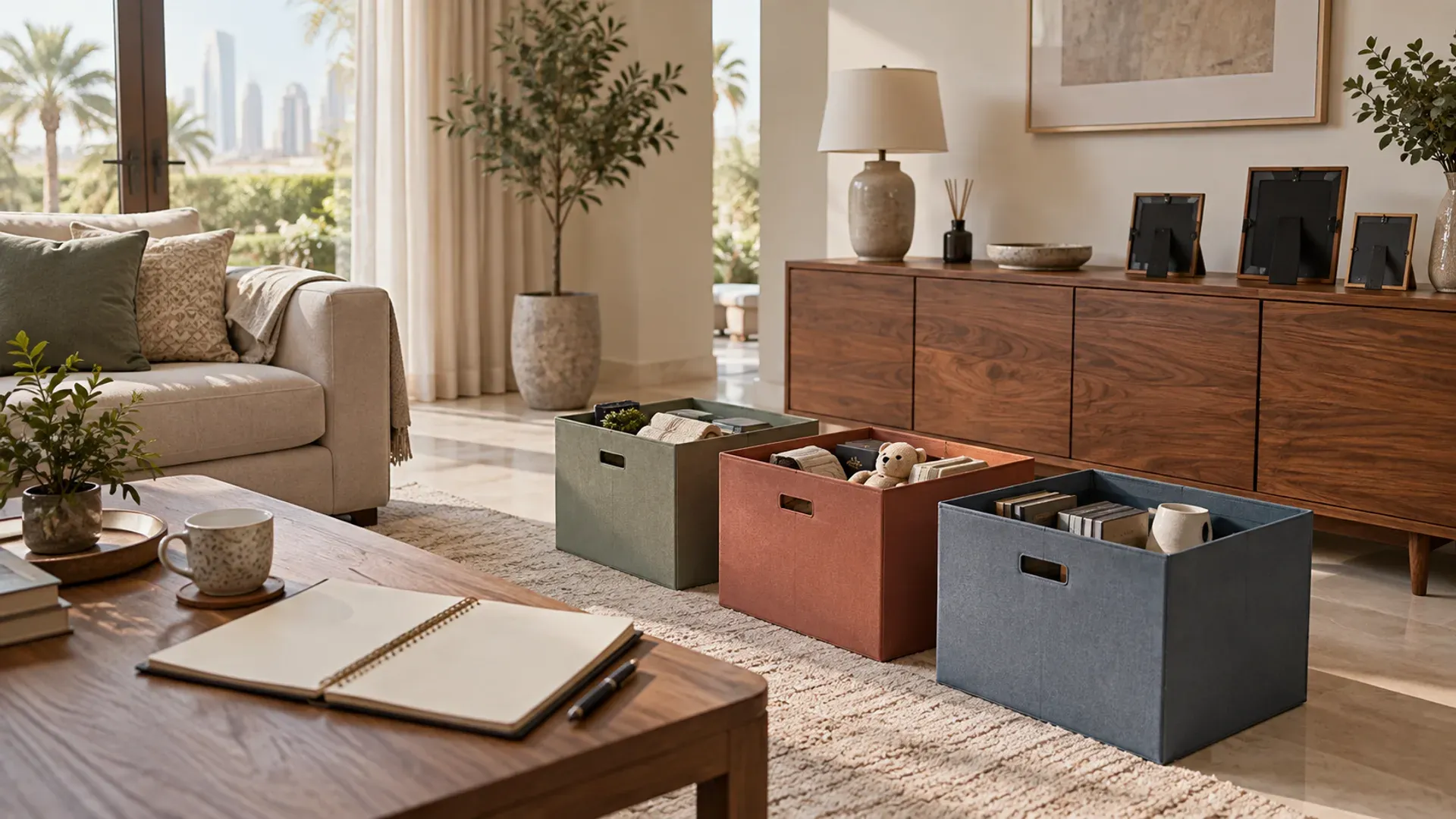
The picture is a living room with household boxes and a notebook. It is not a managed building’s store, and it does not show a lost-property label or a management message. Use it only as a picture of boxes waiting with a written note. Your own photos still have to show this one box and the writing that names it.
Photograph the box and the writing
Send five photos.
The first is the whole box, closed or as you were told to leave it, with nothing else stacked on the lid.
The second is the label, or the face that has no label, so the object cannot be confused with the box beside it.
The third is the building’s writing, cropped so a card number or a passport number is not in the frame. The words that matter are the refusal to store this box, the name of the person who may send it, and any date the building wrote.
The fourth is the inside, only if the writing allowed the named person to open it, after identity documents and cards have been removed. If it stayed sealed, the fourth photo is the intact tape, with the sentence “not opened”.
The fifth is the door of the room it waits in, and the next tight point on the path, with the numbers in the message.
Add whether a second box was left behind, and that it is not included. Add who will meet the crew, and that this person is the one the writing names, or that they are only opening the door and cannot add items.
If the writing is missing, send the photo of the box and do not ask for a collection time. A time booked against an unnamed box is a visit that should not take it.
Take the photos in the light of that room. A cupboard shot with the door nearly shut hides a second container you would otherwise have left off the list.
The arrival checklist is the general preparation for a visit: the route, the contact, and what not to stack in a corridor. Use it for the morning as a whole. This page is the extra fact that checklist does not contain: one box, and the writing that says the building will not keep it.
Book that box only
You can ask for a trash pickup for that box only when the writing is in the message, the box is the one the writing names, and anything the named person had to remove is already out. This is one box. It is not a flat clearance, and it is not a shelf of unclaimed goods.
In the message, say:
- that the item is one box, and what it is made of
- that the building has said it will not store this box, and where that sentence is copied from
- the name of the person who may send it
- whether the box was opened, and by whom
- what was removed, in categories, without document numbers
- that a second box or a shelf was left in place
- the measurements and the door
- any step, turnstile or turn
- any lift note, or “no lift instruction yet”
- who will be there, and whether they may add items
Do not write “lost property” as the only line. A conversation you cannot show is not the building’s writing. A key is not that writing. A box you opened without being the named person is not a cleared box.
If a larger pile is leaving on the same visit, keep this box out of that pile in the photos. The pile can be named, with its own authority. It should not hide the box.
If you have not read the writing against the label on the box, you are early. Read it first. A collection booked from a photo of a carton cannot see that the note was about a different container.
The property-clearance page remains a home the arranger does not occupy. The acceptance page remains a box the household has already decided to send. The arrival page remains the general check before a crew comes. This page remains the one box a managed building will not store.
On the morning it leaves
Leave the box where the photos showed it, with the writing in the room, not in a pocket you might forget. Do not add a bag from the shelf overnight. Do not move it to the lobby before the crew is inside, unless the building’s instruction was to place it in a named store and you have already photographed that place.
The person who meets the crew points at this box and at what is staying. If that person is not allowed to add items, they say so before anything is lifted. A second carton “that might as well go” is a new box and needs its own writing. It does not join this one on the way to the door.
Walk once to the door with the box’s width in mind. A trolley someone parked in the turn is the new tight point. A mat will catch a corner. Lift the mat if it is yours to lift. If it is the building’s, say it is there and do not pull it up.
If the box will not pass, stop. Do not crush it, and do not empty it on the landing to make it smaller. Bring it back to the room and update the note. The measurements you took are the record.
When it has gone, look at the shelf. The box you named should be the one that left. Anything the writing did not name should still be there. Identity documents you removed should be with the person who was supposed to hold them, not in the vehicle and not on the floor of the store.
The useful record is the sentence from the first check: one box, the building’s writing that it will not store that box, and the name of the person who was allowed to send it.