A drum kit leaves as a list of pieces, not as one shape. The shells, the stands, and the cymbals are separate lines, and the note says which rigid piece will not fit the lift. This page is that kit and that comparison. It is not a piano, and it is not a guitar.
A booking that says “the drums” will be read as a corner of a room. If the kit is several shells and a set of stands, the note has to count them before anyone plans a carry or assumes a lift.
Name every piece before you call it one kit
Write a line for each thing you can point at. A bass drum is one line. A snare is one line. Each tom is one line, with a count if several toms are the same kind. Each cymbal is a count, not a pile. Each stand is a count. A bass pedal, a hi-hat pedal, and a throne are their own lines.
Under the bass drum, say whether both heads are still on, whether a pedal is still clamped to the hoop, and whether the drum is in a bag. Under each smaller shell, say the same: heads on or already off, and bag or no bag. Under the stands, say how many are still set up and how many already fold by a joint you can see.
One line that says “drum kit” without that count is incomplete. Same visit is not same object. The person looking at the photos needs the shells and the stands as separate shapes, not a dark corner behind a sofa.
A piano is not this page. Do not describe a piano, an upright, or a keyboard built into a piano cabinet as this job. This note does not confirm or refuse a piano. It stops a piano being booked under the name of a drum kit.
A guitar, a musical keyboard, and a small amplifier are other objects. A keyboard and a small amplifier have their own note. This page does not become that pair, and it does not become a guitar guide. If a guitar is also leaving, give it its own line and keep it out of a drum bag. If the only things leaving are this kit, say that, so a second instrument is not assumed.
A single practice pad, a pair of sticks, and a folder of sheet music are small items. Bag them if they are leaving, and label the bag. They are not the kit. Do not put sticks inside a bass drum to keep them together. Look in every shell before you call it empty. A shell you have not looked in is not empty.
Stands fold only by a joint you can see
A stand is not a drum. A cymbal stand, a snare stand, a hi-hat stand, and a tom arm are metal lines of their own. If a wing nut, a clutch, or a collar turns by hand and the tube slides without force, collapse that stand and measure the folded length. Write “folded by hand”.
If you cannot see how the joint works, leave the stand set up and measure it as it stands. Write “not folded”. Do not hit a joint to make it move. Do not saw a tube to make a stand shorter. Do not remove a rubber foot to change the width.
A boom arm that is still tight is still part of that stand. Leave it if it will not slide by hand. A memory lock you do not recognise is a reason to leave the stand as it is, not a reason to force it.
Count the stands after you fold the ones that fold. A stand left behind the sofa will be missed, or it will be added on the day as a surprise length. Put the folded stands in one place, parallel, where the photo can count them.
A rack, a clamp, and a multi-arm frame are not a single stand unless they already come apart by the clamps you can see. If a tube runs through a clamp and the clamp will not open by hand, leave the rack as one rigid piece and measure that piece. Write “rack still together”. Do not cut a tube out of a clamp.
Leave the shells whole
Leave the drum heads on. Do not loosen tension rods to make a shell softer. Do not take a head off to change the depth of a bass drum. Do not remove lugs, a badge, or a mount as a way to make a shell smaller. A shell with both heads on is the item you measure. A shell you have opened is a different object, and this page will not tell you how to take it apart.
If a head is already torn or already off, say so, and keep loose rods in a bag labelled with that drum. Do not tape a torn head back on and call the shell sound. Condition is a photo, not a repair.
A bass drum with a pedal still clamped to the hoop is longer than the shell alone. If the pedal comes off by the clamp you can see, take it off, bag it, and label the bag “bass pedal”. Measure the shell again without the pedal. If the pedal is bolted through a board, or you cannot see the clamp, leave it and write “pedal still on”. Do not split the board.
A tom mount, a snare strainer, and a spur on the bass drum are parts of those shells when they are still attached. If a spur folds by a hinge you can see, fold it so the measurement is honest. If it does not fold, measure with the spur out and say so. Do not bend a spur.
Cymbals come off a stand by the clutch you can see, if it turns by hand. Take them off, count them, and bag them or put them in a case that already fits without forcing an edge. A loose cymbal in a sack of other items will be bent or lost. Do not stack cymbals under a bass drum to save a photo. Do not tape two cymbals face to face unless a sleeve already exists for that. A felt, a sleeve, and a wing nut from the stand go in the same labelled bag as the cymbals if they are leaving. Write the count on the bag.
A throne is a seat, not a drum. If it folds by the joint you can see, fold it and measure it. If it does not, leave it open and measure it open. A rug or a mat under the kit is not a shell. If it is leaving, roll it only if it is already a loose mat, and name it. If it is a fitted carpet, it is not this kit. Leave it.
Cases and bags are useful only when the shell or the stand already fits and you can close them without forcing a head or a joint. If a bag is split, say the bag is split and do not rely on it as the only protection in the note. Measure the shell or the closed bag, and say which one you measured.
The lift is a measurement, not a guess
The kit fails a lift one piece at a time. The bass drum is often the piece that fails, because it is deep and it does not fold. A stand that did not fold can fail on length. A rack that is still together can fail on width. You find out by measuring, not by assuming the passenger lift is enough.
Measure each rigid piece at its widest, its deepest, and its tallest, as it will be carried. For a bass drum, include a spur that is still out and a pedal that is still on. For a folded stand, measure the folded length. For a cymbal bag, measure the bag and say it is the bag. Then measure the door of the room, and write down any lift opening the building has already given you.
If you have no lift measurement, write “no lift measurement yet”. Do not invent one. Do not assume a service lift because the building is a tower. If the building has told you which lift to use, copy that instruction. If you have no instruction, write “no lift instruction yet”.
Compare the largest rigid piece with the opening you were given. If the bass drum’s depth is greater than that opening, write “bass drum will not fit the lift” and stop. Do not tip it on a stair to test the idea. Do not take a head off on the landing. Do not carry it into a corridor to see what happens. The comparison is the record. The carry is a later decision, made with that record, not a method this page will invent.
The route through a tower, from the room to the vehicle, is a different page. The tower bulky-item guide keeps that path: doors, turns, and the lift the building names. Come back here for the kit itself. Do not let that guide’s list replace the count of shells and stands.
The photo-and-route habit for one bulky object is the bulky-item guide. Use it when you need the general method for a single object. A drum kit is several objects. The general method does not replace the lines on this page.
If there is no goods lift at all, say that in the same message. This page still does not tell you how to take a bass drum down a stair. It tells you to name the piece that cannot use a lift, and to leave it in the room until the collection is planned from that fact.
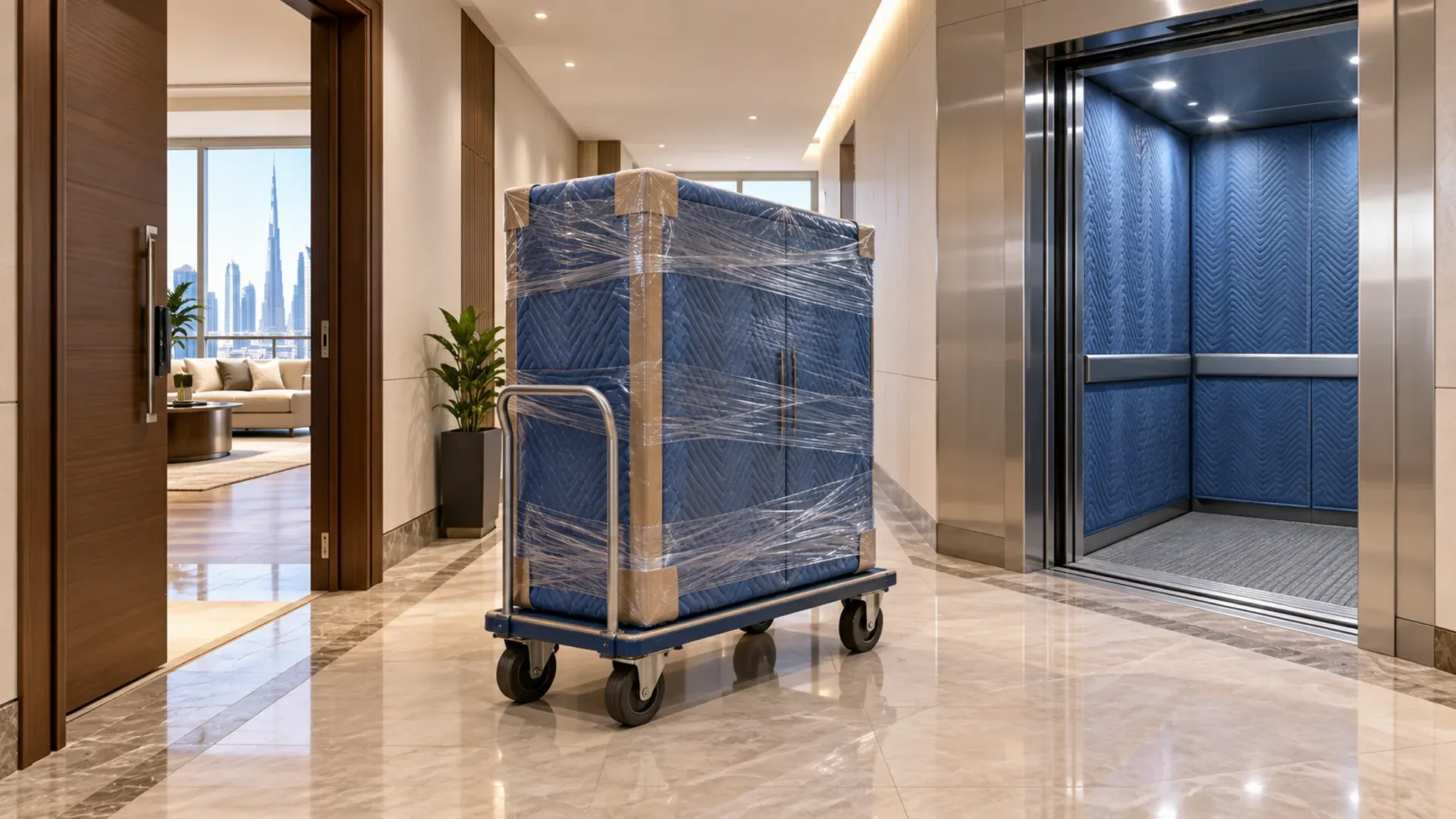
The picture is a wrapped cabinet on a trolley beside a padded service lift. It is not a drum kit. It does not show a bass drum, a stand, or a cymbal. Use it only as a picture of a lift opening kept clear. Your own photos still have to show the shells and the stands as separate pieces, and the opening they have to pass.
Photographs that match the count
Send photos that a person can count against your list.
The first is the whole kit before you move it, so the number of shells and stands is visible in one frame.
The second is the bass drum alone, heads on, pedal off or still on as you wrote, with a note of the three measurements.
The third is the smaller shells in a row, each one identifiable, bags open enough that a head can be seen.
The fourth is the stands, folded or still set up as you wrote, laid so the count is obvious, plus the cymbal bag with the count written where the photo can see it.
The fifth is the doorway and the lift opening if you are allowed to photograph it, or the sentence “no lift measurement yet”.
Add whether any stand would not fold, whether a pedal is still on a board, and whether a shell was already open. Add that a piano and a guitar are not included.
Take the photos with the room light on. A black corner behind a bass drum hides a second tom. A closed bag hides a cymbal count you have not checked.
If a piece is still fixed to the building, which a kit on its own feet should not be, send the photo of that fixing and do not ask for a collection time. A rack bolted to a wall is fixed. Do not unbolt it. Write “rack still bolted” and ask the person responsible for the wall.
Book the kit as the pieces that will not fit
You can book the kit as bulky junk when the shells and the stands are counted, the pieces that fold have been folded by hand or marked as not folded, and you have said which rigid piece fails the lift or that you do not yet have a lift measurement. This is one kit. It is not a furniture room, and it is not a single guitar.
If the rest of the home is beds, wardrobes, and a dining set, that booking is a different list. Have the furniture taken on the furniture page’s own terms. Keep the kit on these lines even if it leaves on the same day. A bass drum inside a sentence about a wardrobe will be planned as furniture, and the lift comparison will be missed.
In the message, say:
- the count of shells, stands, cymbals, pedals, and the throne
- which pieces were folded by hand, and which were left as they stood
- that heads were left on, except any shell you found already open
- the bass drum’s three measurements, and the measurement of any other piece that is larger
- whether that piece fits the lift opening you were given, or “no lift measurement yet”
- any lift instruction, or “no lift instruction yet”
- any guitar, keyboard, piano, or amplifier, and that it is not this kit
- the doorway, and any step or turn you have already walked
Do not write “drums” as the only line. A stand you have not counted is not a cleared kit. A cymbal bag you have not opened is not a count.
If a larger pile of household items is leaving on the same visit, keep the shells and the stands out of that pile in the photos. The pile can be named. It should not hide a bass drum.
If you have not measured the bass drum, you are early. Measure first. A collection booked from a photo of a corner cannot see which piece fails the opening.
The tower page remains the path through the building. The bulky-item page remains the general photo method for one object. The furniture page remains beds, wardrobes, and tables. This page remains the kit and the lift.
On the morning the pieces leave
Leave the shells and the stands where the photos showed them. Do not set the kit back up overnight if you had folded the stands, unless you update the note and the measurements. Do not put a cymbal bag under the bass drum where it will be missed.
Point at what is staying: a guitar, a keyboard, a mat you are keeping, a rack you wrote was still bolted. Point at the cymbal bag and the pedal bag so they are not left on the floor. Point at the bass drum and say again whether it fits the lift.
Walk once to the door with the bass drum’s depth in mind. A chair you moved and then put back is the new narrow point. A loose rug will catch a stand foot. Lift it before anyone carries a shell.
If the bass drum will not pass the door you measured, stop. Do not turn it onto a head to shorten a side, and do not remove a head in the corridor. Bring it back into the room and update the note. The measurements you took are the record.
When they have gone, look at the floor where the kit stood. A stand you said was leaving should be gone. A stand you could not fold should be gone only if you listed it at its open length. The wall bolt you were not releasing should still be in the wall. A guitar you said was staying should still be in the room.
The useful record is the sentence from the first check: one kit, shells and stands counted, heads left on, and the rigid piece that will not fit the lift named before anyone is asked to carry it.