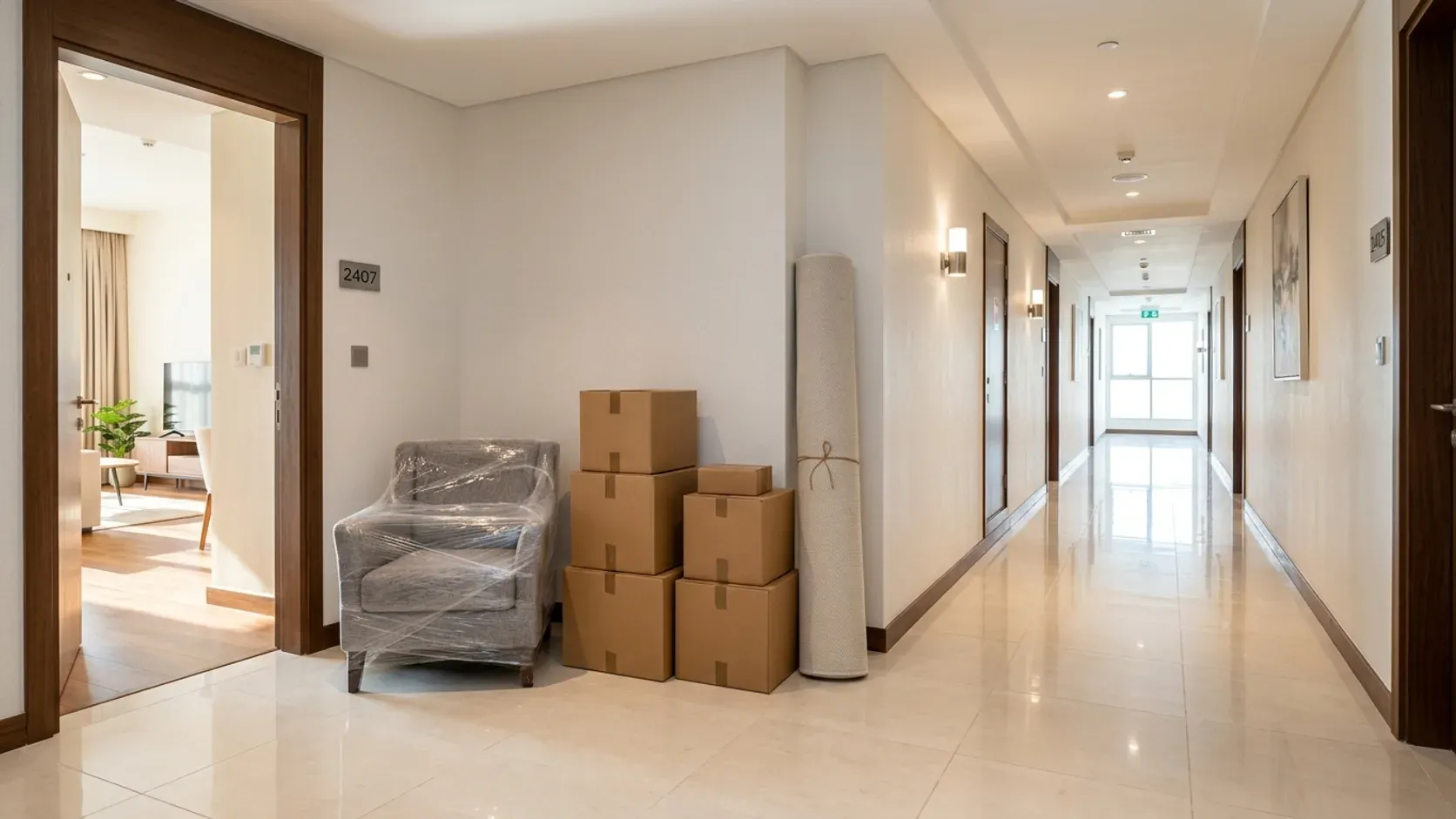
A building with no service lift is a stair carry, not a tower booking with the goods lift left blank. Confirm that no goods lift exists, walk each flight you will use, and photograph the landings and turns before you ask for a collection. A passenger lift, a fire door or a balcony is not a route you choose because the stairs look awkward.
Write down the floor, the number of flights, and whether the stair is the only way out. A photo of the sofa in the living room does not describe the turn at the half-landing.
Confirm that no goods lift exists
Ask the building, in writing if they use a form or a message thread, which lift bulky items must use. Some lobbies have a passenger car only. Some have a second door, a key and a padded car that residents are told to book. Those are different buildings. The service-lift guide is the second case: a goods lift that has to be reserved, padded and timed. This page starts only when the answer is that there is no service lift to book.
Do not decide from the look of the lobby. A narrow car with a mirror can still be the lift the building allows for furniture, and a wide car can still be reserved for passengers. The management office, the security desk or the posted moving rule is the source. Copy what they say into the note you send with the photos.
If the building has a service lift and it is already booked, out of order, or too small for one piece, stay on the service-lift guide. That guide says not to switch to the stairs, a passenger lift, a balcony or an emergency exit on your own. Each of those needs the building’s approval for that job. A missing goods lift is not the same problem as a goods lift that failed on the day.
Name the person who gave you the answer and the date. If a new manager later says a goods lift does exist, stop and re-plan. Do not keep a stair booking after the route has changed.
Walk the stair you will actually use
Start at the item and walk to the vehicle in the order the carry will take. Room door, flat door, corridor if there is one, stair door, each flight, each landing, the lobby, the street door, and the place a vehicle can stop. Count the flights. Note a half-landing that is only wide enough to turn a person, and a landing that is wide enough to stand a wardrobe on end.
Photograph each turn from both directions. A straight-on picture of a flight hides the space needed to rotate a rigid piece. Include the handrail, the door that opens onto the landing, and any meter cupboard, shoe rack or plant that narrows the turn. If a door swings into the landing, photograph it open and closed.
Look up as well as along. A light fitting, a bulkhead or a door closer can stop a tall piece that would otherwise turn. Look down for a loose nosing, a broken tile or a step that is not the same height as the others. Say so in the note. Do not treat a damaged step as something the crew should discover with a loaded piece in their hands.
At the bottom, photograph the lobby door, the step or ramp to the pavement, and the kerb. A piece that has come down four flights can still fail at a single step and a tight street door. If the building tells you where a vehicle may stand, photograph that bay and the distance from the door. Do not instruct anyone to stop on a yellow line or across a neighbour’s gate to shorten the carry. The service-lift guide makes the same point for towers: the loading place is the building’s instruction, not a guess that saves steps.
If the load is in a basement cage and the only way up is this stair, walk that route too. A cage key, a ramp and a separate door belong in the same note as the floor of the flat. The service-lift guide covers a basement that uses a goods lift. It does not cover a basement that only has stairs.
Measure the piece that has to turn
Measure the largest rigid item at its real width, depth and height, including feet, handles and a fixed arm. A sofa measured without its feet is a different object from the sofa on the stair. A fridge measured with the doors closed still needs a note if the doors are taped or if the hinge side faces the handrail.
Then stand at the tightest landing with those numbers in mind. You do not have to carry the piece down to test it. You do have to say, in the photos, which corner is the one that worries you. A landing that looks wide in a phone photo can be short once a handrail and an open door are in the frame.
For one awkward object, the bulky-item pickup guide is how to show the object and the whole path. Use it for the measurements. Come back here for the fact that the path is stairs because there is no goods lift. The tower checklist in the bulky-items guide assumes a service lift, a lift lobby and a loading bay. Do not send that checklist as if a goods lift were waiting.
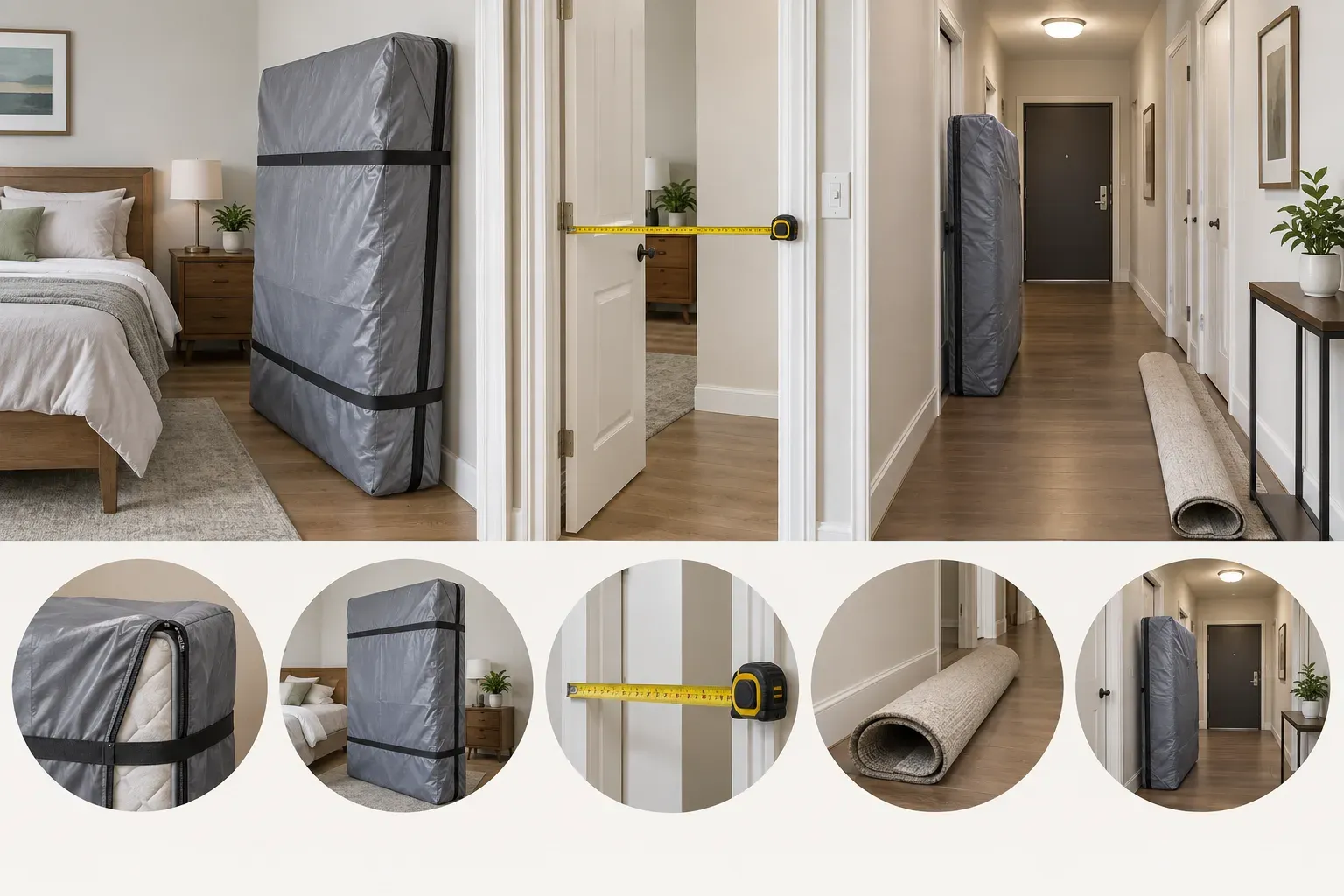
A mattress, a bed frame, a wardrobe side and a dining top each fail in a different way. A mattress bends and still catches on a rail. A frame with a fixed headboard does not bend. A glass or stone top should be named before it meets a turn. If a top comes off, pack it and give it its own line. If it does not come off, say that it travels whole. The furniture-dismantling guide is the place for which joints are meant to separate. This page only needs the result: whole, or in the sections you can already release without forcing a fitting.
A sofa that stops at the room door is a doorway problem before it is a stair problem. The sofa doorway guide covers feet, modules and the opening. Once the sofa can leave the room, the landings on this page decide the rest. Do not describe a sectional as one sofa if the pieces will travel separately. Name each section and say whether the connectors are still fitted.
Keep the stair clear until the carry starts
Leave the load inside the flat until the crew is on site and the route is agreed. A sofa parked on a landing blocks neighbours and the way down if someone needs to leave. The service-lift guide says the same about a shared corridor: items stay in the unit unless management has told you to stage them outside. A walk-up has less space, not more.
Move shoes, bicycles, a folded pram and loose boxes off the landings you will use, if they are yours to move. If they belong to a neighbour, do not shift them. Photograph them and say the turn is partly blocked by something you cannot clear. The provider can then say whether the job can be planned as shown.
Ask the building whether a bulky carry on that stair is allowed, and whether they want a time window, protection on the walls, or a person from the office present. Do not copy the rule from another building. A walk-up in an older block and a walk-up above shops can have different instructions, including on the same street. Write down the answer you were given for this address.
If the building asks for protection, ask who supplies it and who may fix it to the wall. Do not tape coverings to paint, stone or a handrail unless you have been told that surface may be taped. The pre-arrival guide makes the same point for any route: protection that narrows the stair is worse than no protection.
Tell neighbours who share the stair when the carry is booked, if the building has not already done that. You are not required to invent a building rule about notice. You are required not to fill the only stair with furniture while people are trying to pass. Keep children and pets inside a room that is off the route, with the door shut, until the carry is finished.
Decide what comes apart before it meets a landing
Take off what you can release with ordinary fittings and keep: cushions, a loose mattress, shelves, a table top that lifts off, fridge shelves, and drawers. Bag the fixings with the piece they belong to. A drawer left in a chest makes the chest heavier and can slide on a turn.
Leave a seized bolt, a glued joint and a glass panel that you cannot release safely. Photograph the fitting and say it is still attached. Forcing it on the stair is how a piece becomes two damaged pieces and a blocked flight. If the furniture page’s crew is the one collecting a sofa or a cabinet, that page says the crew carries or dismantles depending on what fits, and that a stair carry is part of the job where there is no lift. Ask them to confirm that this piece, on this stair, is in scope. Do not assume a dismantling method that the photos do not support.
A fridge or another appliance has a separate release from the stair. Empty it, defrost it if it is a freezer or a fridge-freezer, and deal with power and water before the carry. The appliance page says a fridge can be carried by stairs where there is no lift, using straps and a trolley, and that the service lift is booked where the building requires one. On this page there is no service lift to book, so the stair photos matter more than a lift measurement. Disconnection of a hard-wired or plumbed appliance stays with the person qualified to do it. Do not describe a connected appliance as ready because the stair looks clear.
A washing machine, an oven or a dishwasher that is still plumbed is not a stair problem yet. Finish the release those guides describe, then add the stair note. A loose appliance and a fixed one should not share one line on the list.
Wardrobe doors, a mirror and a long rail change the width. If you can lift the doors off and wrap them, do that inside the room and stand them where they will not be loaded by mistake if you meant to keep them. If the mirror is glued, say so. The wardrobe guide owns the sequence for taking a wardrobe down. Use it when the wardrobe is the piece. Use this page for the flights it has to pass.
Do not invent a second route
A passenger lift is available for bulky items only when the building says so. Ask. Record the answer. If the answer is no, the stair is the route. If the answer is yes, photograph the car door and the interior the same way you would photograph a landing, and say the building has allowed that car for this move. A passenger car that residents use for groceries is not evidence that a sofa may go in it.
Do not plan a balcony, a window or an external hoist. This page does not cover them, and the service-lift guide tells you not to switch to a balcony on your own. If a contractor has already proposed an external lift, that is their method and their permission, not a detail to hide inside a junk booking.
Do not use a door that is signed as an emergency exit, alarmed, or kept shut, unless the building has named that door as the way out for this job. In some walk-ups the only stair is also the escape stair. That is a question for the building, not a reason to prop a fire door open overnight. Ask which door may be used, and for how long it may stay open while a piece passes.
If the street door is locked with a code or a key that only one person holds, that person needs to be there or the key needs to be with the representative. A crew at the bottom of the stair with a sofa, and a lock they cannot open, is a failed route even when every landing was wide enough.
Older Al Barsha buildings are one place this comes up
The Al Barsha page already says that older buildings without a service lift still need a crew for the carry, and that municipal bulky collection does not replace that carry. It does not list the buildings, and it does not say that every older block lacks a goods lift. If your flat is in Al Barsha, read that page for the area, then use this guide for the stair: floor, flights, landings and the largest piece. Check the municipal bulky-waste guide only to see whether the address is eligible for that service. Eligibility is not a stair plan, and a collection date that does not match your access does not remove the need to show the route.
Do not add other communities to the booking note as if they shared Al Barsha’s page. A different district can have the same kind of stair and a different building rule. Describe this building. The area page is linked here because its copy already talks about older blocks with no service lift, not because the stair problem is limited to one neighbourhood.
Shops and offices in the same district are a different job. A retail counter and a flat’s sofa do not share this checklist. If the premises are a shop or an office, use the commercial pages those jobs already have. This article is the residential stair where no service lift exists.
A townhouse stair is not this page
Internal stairs in a townhouse or a villa are the townhouse clearance guide and the villa pages, not a walk-up in a shared building. Those homes have their own floors, a front door at ground level, and a community gate where the community has one. The turns can look similar in a photo. The permission is different: a household stair inside one home is not a shared escape stair with a management office.
If you are in a townhouse, follow that guide’s floor-by-floor sequence. If you are in a flat and the only shared route is a stair, stay here. A building that calls itself a townhouse and still has a management desk and a shared stair should be described as it is: say who controls the stair, and send the photos. The label on the brochure is less useful than the route.
A gated community can contain both villas and a small apartment block. The gated-community guide covers the gate and the vehicle. It does not replace the stair photos if the block has no goods lift. Send both: the gate instruction, and the flights.
What to send with the request
Send one note that a stranger could follow from the room to the kerb:
- The floor, and the number of flights.
- The building’s answer on whether a service lift exists.
- The building’s answer on the stair, the passenger lift and the street door, if you have it.
- Wide photos of each landing and turn, from both directions.
- Photos of the largest rigid pieces, with a note of what still has to come apart.
- Anything left on the landings that you cannot move.
- The place a vehicle may stop, if the building has named one.
- The name of the person who will be at the flat.
Ask for a one-off rubbish pickup with that note attached. The service page is the booking. It says you do not have to sort the load, bag it, or bring it downstairs yourself. This article is the preparation that makes a stair carry describable. A request is not a booking until the scope and the time are agreed.
If the load is only a sofa, the furniture pages still hold that transaction. Attach the stair photos to the request so the route is visible. If the load is a fridge as well as household junk, say so. An appliance that is still connected is not ready, even when the stair is clear.
Do not send a price you have guessed from another building, and do not ask the provider to match a figure you saw elsewhere. Send the photos and the floor so the route is part of the request. A higher floor with more turns is a different job from a first-floor flat with one straight flight. Show the difference. Do not hide it to make the job look simpler.
Keep a copy of the building’s answer with the photos. If the crew is met by a desk that was not mentioned, the representative can show what was agreed. If nobody from the building will be there, say that too.
On the day
Have the representative at the flat before the carry starts. They should be able to open the street door, the stair door and the flat, point to what leaves, and point to what stays. Two similar chairs are easy to mix up when the stair is the priority. Mark the one that leaves.
Walk the flights once more before the first piece leaves the room. A bicycle that appeared overnight, a wet patch from cleaning, or a door that now swings the other way because a latch failed, changes the plan. Say so before a piece is on the stair.
Agree which piece goes first if the flat is tight. The piece nearest the door is not automatically first if a larger one behind it cannot pass until the front of the room is clear. Say that in the room, not halfway down.
Keep the landings clear as each piece passes. Do not rest a second piece on the half-landing while the first is still in the lobby, unless the crew asks for that and the landing can hold it without blocking the rail. People who live above and below still need a way past, or a pause they have been told about.
After the last piece, walk the stair from the flat to the street door. Look for a fitting that dropped, a drawer that opened, or a mark you should tell the building about. Collection from the room is not a promise to repaint a wall. If the building asked for protection, confirm it has been removed by the person who was supposed to remove it.
If the job stops because the turn is tighter than the photos showed, or because the building refuses the stair on the day, fix that fact before you rebook. A second appointment with the same gap produces the same stop. Add the missing photo or the missing permission, then ask again.
A same-day hope does not change the stair. If you need a date, send the route first and ask what can be planned. Do not promise a landlord or a delivery team that the flat will be clear until the booking is confirmed and the route has been accepted as described.
Questions
What if I was sure there was no goods lift, and the desk says there is one?
Stop the stair plan and open the service-lift guide. Book the lift the building requires. Do not carry on down the stairs because the photos are already taken.
Can the passenger lift be used for a sofa if the stairs are tight?
Only if this building says bulky items may use that car. Ask, and keep the answer with the photos. A car that is large enough in your judgement is not an approval.
Do I have to carry the furniture down myself before the crew arrives?
No. The junk-removal page states that you do not have to bring the load downstairs. The furniture page states that a stair carry is part of getting furniture out where there is no lift. Your job is the photos, the permissions and a clear stair, not a rehearsal with the sofa.
Is this the same job as a townhouse?
No. A townhouse stair inside one home belongs to the townhouse clearance guide. This page is a shared building with no service lift.
What should I do with a piece that will not turn on the landing?
Photograph the landing and the piece, and say it may not turn. Ask whether it should be separated before the day. Follow the furniture-dismantling guide for joints that are meant to come apart. Do not force a seized fitting on the stair.
Does Al Barsha mean the building has no service lift?
No. The Al Barsha page says older buildings without a service lift still need a crew for the carry. It does not name those buildings. Ask your building, then use this page if the answer is that there is no goods lift.