A townhouse is cleared from the top floor down, with the staircase treated as the route that decides everything else. Before booking, decide what is leaving from each level, measure the tightest turn on the stairs, and find out where a vehicle may stand and when contractors are allowed in. The volume may be smaller than a detached villa's, but the carry can be harder: bulky pieces come down an internal staircase, a front garden may be too small to stage a whole house, and the neighbours share the walls, the path and sometimes the parking.
Those constraints decide whether a clearance runs smoothly. The number of bedrooms matters less than the stairs, the space at the front door and the decisions you have already made.
Why a townhouse clearance is planned differently
An apartment usually has one level and one exit route through a corridor and a lift. A detached villa usually has space around it: a driveway, a side passage, a garden where items can wait. A townhouse sits between the two. It has the floors and the storage of a house, but a narrower plot and closer neighbours.
The stairs are the defining feature. A sofa, a wardrobe or a bed frame on the upper floor has to travel down a staircase with a turn, a landing, a banister and a wall that will show any scrape. In some layouts the staircase is open on one side; in others it is enclosed between walls with a low ceiling at the turn. A piece that came into the house before the stairs were finished, or that was assembled in the bedroom, may not leave in one piece. Measure before deciding.
The front of the property is the second constraint. A small front garden or a short driveway shared with a parking space may have room for a few items, not the contents of three floors. If the clearance depends on staging everything outside before the vehicle arrives, there may be nowhere to put it without blocking a path a neighbour uses.
The third is the community. Where a townhouse sits in a managed community, that community sets its own arrangements for contractor entry, working hours and where a vehicle may stop. Do not assume the rules of a previous home apply. Ask your community management or the owner's association what is required for your particular clearance, and get the answer before fixing a time. The gated-community access guide explains how to separate entry approval from permission to work.
Decide what the townhouse must look like afterwards
Write down the finish line before you sort anything. A townhouse being handed back to a landlord, one being prepared for sale, one being emptied before a renovation and one where only the spare room and the garage are being cleared are four different jobs.
For a handover, everything you own must go, and anything belonging to the landlord must stay. Check the inventory for furniture, appliances, curtains and outdoor items that came with the property. Built-in wardrobes, fixed shelving and fitted kitchen units are usually part of the house, not part of your clearance, but confirm this with the landlord or agent rather than assuming. The villa handover guide covers the inspection side in more detail; this guide focuses on getting the contents out of a multi-level home.
For a move to a smaller home, the clearance may follow the movers. Mark what is travelling with you and keep it physically apart from what is leaving. If both happen on the same day, decide which goes first and leave a clear route for the other.
For a renovation, clear only the rooms the contractor needs, and keep a record of what has gone so nothing is lost between phases. Renovation debris such as tiles, plaster or old fittings is a separate material from household contents; describe it separately when you ask for a quote.
For a partial clearance while you are still living there, choose the order by what frees up working space first. Clearing the storage under the stairs or the garage early can give you somewhere to sort the rest.
Work from the top floor down
Start on the highest level and finish at the front door. Clearing the ground floor first leaves nowhere to put items coming down the stairs, and anything carried past a half-cleared room risks being picked up by mistake or damaging what remains.
The roof terrace and upper storage
Some townhouses have a roof terrace, an upper storage cupboard or a small room off the top landing. These spaces can collect outdoor furniture, old planters, broken fans, spare cartons and items that were taken up once and never brought down. Check them first, because they are easy to forget until the end of the day. Outdoor sets, sun-damaged chairs and pots need the same separation described in the balcony clearance guide: furniture in one group, plant material in another, and anything with soil declared as heavy.
Bedrooms and the upper landing
Bedrooms can hold some of the largest furniture in the house. Empty wardrobes, drawers and bedside tables before anyone tries to move them. A full chest of drawers is heavy and its drawers can slide out on a staircase. Look under beds and on top of wardrobes for stored boxes, suitcases and papers.
Decide which pieces need dismantling upstairs. A wardrobe that was assembled in the room, a large bed frame or a bunk bed may not clear the stair turn whole. The wardrobe removal guide explains how to judge whether a unit should stay assembled. Keep the screws and fittings of anything that might be reused in a labelled bag taped to the largest panel.
The middle floor and the living areas
On a three-level townhouse the middle floor may hold the main living room or additional bedrooms. Treat it the same way: empty, sort, then identify the bulky pieces and their route. A sofa can stall on a staircase, especially a corner sofa or a recliner. Photograph each one and measure its depth and height, not only its length.
The ground floor, the maid's room and the garage
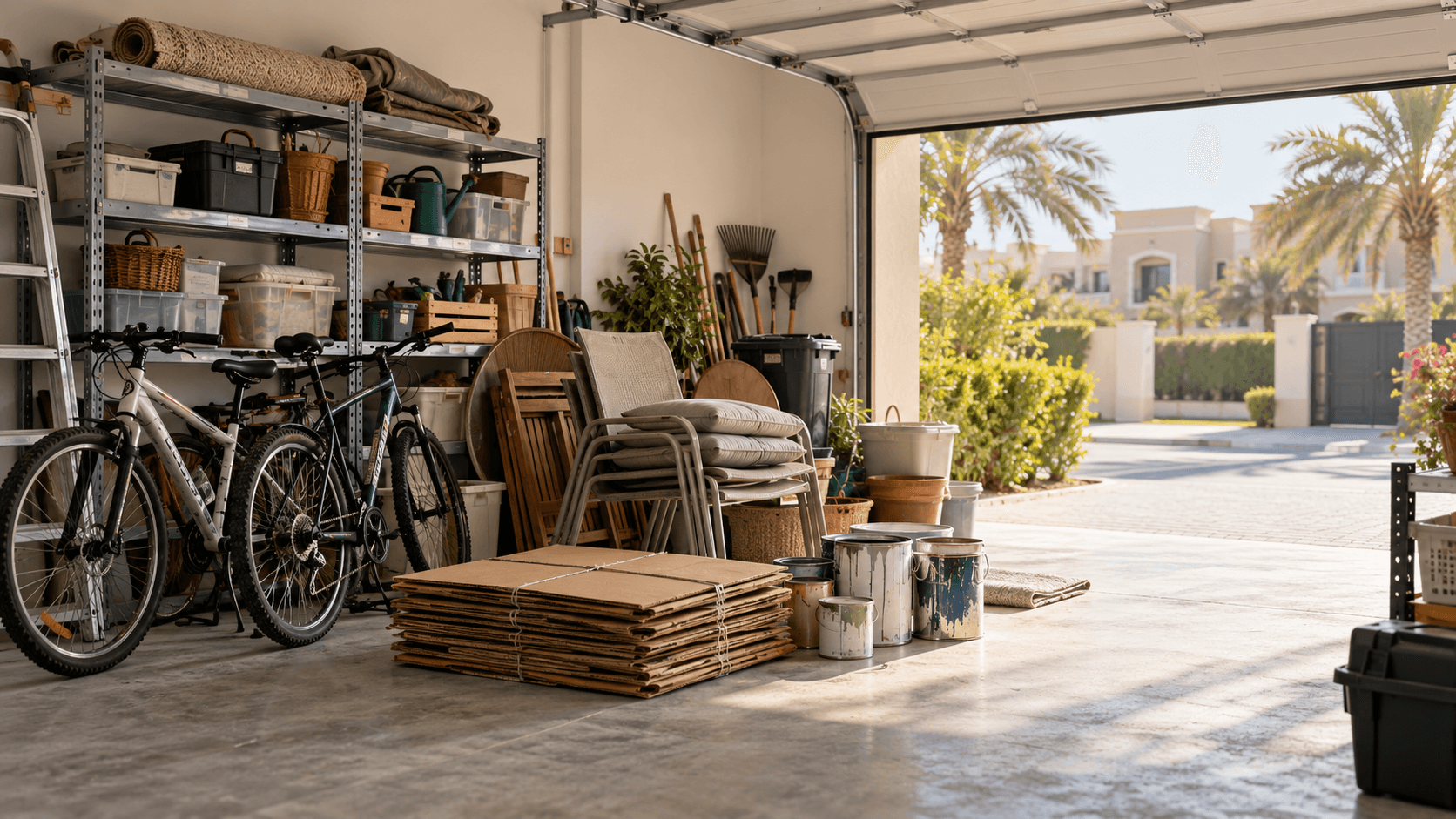
Leave the ground floor until the floors above are clear, unless it is blocking the stairs. The ground level may hold the kitchen, a dining area, a maid's room in some layouts, the storage space under the stairs and, where the design includes one, a garage or covered parking bay. Garages and covered bays can gather heavy and awkward contents, and some of them need a different route altogether. The garage clearance guide explains how to sort mixed garage contents before a collection.
Measure the staircase before anything is carried
The staircase decides what can leave intact. Measure it before the clearance day and include the measurements in the quote request.
- The width of the stairs at their narrowest point, between the wall and the banister or between two walls.
- The headroom at any turn or landing, where a ceiling or an upper floor slab comes down.
- The size of the landing at each turn, which decides whether a long item can pivot.
- The width of the doorways at the top and bottom of the flight.
- The distance from the bottom of the stairs to the front door and then to where a vehicle may stand.
Take a photo from the top of the stairs looking down and another from the landing. A picture of the turn shows the problem far better than a description. Mention anything fragile on the route: a glass balustrade, a light fitting at head height, framed pictures, a polished wooden handrail or a recently painted wall.
Decide in advance what should be protected. Corners of walls, banister rails and the floor at the bottom of the stairs take the most contact. Ask the provider what protection they use and whether you need to remove anything, such as a stair runner or wall art, before they start.
Plan where things wait and where the vehicle stands
A townhouse clearance needs a holding area that does not block a shared path, a neighbour's door or the stairs themselves. Inside the property, the best place is usually the largest ground-floor room once it has been cleared, or the garage. Outside, use only space within your own plot.
Group items by what they are and how they will travel. Bagged soft items together, boxed items together, bulky furniture closest to the exit, and anything that needs separate handling in its own clearly marked spot away from the general pile. This lets the carry begin with the pieces that free up the most space.

Keep a clear path at least as wide as the largest item from the stairs to the front door. If the door opens into a narrow hallway, remove shoe racks, mats and small tables from that route on the morning of the collection.
Find out where a collection vehicle is permitted to stop. Some communities direct contractor vehicles to particular bays or times, and a narrow street of townhouses may not allow a vehicle to wait outside a front gate without obstructing traffic. Check with community management, tell the provider what you learn, and give the gate or security team any details they ask for. If your neighbour shares a driveway or a path, tell them when the vehicle is expected so their own access is not blocked.
Separate what should not go in a general load
A full house collects materials that do not belong with furniture and boxes. Identify them early, because each needs its own answer.
- Paint, solvents, cleaning products and garden chemicals, which may be in the storage under the stairs, the garage or a utility cupboard.
- Gas cylinders from barbecues or heaters, which may be on the roof terrace or in the garden.
- Batteries and electronic items, including old phones, chargers, laptops and small appliances.
- Large appliances that are still connected, such as a washing machine, fridge or dryer.
- Anything you cannot identify, especially sealed containers.
Do not pour liquids away, and do not hide a cylinder or a container under other items. Tell the provider exactly what is present and ask which route applies. The guide to what we take and what needs another route sets out the general accepted and excluded categories.
Personal documents need the same care. A family home accumulates passports, certificates, tenancy papers, bank letters, photographs and old devices with personal data. Collect them into one box that stays with you, not in the holding area. Check drawers, files and the pockets of bags before anything is bagged for removal.
Townhouse or villa: deciding which clearance fits
There is no separate clearance product for townhouses. What matters is the scope of the job, and that is easier to judge once you know what is leaving.
A townhouse where only part of the home is being cleared, or one with modest contents across two floors and no garden material, is closer to an apartment-sized move-out. That scope fits a room-by-room house clearance, which can take one room or storage area first and return for the rest.
A fully furnished townhouse over three levels, with a roof terrace, a maid's room, storage under the stairs, a garage and garden material, is closer to a villa clearance in its spread and variety, even if the floor area is smaller. In that case look at clearing every part of a villa, garden and storage included, because the job involves several separate spaces and mixed materials rather than a single run of furniture.
You do not have to decide this alone. Send photos of each floor and outdoor space and say what has to stay. The provider can confirm which scope applies and plan the visit around it.
Send a quote request that shows every level
Townhouse move-outs are quoted from photos of each room and outdoor space, so the quality of those photos decides how accurate the quote is. Show the whole property, not just the furniture visible from the front door.
- One wide photo of each room on each floor, including the roof terrace, maid's room and garage if present.
- Close views of the largest or heaviest items, with approximate dimensions.
- The staircase from the top and from the landing, plus the measurements you took.
- The front of the property, showing the gate, door and any space where items can wait.
- A list of items that are staying, especially landlord furniture and fixtures.
- The special materials you found, listed separately.
- The deadline, and whether movers, cleaners or contractors are also attending.
If you are still sorting, say so. A request sent before the decisions are made will change, and it is better to send updated photos than to discover extra rooms of items on the day. The villa clearance timing guide explains how the number of separate spaces and the carry route affect how a larger job is scheduled.
Common reasons a townhouse clearance stalls
Delays tend to come from unmade decisions or access problems that could have been checked beforehand.
- The upper floors are still being sorted when the crew arrives, so bulky items cannot be reached.
- A large piece does not clear the stair turn, and nobody had measured it.
- The front of the property has no space to stage items, and the vehicle cannot wait outside.
- Community permission or contractor hours were not checked, so the collection window is shorter than planned.
- Landlord furniture or items for the movers are mixed into the removal pile.
- A cylinder, paint tins or a connected appliance appear at the end of the day with no route arranged.
- The storage under the stairs or the roof terrace is forgotten until the last load has gone.
Each of these is avoidable with the preparation above. A useful step is finishing your sorting on the upper floors before the collection day, so the crew can start at the top and work steadily down.
Walk every floor before the vehicle leaves
When the agreed items are out, go back to the top floor and walk down. Open each wardrobe and cupboard that remains, check the roof terrace, look under the stairs, and look inside the garage and the maid's room. Check the stairs, banister and walls along the route for marks while the crew is still there, so anything can be raised immediately.
Confirm that everything meant to stay is still in place. A townhouse is finished when each level matches the finish line you wrote at the start, not when the vehicle is full.
Questions about townhouse clearance
Can a sofa or wardrobe come down a narrow townhouse staircase?
It depends on its dimensions against the width, headroom and landing size of your stairs. Send measurements and photos of both the item and the turn; if it cannot pass assembled, the provider can tell you whether dismantling is the answer.
Should I clear the ground floor first to make space?
Generally not. Clearing from the top down keeps the stairs and lower rooms free for the carry. Clear only what blocks the stairs or the exit first.
Can items wait outside in the front garden before collection?
Only within your own plot and only if they do not block a shared path, a neighbour's access or a fire route. Check community rules if you are unsure, and keep the holding period short.
Does a townhouse count as a villa clearance or a house clearance?
It depends on the scope, not the property label. Partial or modest clear-outs suit a house clearance; a fully furnished home with garden, garage and several storage spaces is closer to a villa clearance. Photos of each floor settle it.
What if more items appear on the day?
Tell the crew before loading begins. Additional items can change the load and the time needed, so it is better to raise them at the start than after the vehicle is full.