Before booking washing machine removal in Dubai, confirm who owns the appliance, whether it has been safely disconnected, and how it can be taken from its current position to the loading point. Send photographs of the machine and the route out, along with your floor and access details. Ask specifically whether any preparation or stair carrying is included.
The job is not defined by the appliance alone. A freestanding washer beside an accessible doorway presents different questions from a built-in unit, a stacked laundry arrangement or a machine upstairs without an available lift. Describe those conditions before choosing a collection time so the plan matches what is actually on site.
Decide whether you need disposal or another service
Start with the destination of the machine. Are you disposing of it, having it repaired, or keeping it for another property? These are different jobs. A removal enquiry should make the intended outcome clear so nobody treats an appliance you want retained as an unwanted item.
For an unwanted washer, the appliance disposal service is the relevant starting point. If you intend to keep and relocate it, arrange the appropriate moving service and follow the manufacturer's transport guidance. Do not assume that an appliance-disposal booking includes delivery and installation at another address.
Confirm that the machine is yours to remove
In a furnished rental, check the inventory and your agreement before booking disposal. If the appliance belongs to the landlord, ask what they want done with it and keep the instruction. A fault or replacement delivery does not by itself give you authority to dispose of someone else's property.
If several people share the home, confirm the decision with the owner of the machine. Identify which appliance is leaving when there is more than one washer or dryer. A photograph and model description can prevent confusion when a representative is attending instead of the person who made the booking.
Make repair decisions before confirming disposal
If you are still considering repair, ask the manufacturer or an appropriate technician to assess the fault before committing to removal. This article does not diagnose appliance failures or estimate whether a repair is worthwhile. The collection provider needs a settled instruction about what is leaving.
Likewise, if a retailer has offered old-appliance removal with a replacement, check that arrangement directly. Confirm its conditions, preparation requirements and timing. Do not maintain two collection bookings for the same machine because each provider might otherwise assume they are responsible for removing it.
Record the installation type and machine details
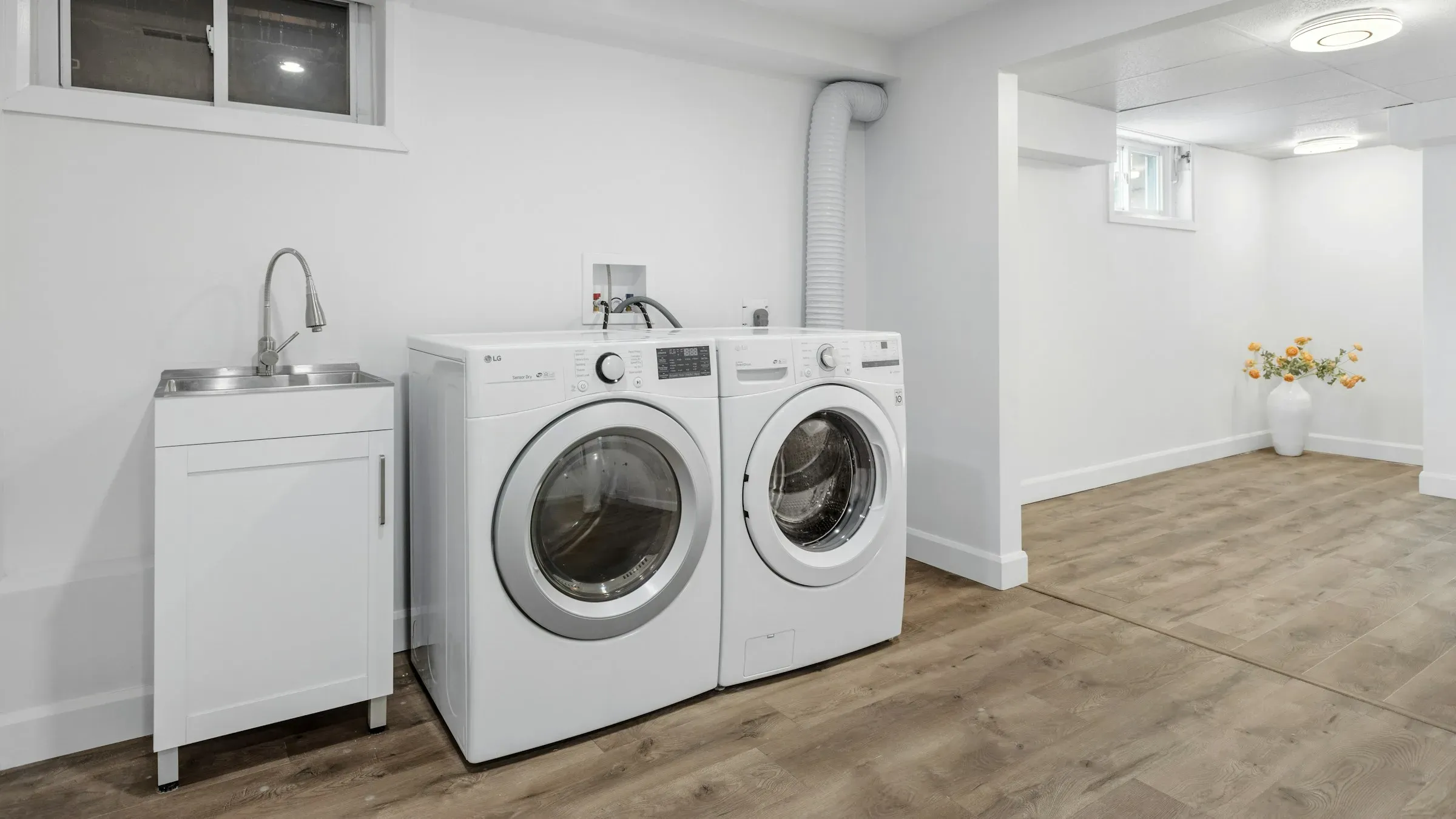
Tell the provider whether the washer is freestanding, built into cabinetry, placed on a raised base or combined with another appliance. Include the make and model if you can read them without moving the machine. A label photograph can help identify the appliance and locate its instructions.
Measure or obtain the appliance dimensions from its documentation where possible. Explain any uncertainty. Do not reach behind a heavy machine or pull it from a tight gap solely to obtain a measurement; photographs of the installation and the available space can start the assessment.
Freestanding does not mean ready to lift
A freestanding washer can still be connected to water, drainage and power, or positioned beneath a counter with little working room. Show the space in front of it and the route to the room door. Describe whether it is already accessible or still in its normal operating position.
Remove your own loose belongings from the surrounding area, but leave the heavy handling to the agreed provider. A clear description of a difficult position is more useful than an attempt to make the machine accessible by dragging it across a floor or pulling on a connection.
Built-in and stacked arrangements need explicit planning
If a cabinet door is attached to the appliance, or the washer sits within fitted units, show that arrangement. Ask who is responsible for releasing it from the installation. Do not assume that a general collection includes work on cabinetry, brackets or fixtures around the machine.
For a dryer stacked above a washer, identify both appliances and the stacking arrangement. If the dryer is the one leaving, the dryer disposal guide covers vent hoses, water tanks and unstacking. Say which unit is leaving and which must remain. The provider needs to assess the complete setup; removing the lower unit cannot be planned as though nothing is above it.
Confirm disconnection before collection day
Ask whether the collection includes disconnection or whether you need to arrange an appropriate professional separately. Make that question explicit at booking. “Washing machine removal” can otherwise leave you and the provider with different assumptions about the condition in which the appliance will be presented.
Use the instructions for your specific model. Bosch's washing machine moving guidance discusses disconnecting the appliance, managing residual hose water and clearing the route. It also advises seeking professional help if you are unsure about moving a heavy appliance. That guidance is a useful reference, not a substitute for the manual for a different model or an assessment of a damaged installation.
Do not turn a collection checklist into DIY plumbing instructions
If a connection is inaccessible, a valve appears damaged or you are unsure what to disconnect, arrange qualified help. The same applies to a water heater, which also has to be drained; the water heater removal guide covers that sequence. Do not force fittings, cut hoses or improvise electrical work to meet a collection deadline. Tell the removal provider what remains unresolved and adjust the sequence if necessary.
The practical task is to establish responsibility: who makes the appliance safe and ready, when they will do it, and how the collection provider will know it is ready. You do not need to perform the work personally in order to arrange it properly. A dishwasher follows the same responsibility-first principle but adds cabinet fixings and retained drain water; the dishwasher removal guide separates those tasks.
Report retained water, faults and damaged parts
Tell the provider if the machine has water inside, has leaked, or has a damaged door or casing. Do not describe it as disconnected and empty unless that has actually been confirmed. Share relevant information with the professional preparing the machine as well as with the collection provider.
Follow the model-specific instructions for dealing with retained water, using professional help where needed. This guide does not give a universal draining procedure. Different installations and faults require different decisions, and an urgent pickup time should not become a reason to guess.
Assess the route out of the property
Photograph the doorway out of the utility room or kitchen, the nearest turn, any steps and the route to the building exit. The narrowest point may be outside the appliance recess. A clear room entrance does not establish that the machine can pass through every later doorway.
If you have measurements, describe what they refer to: the appliance width, a clear door opening or a corridor between fixed obstacles. Avoid presenting a rough measurement as a guarantee of fit. The provider still needs to assess handling room, turns and any protruding features.
Protect items that are staying
Move small belongings out of the planned route and identify fragile or fixed features that need attention. Ask the provider what protection and handling arrangements their scope includes. Do not assume that a statement about collection also confirms every detail of floor or wall protection.
If another person is attending, point out which doors can be opened and which nearby appliances or cupboards must stay untouched. A short walkthrough can resolve these practical details before the machine is moved, rather than leaving the crew to infer them from the room layout.
Upper floors and stairs
Give the exact floor and explain whether a lift is available for the collection. If stairs may be needed, show their layout, turns and access. Ask the provider to confirm whether they can take the job under those conditions and whether the quoted scope includes the carry.
Do not assume that all stair carries are accepted, that a particular crew size will attend or that the collection has a fixed duration. Those are job-specific matters. The residential removal service provides the relevant service context, while your photographs explain the actual access constraints.
Check the building and loading arrangements
Ask management what applies to your address. Confirm any service-lift arrangement, permitted collection window, entry process and loading location. Requirements vary, so do not rely on an article to decide whether a particular permit or booking is necessary for your building.
Pass the confirmed instructions to the removal provider and identify anything still awaiting approval. If the available lift window changes, tell them before the visit. A collection time and a building access time need to work together; neither alone guarantees that the appliance can leave.
Check who will be at the property to provide access. If you cannot attend, agree on a representative who knows which appliance is leaving and can answer questions about the agreed scope. A contact number is useful only if the person can actually be reached during the collection window.
Tell the provider if the loading point is a significant distance from the exit or if there are steps along the route. Do not direct the vehicle to an unauthorised stopping place to shorten the carry. Confirm a workable loading arrangement through the appropriate property contact.
Coordinate removal with a replacement or handover
When a new washer is being delivered, distinguish delivery, old-appliance removal and installation. Ask each provider what they are responsible for. A new machine arriving does not automatically mean the old one has somewhere to go or that its connections will be prepared for removal.
Confirm the order of the appointments before relying on a narrow gap between them. If the old washer occupies the space needed for the replacement, explain that dependency. Ask about completion rather than only arrival, and keep a fallback if one appointment changes.
During an end-of-tenancy clearance
Add the washer to the room inventory and settle ownership and disconnection before the final collection date. If several appliances or rooms are involved, discuss the load as part of a house clearance rather than assuming an appliance-only quote covers everything else.
The end-of-tenancy planning guide explains how to place clearance before cleaning and inspection preparation. Keep appliance work in that same sequence. A washer left connected in an otherwise empty property is still an unresolved task, even if the furniture has gone.
When collection is urgent
If the deadline is today, state it clearly and explain whether the machine is ready. Ask for confirmation based on both availability and preparation. An available vehicle does not remove the need for safe disconnection or approved access.
Use the urgent collection checklist to send a complete enquiry. Avoid interpreting an initial acknowledgement as a confirmed booking, and do not cancel another arrangement until you have the information needed to rely on the new one.
What to include in the collection request
Combine the appliance details with the access information in one message. This helps distinguish an ordinary freestanding collection from a job with unresolved preparation. If you are uncertain about something, say so; the provider can ask a focused follow-up instead of planning around incorrect information.
- Make, model and approximate dimensions, if known.
- Whether it is freestanding, built-in, stacked or raised.
- Whether removal is for disposal rather than relocation or repair.
- Connection status and who is arranging any remaining preparation.
- Photographs of the appliance, surrounding space and tightest access points.
- Floor, lift arrangement, stairs and loading access.
- Any leak, retained water or visible damage relevant to handling.
- The collection deadline and the person providing access.
Ask for the scope and price to be confirmed against that description. Check what happens if the access or item list changes. A quotation should be assessed as an agreement for a described job, not as a universal price for any washing machine in any location.
Keep a copy of the confirmation and share it with your representative if someone else is attending. Before collection, remove any laundry or personal belongings that remain inside the appliance, following the manual and using help if a fault prevents normal access. Do not leave an ownership or preparation question for the crew to resolve after arrival.
Be clear about disposal and transport expectations
Ask the provider how the unwanted appliance will be handled after collection. Do not assume a particular recycling percentage, facility or reuse outcome without supporting information. A machine being removed from your home is not, by itself, evidence of its final destination.
If you are retaining a Bosch machine for a move, the manufacturer's guidance discusses transport bolts and keeping the appliance upright during transport. Ask your mover to follow the instructions for your model. This is distinct from booking disposal of an unwanted unit, and the intended destination should be clear from the beginning.
Once the job is agreed, keep the route accessible and report any change before the visit. After removal, check the area and follow up with the appropriate professional about anything outside the collection scope, such as installation of a replacement. To arrange the removal itself, send the appliance and access photographs with the preparation status and deadline.
FAQs about washing machine removal
Can a machine be collected while it is still connected?
Tell the provider it is still connected and ask who will prepare it. Do not assume disconnection is part of collection. If separate professional help is needed, arrange it before removal and confirm readiness. Avoid forcing fittings or doing unfamiliar electrical or plumbing work to meet the appointment.
Does a broken washing machine need different information?
Describe the fault insofar as it affects handling: retained water, a leaking connection, a damaged casing or a door that will not open. The collection provider does not need an invented diagnosis. They need an accurate account of the condition and any preparation that remains unresolved.
Can the washer be removed from an upper floor without a lift?
Ask the provider to assess the stairs and item before confirming the booking. Send the floor number and photographs of turns and narrow sections. Do not assume that a stair carry is possible or included merely because appliance collection is offered.
Is removal of the old washer included with my new delivery?
Check directly with the retailer or delivery provider. If they offer removal, confirm its conditions, timing and preparation requirements. Keep that arrangement separate from any independent collection enquiry so the same appliance is not booked for removal twice.