The buggy in the hall is a stroller, or it is not. Look for a wheeled frame, a seat or a bassinet, a handle, and a fold. If the catch closes by hand and the frame goes flat, fold it and measure the flat buggy. If the catch will not close, write “will not fold” and measure it open. A booking that says “the pram” will be read as whatever is standing there. This note is one stroller, including one that will not fold flat.
A whole children’s room, with a cot, a chair, drawers and bags of toys, stays on the children’s-room clearance. Come back here when the object is one buggy and the open question is the fold, the wheels and the basket. A high chair that stands at a table is not this frame. That fold is the high-chair note. The photo of one bulky object and the route it has to pass stay on the bulky-item note. What a crew can take in general stays on the acceptance list. This page is the one buggy.
Fold it only where it already folds
Stand the buggy where you can see the frame, the seat and the wheels. Name five parts, even if they are still joined: the frame, the seat or the bassinet, the handle, the wheels, and the basket. A photo of the fabric alone is a photo of cloth. The frame is what makes it a stroller, and the wheels are what make it roll.
Look at the fold before you lean on the handle. A catch you can press with a finger, or a lever the frame already uses, can release. Fold the buggy the way it already moves. Some fold in one movement. Some need the seat to recline, or a second catch, before the frame will close. Do the steps the frame already has. If a catch does not move, stop. Write “will not fold”. Do not hit the joint. Do not stand on the frame to force it flat. Do not saw a tube to make the buggy shorter. Do not cut the fabric to get it off the frame.
If the buggy folds, fold it and then look at the result. Flat means it stays flat when you let go. Measure the length, the width and the thickness after the fold you actually made. A fold you only imagined is not a measurement. If the frame springs back open when you let go, it is not folded. Write “will not stay folded” and measure it in the position it returns to.
If the buggy will not fold, leave it open. Measure the length from the front wheels to the handle, the width across the wheels, and the height of the handle as it stands. Say which dimension is the long one. Do not force a seized catch because a doorway looks narrow. The measurement is the report. A bent tube is not a step on this page.
A pram with a bassinet on the same kind of frame is this note when the question is the fold. If the bassinet lifts off by hand, lift it, set it beside the frame, and write “bassinet off”. If it will not lift, write “bassinet still on” and fold only if the frame still folds with it on. Do not call a bassinet a stroller by itself, and do not call a cot a pram. A cot that stands on the floor, with no wheels and no handle, is not this buggy. A cot is not given a page of its own here. Say “cot” and stop following these steps.
The basket under the seat is not the buggy. Empty it. A bag, a toy, a blanket, a rain cover you are keeping. If you are keeping them, they leave the photograph. If a blanket is leaving, it is not the frame. Name it or take it out of the shot. Look in the basket for a phone, a key or a small purse. A buggy stored for a long time collects those objects. Empty them before you call the frame ready.
A canopy that folds down by hand folds down. Write “canopy down”. If it will not move, write “canopy still up” and include that height in the open measurement. Do not cut the canopy off. A rain cover that unzips or unclips comes off. Bag it and write “rain cover, separate”, or leave it on and say “cover still on”. A cup holder that clips off can come off the same way. If it will not clip off, leave it and write “cup holder still on”.
Wheels change the width. If a wheel comes off a button or a pin you can press, and you want it off so the folded frame is narrower, take it off, bag it, and write “wheels off”. If the button will not press, leave the wheel and write “wheels still on”. If a wheel is missing, or a tyre is flat, write that. A flat tyre is not a fold. Do not remove a wheel by levering it with a tool this page did not ask you to use.
The handle is part of the height. If the handle already telescopes and you can lower it by a button you can press, lower it and measure again. Write “handle down”. If it will not move, write “handle fixed” and measure the height you have. Do not saw the handle.
A strap on the seat stays unless the buckle opens by hand. Leave it and write “strap on”, or unclip it, bag it, and write “strap, separate”. If the buckle will not open, write “buckle shut”. Do not cut the webbing.
A child car seat clicked onto the frame is not the stroller. If the release you can press with a finger lets the seat come off, take it off and write “car seat off, separate line”. The car seat is its own line, and this page does not open a guide for it. If the release will not move, write “car seat still clicked on” and do not cut the connectors. Measure the buggy with the seat still on. Do not hide the seat inside the word “stroller”.
A scooter board or a ride-on that clips to the back axle is the same kind of extra. If it unclips by hand, unclip it and name it. If it will not, write “board still on” and include it in the width.
A double buggy is still one object if it is one frame. Write “double” and measure the wider width. Do not fold one side and call the other side a second stroller. A second stroller, with its own frame, is a second fold and a second measurement. Name them: “buggy in the hall” and “buggy in the store”.
An umbrella fold and a fold that stays thick are both this page. The difference is the thickness you measured, not a second article. Write the thickness. A three-wheel frame is still this buggy. Measure across the wheels you have, not across a picture of a different model.
The opening the buggy has to pass
Walk to the doorway the folded or open buggy has to pass. Open that door as far as it opens. The clear height and the clear width are the gap you can see, not the size of the door while it is shut. A shoe, a mat or another buggy in the opening is part of the width until you move what is yours to move. Move what you are keeping, then measure if the gap changed.
Write the buggy’s travelling length, width and thickness or height, and the doorway’s clear height and clear width. Name the door. If the buggy is still open because it would not fold, the length is the open length and the height is the handle height. If a second doorway is tighter, measure that one and name it. A buggy that leaves the hall and stops at the lift has not left.
If you have already been given a lift instruction, add it: which lift, and any note about a booking. If you have no lift note, write “no lift instruction yet”. Do not invent a lift size. This page does not keep a standard door size. If you have no tape, write “not measured”. A buggy you have not measured is not ready to describe as unable to pass, and it is not ready to describe as able to pass.
The bulky-item note is the method for any one large object: the photo and the route. Use it when you are describing the narrowest point. Stay on this page for the fold, the wheels and the basket. Do not replace the fold with the word “bulky”.
A buggy stored in a gap behind a door or inside a store cupboard is a location. If you can bring it out without moving a piece that is staying, bring it out, and only then fold it if it folds. Hold the frame. Do not drag it by the handle if a wheel is caught. If it catches, stop and look. Write what stopped it. If a wardrobe or a cabinet has to move and that piece is staying, write “piece in the way” and “buggy still in the gap”. Do not unscrew a wardrobe on this page to free a stroller.
The general question of whether furniture should come apart is not this fold. A catch on a stroller that already folds is not a wardrobe taken to panels. Do not take the tubes apart because a furniture guide talks about bolts.
What is not this buggy
A high chair has a seat, a tray and legs that stand at a table. It stays on the high-chair note, even if two small wheels sit on the back legs. Do not list a high chair as a stroller because both fold.
A cot, a travel cot and a crib are not this buggy. Say “cot” and leave this note. Do not add wheels in the description to make a cot fit. A bassinet that has no frame and no wheels, sitting on a floor, is not this page either. Write “bassinet, no frame” as its own line if it is leaving. This page does not open that line into a guide.
A pushchair toy, a doll’s buggy and a ride-on car are not this stroller. If one of them is leaving, name it. Do not fold a child’s toy into the same measurement as the frame a child rode in. A bicycle is not this buggy. A folded pram left on a stair, which is only in the way of a carry, is still this note if it is the object leaving. A neighbour’s buggy on a landing is not yours to move. Photograph it and say the turn is partly blocked by something you cannot clear.
A playpen and a baby gate are not this frame. This page will not turn either into a stroller, and it does not open a page for them. If one is leaving with the room, it stays on the children’s-room list.
A chair from a dining table is not a buggy. The dining-table guide keeps that set. An armchair keeps the adult chair. Do not send a recliner through these steps because it has a lever.
A buggy you are moving to another address to keep using is not a collection. This note is for the stroller that is leaving the property. If someone is taking it to a new home to keep using, say that to the person who is moving it. Do not use a disposal booking as a way to relocate a buggy you still want.
If a tenancy list or a written note says the buggy stays with the property, leave it off the booking. A seized fold is not permission. The person who may release it writes that release. This page does not interpret a contract.
Whether another household could use the buggy is not a test this page adds. The children’s-room page is where reuse of the room’s pieces is separated from the collection. If you have decided the buggy is leaving, the fold and the wheels are the work. If you have not decided, do not book it.
The acceptance list already names prams and strollers among nursery items a crew can take. That list is the wider yes. This page is one buggy, with the fold written down. Do not treat the list as the measurement.
The buggy is not the basket’s contents, and it is not a car seat clicked on top. Point at those only as their own lines. Do not book “buggy and everything in the hall” as one object.
Photos of the buggy and the opening
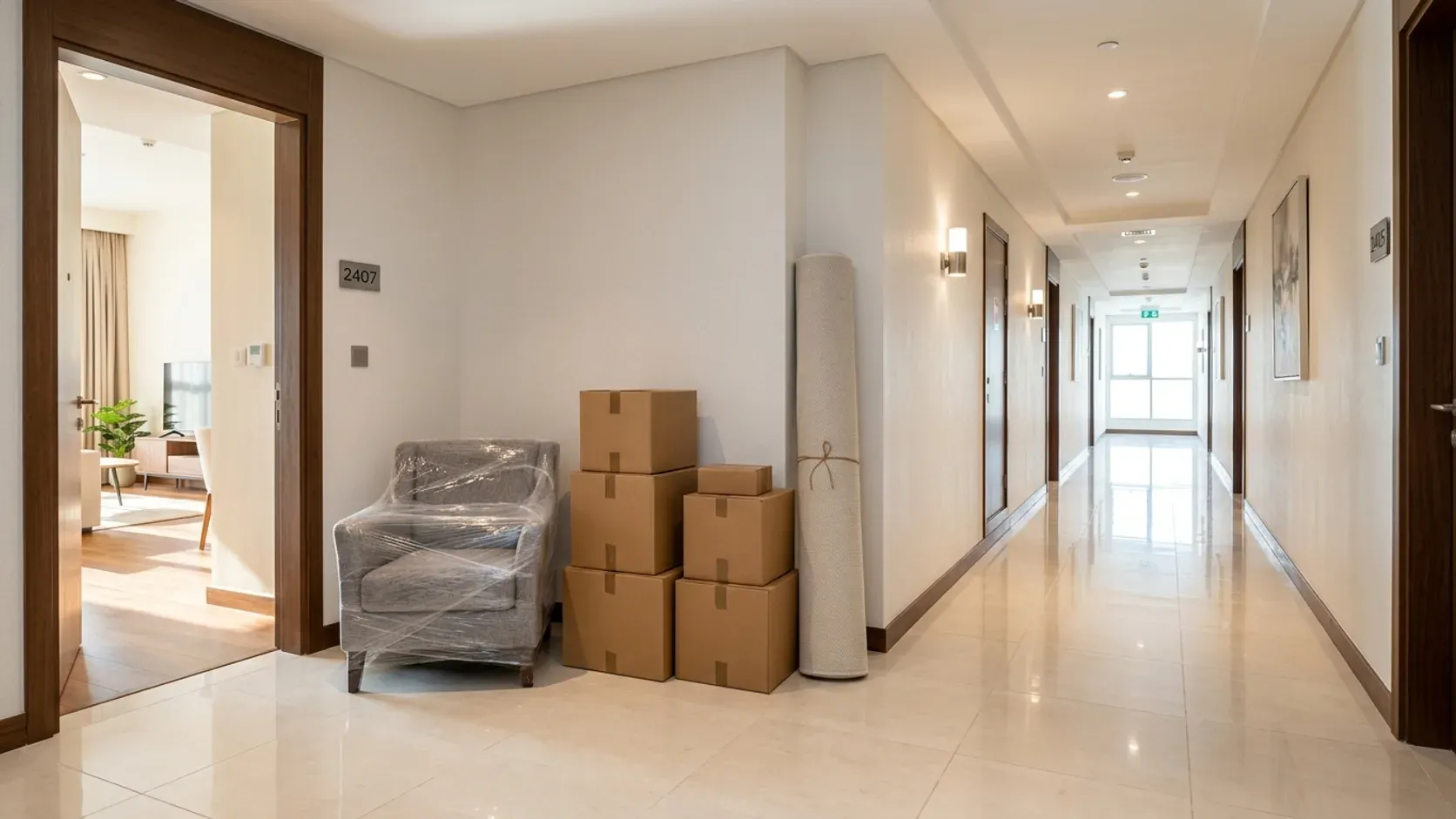
The picture is a corridor and an open doorway with household items staged in a home. It does not show a stroller, a fold, a wheel, a handle or a basket. Use it only as a reminder that a clear doorway is not a photograph of the buggy. Your own photos still have to show the frame and the opening.
Send these views.
- The buggy where it sits, before you move it, so the hall or the gap is visible.
- The buggy after you have brought it out, or the same gap with the words “piece in the way” if you could not.
- The buggy folded flat, or the buggy open with “will not fold” or “will not stay folded”.
- The wheels on or off, and a missing wheel if one is missing.
- The basket empty, or the words “basket still holding” if you could not empty it, naming what is still in it.
- The bassinet off or still on, the canopy down or still up, and a car seat only if it is still clicked on or in its own photo.
- The doorway the buggy has to pass, open as far as it goes, with things you are keeping moved aside.
Add the room name and the floor. Add a lift or loading note you have already been given. Add the length and width you measured, and the thickness if it is folded or the handle height if it is not. Add the clear opening of the door that limits the buggy.
If you have no tape, write “not measured”. Do not invent the numbers. Take the photos in the light the hall already has. If that light does not work, say so. A photo of a closed cupboard does not show the frame.
One line in the booking
You can ask for a rubbish pickup if it will not fold, and the same pickup if it does fold, once the fold is either done or honestly marked as not done, the basket is empty or its contents are named, and a car seat is not pretending to be part of the frame. That page is the one-off load. It is not a request to saw a tube, and it is not the children’s room taken as one word.
If the buggy is leaving with other furniture, name the furniture on its own line. The high chair, if it is also leaving, is the high-chair note. Do not add the buggy to that chair.
Say, in one message:
- one stroller, or one double, and the room
- folded flat, will not fold, or will not stay folded
- wheels on, wheels off, or a wheel missing
- basket empty, or what is still in the basket
- bassinet off or still on, canopy down or still up
- car seat off on its own line, car seat still clicked on, or no car seat
- the length and width as it will travel, and the thickness or the handle height, and the clear height and width of the doorway that limits it, naming that door
- anything that is not this buggy: a high chair, a cot, a toy buggy, a bicycle
Do not write “the pram” as the only words. Do not write a fold you did not make. Do not ask for the frame to be cut because the figure is larger than the gap. The figure is the report.
If the buggy is still open and you have not tried the catch, you are early. Look. If the catch will not move, the open measurement is the honest one. Send that.
The children’s-room page remains the room. The high-chair page remains the chair. The bulky-item page remains the photo and the route. The acceptance list remains the wider yes. This page remains one stroller that does not leave undescribed.
The morning the buggy leaves
Look at the fold again. If someone opened the buggy overnight, fold it the same way, or change the note to the open measurement and photograph it again. Check the basket is still empty. Check a bag you put back in it is out again. Check a wheel you took off is still in the bag you named, or still on the axle if you said it was on.
Open the door to the gap you measured. A box pushed into the opening changes the width. Move it before you treat the old figure as current. If the frame was stood back in the gap, you do not have the same buggy you photographed. Bring it out again, or write that it is back in the gap.
Point at the frame, the wheels and the handle as the stroller. Point at a car seat only if it has its own line or is still clicked on and you said so. Point at a high chair only as the high chair. Leave a cot, a toy buggy and a dining chair out of the gesture.
Do not stand the open buggy in the corridor the night before to save the hall. The corridor is not the gap you photographed, and a frame that springs open does not belong on a shared landing. If the only place it can wait is the room it is already in, leave it there, folded if it stays folded.
When it has gone, look at the floor where it stood. A wheel you meant to include is still a wheel. A rain cover you bagged is still a cover if it is on the floor. The useful record is the sentence from the first look: one stroller, folded flat or honestly not folded, basket emptied, wheels accounted for, and the doorway’s clear opening written beside the buggy’s own length.