A parking-bay locker separate from the flat is a second door. It can sit on a different level, open with a different key, and reach the vehicle by a different route. An empty living room does not empty that locker. Book it only when you can open it and you know which of its contents you are allowed to send.
The flat and the locker are two stops even when one tenancy covers both. Photograph them separately. A note that says “and the store” is not a description of a cage beside a parking bay.
Name the door you are actually clearing
Start with the door in front of you. An apartment storage room that opens off the flat, or off the same corridor as the flat, is the storage-room clearance. That guide is the packed store: what stays, what leaves, and how you walk it. Stay on that guide when the room is the apartment store.
Come to this page when the door is a locker, a cage or a cupboard that belongs to a parking bay. It may be on a basement level, on a podium, or on a parking floor that is not the floor of the flat. The useful facts are the key, the level, and the path from that door to the place a vehicle is allowed to wait. The flat’s floor number does not answer those facts.
A cupboard inside the flat, including a cabinet under the sink, is neither the apartment store nor this locker. Leave it on the flat’s own list. A garage that is part of a villa, with a car door and a mixed pile of household and garden items, is a garage clear-out, not a tower locker. Do not rename a garage as a parking-bay locker to make the booking sound smaller.
Write one line you could hand to someone who has not seen the building: “Locker B12, level P2, key on the blue fob, contents listed below.” If you cannot write the level and the key, you do not yet have a locker booking. You have a guess.
The number painted on the bay and the number on the locker door are not the same fact until you have checked both. A bay marked 12 can sit opposite a cage marked S-12, or beside a row of cages that use a different sequence. Photograph the number you will use in the message, and say whether it is the bay, the cage, or both. Someone sent to “12” can be standing at the car space while the load is one aisle away.
If the locker has no number, describe it by what you can see: the colour of the door, the pillar beside it, and the bay it faces. “The small one near the lift” is not enough when a parking level has several lifts. Walk to it from the lift you will use, and count the turns. Put that count in the note.
Two keys, and who may open the locker
The flat key and the locker key are different objects until someone shows you they are the same. Hold the locker key in your hand and try the lock before you book. A fob that opens the lobby does not, by that fact, open the cage. If the lock does not turn, stop. Do not book the locker as empty, and do not book it as a load, while you cannot see inside.
Ask who issued the key. A key from the landlord, the facility desk or the previous occupant is a fact to write down: who gave it to you, and whether they asked for it back. If you were told the locker is included and you were not given a key, the inclusion is still an instruction to obtain the key. It is not permission to force the lock.
If the key is with an agent, a security desk or a neighbour, name that person in the booking and say the locker cannot be opened until they are present. A collection cannot invent a second key at the barrier. If the desk will release the key only during hours it has written down, send those hours as the desk wrote them. Do not turn one desk note into a rule for other buildings.
Contents can belong to someone who is not you. A box with another name, a bicycle you do not recognise, or a label from a water company is a reason to leave that item in the locker until the person who can release it has done so. Keys to the flat do not transfer ownership of what a previous resident left in the cage. If you cannot tell, leave the item and photograph it as “not in this load”.
The locker door, the mesh, the lock and a shelf fixed to the wall stay unless the person responsible for the building has released them in writing and they are already detached. Do not cut a padlock you do not own. Do not unscrew a cage to make the pile easier to see. The booking is the contents you are allowed to send. It is not the building’s locker.
A spare key found inside the locker is not automatically yours to keep or to throw away. Bag it, label it, and ask the person who issued the locker key what they want done with it. A key can belong to a meter cupboard, a mailbox or another resident’s store. Putting it in the leaving pile because it was on a shelf is how a building loses access it still needs.
The route starts at the locker, not at the flat
Walk from the locker door to the place a vehicle can legally wait, and write that walk down. Count the doors, the ramp, the lift if there is one, and the point where the path narrows. A locker on P2 can be a short walk to a basement bay, or a long walk to a ground-level dock that the flat’s service lift also uses. Those are different jobs. Say which one you walked.
The tower bulky-item guide is the carry from an apartment through a tower’s lift and corridors. Use it when the heavy piece starts in the flat. Use this page when the piece starts in the locker. If both are true, you have two routes. Do not describe them as one corridor.
If the building has told you that a goods lift must be booked, send that instruction with the locker note and ask whether the booking covers the parking level as well as the apartment floor. This page does not set the building’s rule. A lift booking that names only the flat floor may not be a booking for the basement.
If there is no lift between the locker and the vehicle, say so, and say whether there are stairs, a ramp, or both. Do not carry the load up yourself to make the photo look simpler. Say where it will be waiting, and whether a trolley fits through the locker door. A trolley that does not fit is a fact. It is not a reason to drag a wardrobe along a driving lane.
Ask where a vehicle is allowed to stop. If the building has given you a height limit, a time limit or a bay number, copy those words into the note. Do not invent a limit because another tower had one. If you have not been told, write “not stated” and send a photo of the approach. A fire lane, a barrier you cannot open, and a visitor space you have not been offered are not a loading plan. Ask the desk before you promise a time.
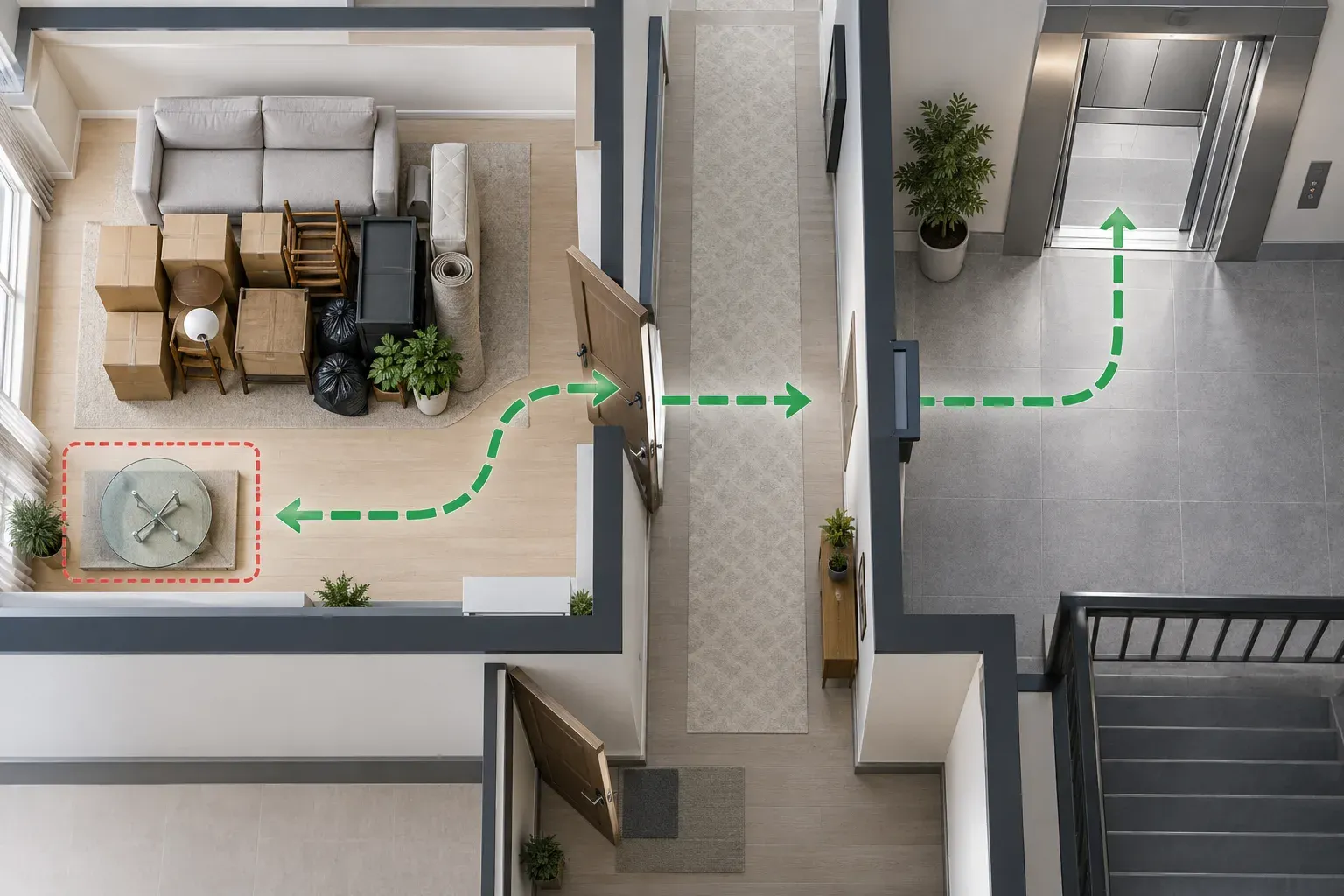
The drawing is an apartment plan with a clear path to a lift. It is a reminder to record a path. It is not a picture of your locker, and it does not show a parking level. Your photo still has to show the open locker, the level, and the tightest point between that door and the vehicle.
Measure the locker door as well as the piece. A cage can be wider than its opening once the door is swung, or narrower because a parked car sits beside the swing. Record the opening you can actually use, not the width of the bay painted on the floor. If a pillar, a hose reel or a low beam crosses the path, photograph it and give the height you measured. If you could not measure, say that.
A ramp between parking levels changes the carry even when the distance looks short on a plan. Say whether the ramp is the walking route, and whether it is shared with moving cars. Do not stand a mattress on the ramp while you go back for a second item. The load stays in the locker, or in a space the building has named, until the vehicle is in the place it is allowed to wait.
If the only exit is a car lift, say so. A car lift is not the apartment service lift, and a booking for one does not book the other. Copy any instruction the building has already given you about which lift the items may use. If you have no instruction, ask before you write a time into the message.
The same-floor store is a different door
Some handovers include a store on the same floor as the flat. Downtown Dubai already describes that door: at a Downtown handover, the facility office and the landlord’s inspector open the store room on the same floor, together with the balcony and, in larger flats, the maid’s bathroom. That sentence is about the store on the flat’s floor. It is not a description of a locker beside a parking bay.
If your Downtown unit has both, keep them apart in the note. The same-floor store follows the storage-room guide and the Downtown page. The parking-bay locker follows this page: its own key, its own level, its own route. Do not assume the inspector’s list on the Downtown page has already named the bay. If you have a written list, use the list. If you do not, ask which doors will be opened, and photograph each one you are told to clear.
No other community is given a locker rule on this page. If your building is not in Downtown, the same split still applies and you do not need a community name in the note. Name the level, the bay or locker number, and the door. A second area page is not required to describe a second key.
The Downtown page already treats Old Town as a different job from the towers: low-rise streets, not a boulevard tower. If you are in Old Town, or in another low-rise with a street and a small store, say that. Do not call a street-level cupboard a basement locker. The person reading the note should be able to tell a tower parking level from a street door without guessing.
The same Downtown page notes that serviced apartments inside hotels can add a luggage room. That room is not this locker unless it opens on the parking bay and you have been given its key for the contents you may send. If the operator keeps that room, leave it off the booking. Photograph only the door you are allowed to empty.
Check whether a collection can reach the locker
A locker of household furniture is still an address question before it is a booking question. Read whether bulky collection reaches that locker and use the live check that guide points to. This page does not add a community to an eligibility list, and it does not say that a basement is covered or excluded. The official route is specific to the address. A parking level is part of the address you check, not a category this page invents.
If the official route needs the items presented in a particular place, read that instruction before you move anything out of the locker. A corridor, a driving aisle and the space beside another resident’s car are not a staging area unless the instruction says so. Keep the contents in the locker until the route you will actually use is confirmed.
If the date you need is tighter than the confirmed window, or the address is not covered, a paid pickup is the other route. That comparison already lives on the municipal guide. Do not rebuild it here. What this page adds is the second door: the locker still has to be open, listed and reachable on the day you choose, whether the collection is the official one or a paid crew.
Items the official list does not take do not become acceptable because they are inside a locker. Paint, batteries, a gas cylinder, a liquid and a container you cannot identify stay out of the outgoing pile. Say they are still in the locker and that they are not in the load. The acceptance guide is the boundary for a paid collection. It is not a reason to hide the container behind a suitcase.
Do not leave bags beside the communal bins while you wait for either route. The locker is the place you control. A parking aisle is a place other people drive through. If the deadline is close, say so in the message and keep the items behind the locker door until the collection you have actually confirmed is ready to take them.
Sort the locker before you photograph it
Open the door fully if it opens fully, and look before you pull. A locker can be stacked high. Take one item from the front, decide where it goes, and only then reach further. Do not climb a pile on a parking level. If the floor of the locker is wet, or a container is leaking, stop and photograph what you can see from the door. Say you did not empty it.
Give each item one destination you can point at: stays with you, stays in the locker because you may not send it, or leaves. A fourth group, for paint and other materials you have set aside, should be visible and labelled in words. “Not in this load” is enough. A piece of tape with no words is not.
Do not spread the leaving pile across the parking aisle while you sort. Sort inside the locker, or in a space the building has told you to use. Another resident’s bay is not that space. If the locker is too tight to sort inside, take one box at a time to the flat only if you are allowed to, and say that the flat is now holding the locker’s contents. Do not create a third unnamed pile in a corridor.
Measure the awkward piece while it is still in place if you can do that without pulling the stack down. A folded bed, a spare mattress, a bicycle and a boxed fan are different shapes. Record the one that will not pass the locker door, the ramp or the lift. If you cannot measure without unpacking, say the photo is the front of the stack and that the depth is unseen.
Keep documents, spare keys and anything with a person’s name on it out of the leaving pile. A locker is a place a spare set of papers can sit. Open a closed box far enough to see that it is not papers. If you will not be the person on site, leave those boxes out of the load and say so.
Textiles and a rolled rug need a look before they join the pile. If a rug is damp or heavily soiled, say so. Do not wrap it around other items to hide the condition. A bicycle should have its lock status written down: locked to the cage, locked to itself, or free. Do not cut a lock that is not yours. If the bicycle is not on your release, it stays in the “not in this load” corner even when it blocks the door. Move it only if you can put it back, and say that you did.
Photograph the bay as its own place
The flat’s living-room photo does not show the locker. Send a photo of the locker door with the number visible, a photo from the doorway once it is open, and a photo of the tightest point on the route you walked. Add the level and the key note in the same message. If the locker is still locked, send the locked door and say it is locked. Do not send a photo of a different store and call it the bay.
If part of the contents is staying, put it where the photo shows the split, or say in words which side stays. A wide photo of a mixed locker will be read as one pile. Move the “not in this load” items to a corner you can point at, or leave them and draw the line in the words you type under the photo.
Say whether the flat is also being cleared on the same visit. If it is, the flat is a second list and a second route. If it is not, say the visit does not include the flat. A booking that grows from a locker to a flat, without a second list, is how a lift slot runs out before the cage is empty.
Include the vehicle approach if you have it: the bay number, the barrier, the height figure you were given, or a photo of the ramp. “Near the tower” is not an approach. The tower name, the parking level and the door you mean are the approach.
Take the route photo from both directions if the tight point is a turn. A photo looking out of the locker can miss the pillar you have to pass on the way back. A photo of the ramp from the top can miss a barrier arm at the bottom. Two photos of that kind are more useful than a set of labels on boxes.
Book the locker once the key and the route are known
Book the locker once the key and the route are known when the load is the contents you are allowed to send and the door can be opened. This is a pickup from that door. It is not a clearance of the flat, and it is not a new rule about who qualifies for an official collection. The municipal guide remains the place to check the address. The storage-room guide remains the apartment store. The tower guide remains the carry that starts in the flat.
In the message, say:
- the locker or bay number and the level
- who holds the key, and that you have opened the door or that you have not
- what is leaving, in plain items, and what is staying
- what you set aside and are not sending
- the route you walked, including stairs, a ramp or a lift
- a height, time or bay instruction the building has already given you, or “not stated”
- whether the flat is a separate list or is not part of this visit
Send the three photos named above. Do not send a set of close-ups of brand labels. The label does not show the level.
If the door is still locked when you write, you are early. Get the key first. A collection booked against a locked cage cannot be finished from the pavement.
If the pile includes a mattress, a wardrobe or a bicycle, name the item. Do not rely on the word “locker” to describe a shape. Preparation notes for those pieces stay on their own pages when the piece itself is the problem. This page stays the second door: the key, the level and the route.
If you are also asking for the same-floor store to be cleared, say that in a separate line and point it at the storage-room guide. One message can hold two jobs. One vague line cannot. The person pricing the visit should be able to see two doors, two photo sets and two answers about keys.
When the locker is opened on the day
Meet at the locker, not only at the flat. The person who holds the key should open it before anything is carried, and should stay long enough to point at what stays. Two people pointing at two different cages is how a neighbour’s bicycle leaves.
Walk the route once more before the first item moves. A car that was not in the aisle yesterday is now part of the route. If the path is blocked, wait until it is clear. Do not move someone else’s vehicle, and do not stand items in the driving lane to save a second trip.
Check the “not in this load” corner after the leaving pile is out. Papers, the spare key and the container you set aside should still be there. The cage, the lock and the fixed shelf should still be there unless you were told, in writing, to remove a part that was already detached.
Return the locker key to the person who asked for it. A cleared locker with the key in your pocket is an unfinished handover. Photograph the open locker if you were asked for a record, then lock it if you were told to lock it. The flat’s own inspection is a separate walk. Do not treat a photo of the living room as a photo of the bay.