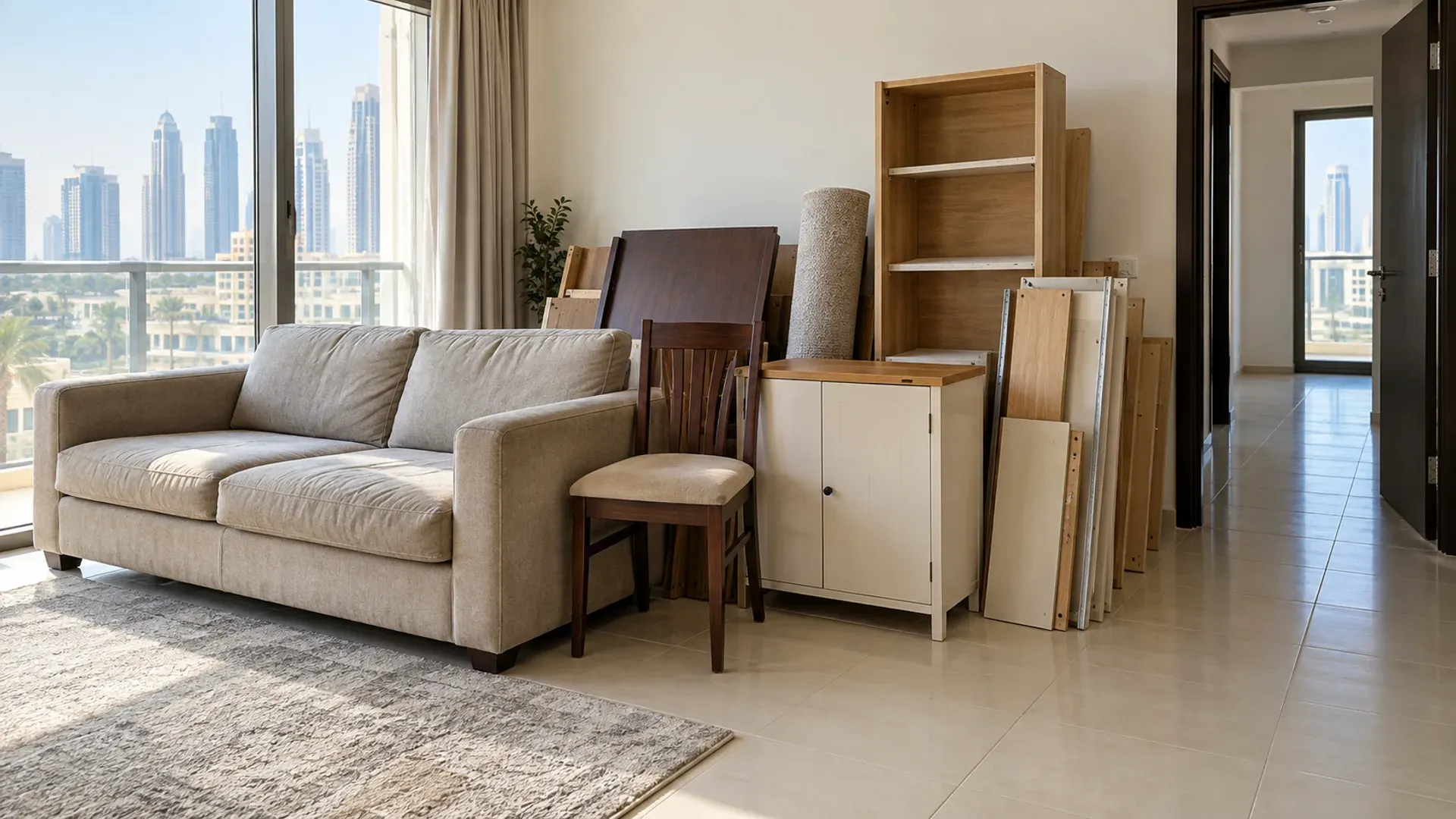
The old piece is still in the room, and the new one is already on a delivery note. The doorway can take one of those movements at a time. The piece that is already there leaves first. The delivery uses the same door afterwards, when the route is actually clear.
A booking that says “we will work around the delivery” has not named which piece is in the way, which door it uses, or which visit is allowed to be there first. Write those three facts down before you ask either team to come.
Name the piece that is blocking the room
Say what is standing there. A wardrobe, a bed and its frame, a dining table, a sideboard, a bookcase or a cabinet are different shapes. “The furniture” is not a shape. Do not measure it until you have named it. The name decides which preparation applies, and it stops a delivery team and a removal visit from arguing over a room they have both been told is “ready”.
If the piece in the way is a sofa, and the delivery is a replacement sofa, use the sofa that has to leave before a new one. That guide is one sofa, the retailer’s written scope for that sofa, and the route that sofa needs. Stay there when the clash is sofa for sofa.
Come to this page when the piece is some other large item, or when more than one large piece is still in the room on the day a delivery is due. A new sofa arriving while an old wardrobe is still in the only doorway is this page. A new bed arriving while the old bed, the mattress and a chest are still in the bedroom is this page. A whole van of replacement furniture, with several old pieces still in place, is this page. Do not stretch the sofa guide over a wardrobe because both are bulky.
If you are not allowed to remove the piece, because it is display stock, a landlord’s item or someone else’s, stop. Display stock that has not been released is the show-flat furniture note. A piece a flatmate left, while other people still live there, is a different note again. Do not book a delivery-day collection for a piece you have not been allowed to send. The delivery can still be a problem. The solution is not to load an item that is not yours.
Write one line a person who has not seen the room could use: “double wardrobe, still assembled, in the bedroom doorway, new chest of drawers due the same morning”. If the line does not name both the old piece and the delivery, it is not this job yet.
A piece in a second room, which the delivery will not pass, can stay on a different list. Do not add it to the delivery-day booking to “get it done” unless it uses the same door at the same time. The clash is the shared door, not the fact that the home contains furniture.
Read the delivery note, not the assumption
Open the retailer’s message and read what it says about the old piece. Some notes are silent. Silence is not a promise that the delivery team will take the old furniture away. Assembly of the new piece is not collection of the old one. Packaging take-back, if it is offered, is not the same as removing a wardrobe.
If the note says the old item will be collected, check what “the old item” means. A line that says “old bed” may not include the mattress, the bedside tables or the wardrobe that is actually blocking the door. Copy the words they used into your own list, then add the pieces they did not name and decide those separately. Do not upgrade their sentence.
If two companies are involved, one to deliver and one to remove, each may need its own instruction. Tell them about each other in writing: who is due, at which door, and which visit you want first. A permission or a time slot issued for a delivery is not, by itself, a permission for a collection. Ask, and keep the answer. If you do not have an answer, write “not stated” rather than guessing that one slot covers both.
Do not cut, drill or strip a piece because you hope the retailer will refuse it otherwise, or because you hope they will accept it. Leave it assembled until the person who is allowed to send it, and the person who will carry it, have agreed it can come apart. Taking the back off a wardrobe in the morning, before anyone has confirmed the collection, can leave you with panels in the doorway and a delivery that still cannot enter.
Keep the delivery note, the removal message and any building note in one place the person on site can open. Three inboxes and a verbal “they said it was fine” are how the wrong team is let up first.
Leave a gap the two visits cannot share
Put the removal first and the delivery after the old piece has left the building, not merely left the room. “Both in the morning” can mean the new piece is in the lobby while the old one is still on the bed. Neither team then has a clear door. The delivery may have other stops. The removal cannot carry through a corridor that has just been filled with a wrapped replacement and its packaging.
Ask for times you can put in order. If the times you were given overlap, ask one of them to move. Do not assume a building will hold a lift for both, and do not assume either team will wait. What you can ask for is a sequence: old piece out, route checked, then the new piece in. If a sequence is refused, the honest position is that the room is not ready for the delivery. Moving the delivery is then the decision, not a squeeze.
Leave enough of a gap that a late removal does not collide with an early van. This page does not set that gap in minutes. A gap you cannot point at, because both messages say the same hour, is not a gap. Change one of the messages.
If the household cannot be without the old piece until the new one arrives, say so before you book the removal for the day before. A bed you still need tonight is a reason to choose a different sequence, not a reason to hide the bed in the corridor overnight. The sequence still cannot be two large pieces in one doorway at once. It might be a later delivery, or a removal that starts only when you are ready to be without the piece. Write which one you chose.
Cancellations belong in the same thread. If the retailer moves the delivery, tell the removal visit before it is on the way. If the removal moves, tell the retailer before the van is at the barrier. A change that lives in one phone and not the other is the overlap you were trying to avoid.
One doorway, measured twice
The old piece and the new piece both have to pass the same openings, and they may not be the same size. Measure the old piece at its widest points, including feet, handles and a headboard. Then write down the new piece’s sizes from the retailer, including the packaged sizes if they sent them. Packaging can be larger and less flexible than the finished item. A flat carton and an assembled wardrobe are different problems in the same corridor.
The way to record one object and the tight points on its route is the photo and route for one bulky piece. Use that method for the old piece, and use it again for the new piece if the retailer has not already confirmed the path. Do not wait until both items are in the corridor to discover the turn.
Walk the route the old piece will take, then walk the route the new piece will take. Check whether they are the same doors. Note a door closer, a handrail, a light fitting, a shoe rack and a rug that reduces the width. A rug you roll only after the old piece has left is a rug the old piece still has to cross. Roll it before, or accept that the route includes it, and say so.
If the old piece will not pass a door in one piece, that question is whether the piece should come apart. Decide it before the delivery day, not while the van is downstairs. Panels, screws and a stone top each need a place to wait that is not the doorway. Do not start that work in a shared corridor.
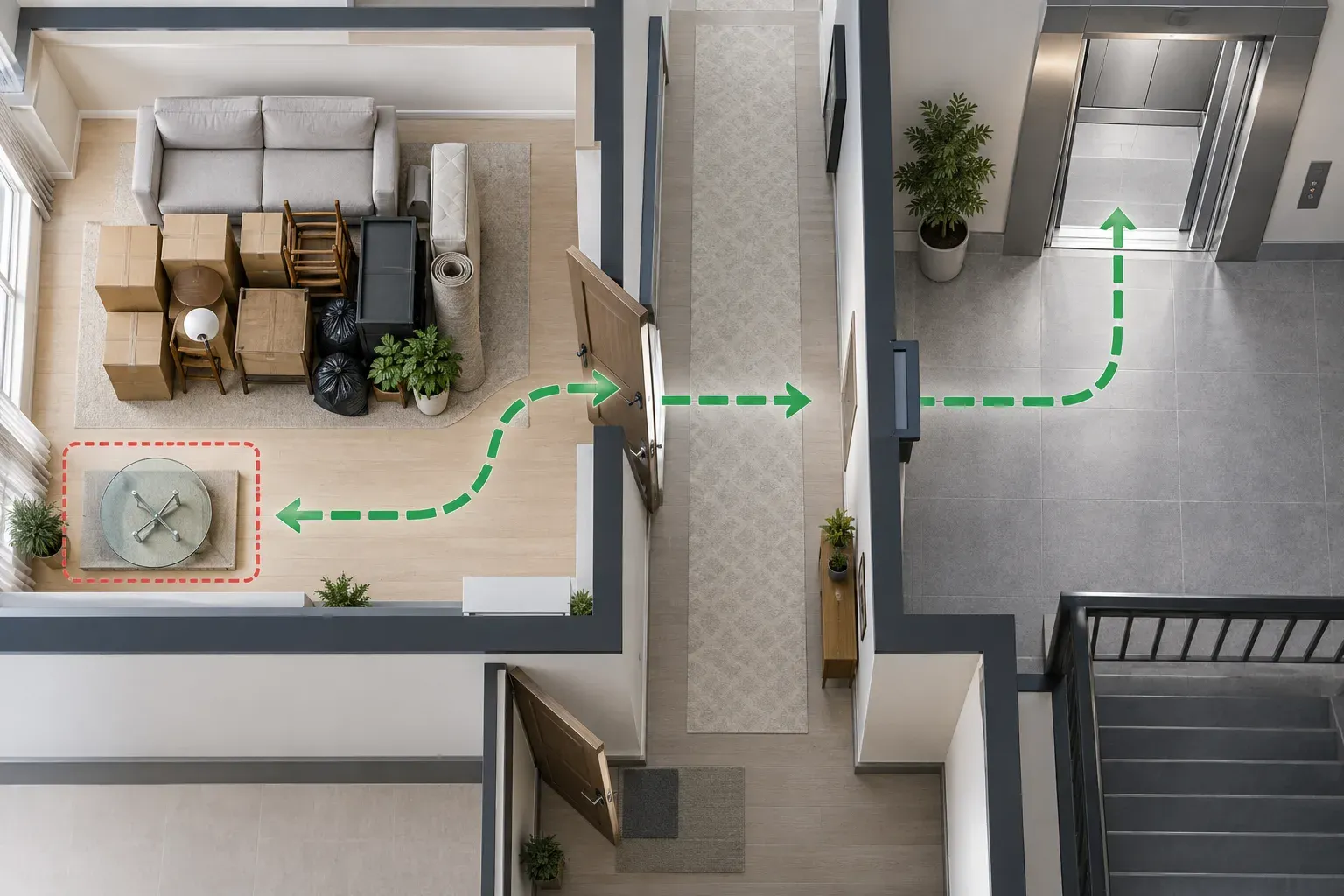
The plan shows items kept off a path to a lift. It does not show a retailer, a second vehicle, or two teams at one door. Use it as a picture of a clear route. Your own photos still have to show the piece that is leaving and the door it has to pass. The drawing is not a measurement of your corridor.
A balcony door, a bathroom door and the front door are three different widths. The piece leaves by the front door or by the service door the building has named, not by whichever door is closest to the sofa. If you have not been told which door a delivery may use, ask before you measure the wrong one. Write the answer as you received it.
Chairs, a coffee table and a pile of bags are part of the route when they stand in it. Move them before you measure, or measure with them in place and accept the narrower figure. A width taken in an emptied doorway, when the doorway will not be empty, is the wrong width.
One lift slot at a time
Where a building has a goods lift, a loading entrance or a written time for moves, the booking of that slot is how a lift slot is booked. Use that page for the request itself. Use this page for the fact that two visits want the same slot.
Ask the building, in the words they use, whether the outgoing piece and the incoming delivery need separate permissions. A yes for the delivery is not a yes for the collection until someone has said so. Send both descriptions: what is leaving, what is arriving, and the order you want. If the building allows only one booking in the window you were offered, choose the removal first and move the delivery, or move the removal earlier. Do not book one label and hope the second van is waved through.
This page does not say what towers require. Buildings differ, and a rule you were given for one address is not a rule for the next. If you have been given no instruction, write “no lift instruction yet” and ask before the day. Finding out at the barrier, with both vehicles arriving, is the clash with both vans already there. You still do not invent the building’s answer to fill the gap.
Protection of doors and lift walls, if the building has asked for it, belongs in the lift note. Do not promise padding you have not arranged. Tell each team what the building actually said, including that you have no written note.
If there is no goods lift, say that too. Stairs, landings and a turn at the half-landing are then the route, for the old piece and for the packaged new one. A delivery team and a removal visit cannot pass on a narrow stair. The sequence matters more, not less. Name the stair in both messages so neither team arrives equipped only for a lift.
A villa gate or a podium barrier is the same kind of fact. If a code, a time or a bay number was issued for one vehicle, ask whether the second vehicle is included. Write the answer beside the code. A code that works for the delivery van and not for the removal is two arrivals, not one.
What stays off the route
The room has to lose the old piece without gaining a new obstacle. Leave the rug rolled, the coffee table out of the path, and the new layout unmarked until the delivery is inside. Small pieces of tape on a floor can wait. A bookcase you dragged into the doorway “to make space for the new one” is now the thing the old wardrobe cannot pass.
Group items you are keeping where the leaving photo does not include them, or label that corner in the message. A wide photo of a full room will be read as a full room leaving. If only the wardrobe is leaving, the bed you are keeping should not look like part of the load. Move it aside if you can do so without blocking the door. If you cannot, say “bed stays” in the note and point at it on the day.
Children’s kit, a laundry pile and packed suitcases are route blockers when they sit in the hall. They are not furniture, and they are not the delivery. Clear them before either visit. A hallway that is your temporary store will be used by both teams as if it were empty, unless you have made it empty.
Protective wrapping on the old piece comes off only if the people carrying it ask for that, or if you already know it will not pass while wrapped. Wrapping you add in the hope of protecting a wall can add width. Do not add a layer and then claim the old measurement.
The new piece’s packaging is not in the room yet. Plan a place for it that is not the doorway, and decide before the day whether empty cartons are leaving with someone or staying for you to flatten. If the delivery leaves a stack of cartons in the corridor, the blockage you just removed is back. If those cartons are the next problem, the plan for delivery cartons in a lived-in flat is that pile. It is not this clash.
Book only the pieces that are blocking the door
Move the old furniture before the delivery when the pieces are yours to send and the route will be clear of the new delivery. This is a furniture collection of the pieces you named. It is not a clearance of the whole home, and it is not a promise about the retailer’s van.
In the message, say:
- the old pieces by name, and that they are still in the room
- what the delivery is, and the time you were given for it
- that you want the old pieces gone before that time
- whether the retailer is also supposed to take anything, in their words, or “not stated”
- the door, the stair or the lift note, including “no lift instruction yet”
- what is staying, and where you have put it
- whether anything must come apart, or that you have left it whole
- a phone number for the person who will be at the door
Do not write “furniture before delivery” as the only line. Name the wardrobe, the bed, the table. A delivery time without the piece that blocks the door is half the job.
Send the photos from the bulky-piece method: the whole piece, the tight point, and the path with the staying items out of it or labelled. Add the retailer’s line about the old item, even if that line is “they did not mention it”.
If the piece is still fixed to a wall, or you are not sure it is free, say so and do not book it as a loose item. A bookcase that is screwed to a rail is a fixing question before it is a carrying question. This page does not remove fixings the building or a landlord has not released.
If the delivery is today and you have not confirmed a removal time that finishes first, you are early for one of the two visits. Change one time. A collection and a delivery that share an hour are the situation this page is trying to stop, not a plan.
The sofa guide remains the sofa-for-sofa exchange. The bulky-piece page remains how you photograph one object. The lift page remains the slot. The dismantling page remains the decision to take a piece apart.
If the new piece arrives too early
Stop the two teams at the door. Do not ask them to pass each other in the doorway, on the stair or in the lift with both pieces in motion. Tell the delivery the room is not clear. Ask whether they can wait or return. Do not invent a yes, and do not tell the removal visit to hurry past a wrapped item they cannot see around.
Do not drag the old piece into a corridor, a lobby or a parking bay to “make space” unless the building has said that place may hold it. If you have not been told, the piece stays in the room until it leaves with the visit that is booked to take it. A wardrobe in a fire route is a new problem, not a solution.
If the delivery team unloads before you have stopped them, the packaging and the new piece need a place that is not the old piece’s exit. That place should be inside the home only if it does not block the door you still need. If there is no such place, the honest request is that the new piece goes back on the vehicle until the route is clear. Whether the retailer agrees is their decision. Your decision is not to stack the new carton in the only doorway.
Tell the building if a slot is now being used differently from the note they approved. A delivery that arrived during a removal window, or the other way around, is a change. Report it rather than hoping the desk does not notice two vans.
When the overlap has been stopped, reset the order in writing to both teams. One sentence is enough: which visit is next, which door, and that the other visit waits until the route is clear. Keep that sentence. It is the record if the same clash starts again an hour later.
A person who came only to sign for the new furniture should not start unscrewing the old piece because the van is idling. Tools come out when the removal visit, the owner and the building note agree. An idling van is not that agreement.
After the old piece has gone
Walk the route the delivery will use, including the lift or the stair, before you tell the retailer the path is clear. Look for a screw, a foot, a strip of packaging or a rug you rolled and then left in the turn. The old piece leaving the room is not the same as the route being open down to the vehicle.
Keep the staying items where they were. Do not drag the bed back into the doorway because the wardrobe has gone and you want the room to look normal. Normal can wait until the new piece is inside and the packaging has a place that is not the exit.
Meet the delivery at the door you named. Point at the space, not at a different room. Check the new piece against the note before you sign: the item, the number of cartons if they listed them, and whether the path they used is the path that was approved. A dispute about damage or a missing part is for the retailer’s own process. It is not a reason to block the corridor with an opened crate while you decide.
If the delivery leaves cartons, move them to the place you chose before the day. Do not leave them in the lobby because the room feels full. The lobby was not the plan unless the building said it could be.
If the old piece still could not leave, tell the retailer before their next attempt, and tell the building if a slot was used or missed. The room is then still this job. Book the removal again with the same photos, updated, rather than describing the home as clear.
The fact that makes the day work is the order: the named old piece out, the route walked, then the delivery in. Two teams and one unspoken doorway will not produce that order on their own.