A standing desk in a home office is one piece of furniture in a room someone lives in. It leaves when the top is clear, the frame is free of the wall, and the note names that one desk. It is not a workplace floor, and it is not a computer.
A booking that says “the office” will be read as several desks, chairs and a fit-out. If the object is a single standing desk in a flat or a villa, the note has to say that before anyone plans a crew, a dismantling job or a loading bay.
One desk, in a home
Walk into the room and count the desks that are leaving. This page is the case of one. A second table, a dining table used as a desk, or a run of benching is a different list. Write “one standing desk” only when you can point at one top and one frame.
The room can be a spare bedroom, a corner of a living room, or a study. The building can be a tower or a villa. Those facts belong in the route, not in a new name for the desk. Do not retitle the job as an office clearance because the room contains a monitor.
A workplace inventory, with asset numbers, a floor of workstations and a facilities approval, is the office desk guide. Stay on that page when more than one workstation is being released, or when the desk belongs to an employer’s floor. Do not copy that checklist onto a home and do not hide a home desk inside the word “office”.
If the desk belongs to a landlord, a furnished let, or a company that has not released it, leave it in place. A key to the flat does not decide a leased piece. If a sticker or a lease line names the desk, photograph it and write “ownership not confirmed”. This page does not interpret a tenancy.
Clear the top before you measure
Take everything off the top. A monitor, a laptop, a lamp, a notebook, a headset and a mug are not the desk. Put what is staying on a surface you are keeping. Put what is leaving in its own group, with its own name.
A computer, a screen and a printer are electronics. They need their own line. The IT equipment guide is a commercial floor of machines, drives and a loading arrangement. Use it when the desk is one item in that floor. For a home, name the screen and the computer in the same message as the desk, and say whether each one is staying or leaving. Do not call the desk “IT” because a monitor was clamped to it.
Unplug the screen and the computer from the sockets you can see. Coil the leads you are sending with those machines, or bag them and label the bag. A lead that still runs to a router you are keeping stays with the router. Follow a cable to both ends before you pack it.
A computer keyboard and a mouse are peripherals. They are not this desk, and they are not a musical keyboard. Bag them with the computer if that computer is leaving. Leave them on the desk you are keeping if only the standing desk is going.
Open any drawer, tray or modesty shelf. Paper, a passport, a spare key, medicine and a bank card come out. A drawer you have not opened is not empty. If a drawer is locked and you have no key, write “drawer locked” and do not force the lock.
Look under the top for a keyboard tray, a cable basket or a power strip clipped to the frame. A power strip is its own small object. Unplug it from the wall if the plug is visible, and say whether it is leaving. Do not cut the strip’s lead to make the frame look tidy.
An anti-fatigue mat, a chair and a waste bin are not the desk. Move them out of the photograph or name them as separate lines. A chair that is also leaving is a second piece of furniture.
Leave the lifting mechanism alone
Say how the top changes height, in ordinary words. A handle you turn. Buttons on a small pad. A lever. A fixed top that never moved, sitting on a frame that only looks like a standing desk. Photograph the control or the handle. You do not need the brand’s manual, and you do not need to diagnose an error code.
If the top moves by the control you already use, you may leave it at a height that lets you see the feet and the door. If the control does nothing, write “will not lower” and leave the height where it is. Do not open a leg, a motor housing or a control box to find out why. Do not release a strut, a spring or a pin inside a column. Those parts are not loose accessories.
Do not cut a cable that runs into a leg. If a lead from the control goes into the frame and you cannot see a plug, say “cable enters the leg”. Unplug only a plug you can see at a wall socket. If the supply disappears into the floor, the skirting or the wall with no plug, stop and write “no plug visible”. That desk is not ready.
A riser, a shelf or a small platform that sits on an ordinary table is not this page until you have separated it from the table. Lift off only what is already loose. If it is screwed to the table, say so and do not treat the pair as one standing desk. The table, if it is leaving, is its own line.
A desk that was a normal table and now has a frame under it needs both parts named. Photograph the joint. If you cannot see how the top is held, do not prise it off with a tool. The dismantling guide is the decision about whether any furniture should come apart. It is not the default for a desk that still stands as one frame. Do not saw the top, a foot or a column so the desk will fit a door.
Feet, a crossbar and a fixing
Look at the feet and the back. A freestanding desk stands on its own feet or its own base. It is not screwed to the wall, not bolted to the floor, and not built into a cupboard. If you can see a screw into the wall, a bracket, or a foot plate with bolts into the floor, stop. Write what you see. That desk stays until whoever is allowed to release the fixing has released it.
“Against the wall” is not the same as “fixed”. A desk can touch the wall and still be free. Look behind the top and behind each foot. A cable hole in the wall is not a fixing of the desk, but a cable that passes through it might be. Do not pull the desk off a cable you have not traced.
Name the feet. Two T-shaped feet, a single central foot, or a frame with four corners. Say if a foot is bent, cracked or missing its pad. A bent foot changes how the desk stands while it waits. Do not park it where a slope or a loose rug can start it moving.
A crossbar, a cable spine and a modesty panel count in the width and the height. Measure to the outside of those parts. A panel you can lift off without a tool can come off if you bag the fasteners with the desk and say you have done so. If it is riveted or you cannot see the fastener, leave it on.
A monitor arm clamped to the top is not part of the top until you decide. If the arm comes off by the clamp you can see, take it off, put the screen somewhere safe, and bag the clamp with the screen or with the desk, labelled. If the arm is bolted through the top and you would have to open the top to release it, leave it and write “arm still fitted”. Do not drill, and do not stand on the desk to reach a wall mount. A screen that is on the wall, not on the desk, stays on the wall. This page does not take brackets out of plaster.
Glass in the top, if there is any, stays in the top unless it is already loose. Do not tap it. Say “glass in the top” or “no glass” so the carry is not a surprise.
Measure the desk you actually have
Measure the top at its widest and its deepest, including a grommet cover, a handle and any overhang. Measure the height as it stands now, from the floor to the highest point, including an arm you left on. Then measure the room door and the next door the desk has to pass, width and height, with the door open as it will be on the day.
Write both sets of numbers in the same note. A desk that fits the study door can still fail at the flat’s front door or at a stair turn. Walk the route once with the top clear. Name a rug, a threshold, a sill and a turn. You do not have to build a ramp. You do have to mention the step.
If you do not yet know which lift, stair or villa door the building will let you use, write “no lift instruction yet”. Do not assume a service lift because the building is a tower, and do not assume the stairs are acceptable because the top looks narrow on its side. Copy any instruction you have been given. Do not turn one building’s rule into a rule for the next building.
A desktop that is two pieces, or a return that makes an L, is wider than the main top. Measure the L as it is, or separate the return only if it is already a second top held by a fitting you can undo and bag. If you are not sure, leave it joined and measure the joined shape.
Weight in kilograms is not required. A thick top, a stone-look top, or a top that needs two people to slide on a trolley in the room is a description: “thick top” or “top does not slide easily”. Photograph the edge so the thickness shows.
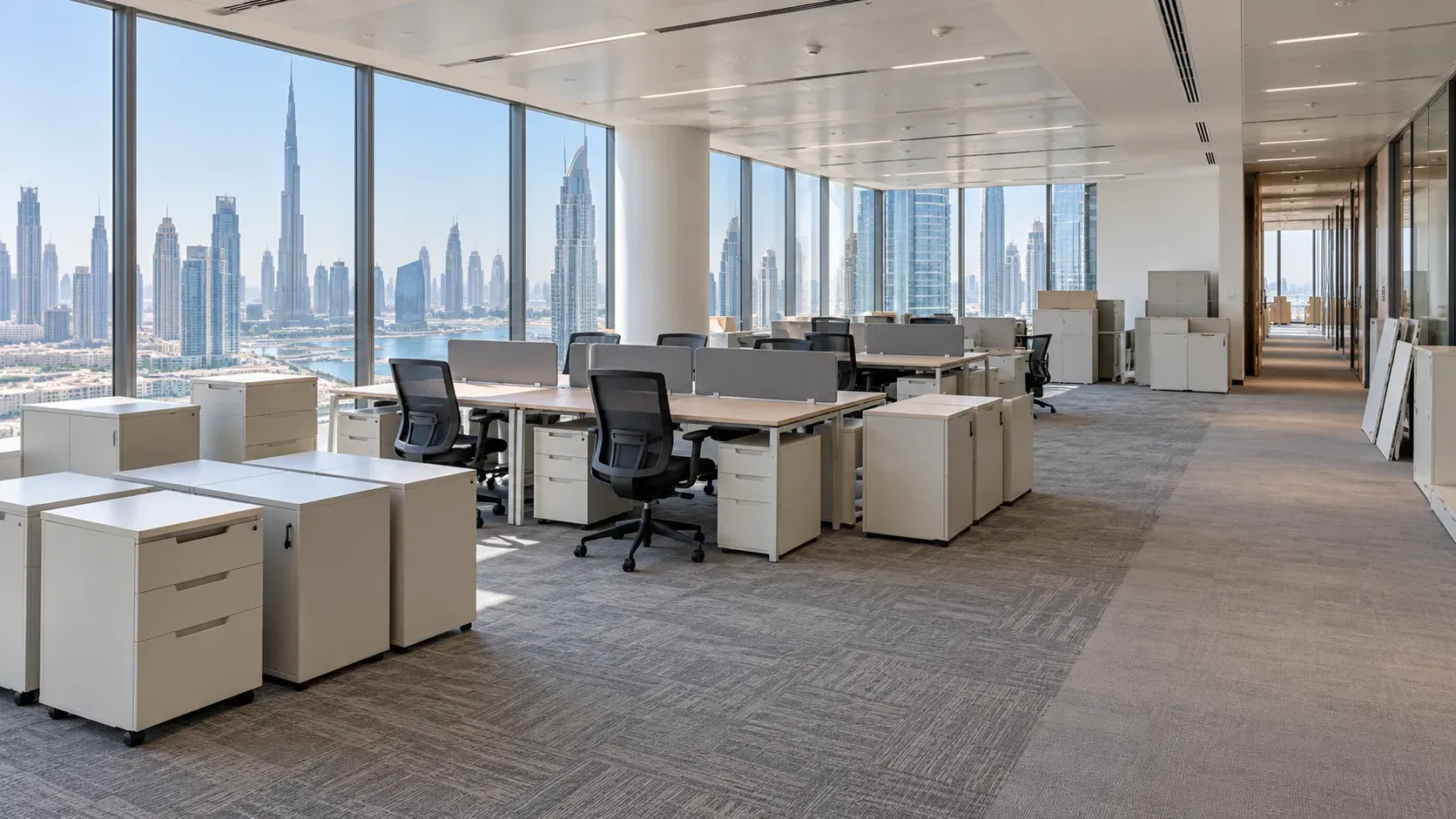
The picture is a workplace floor of desks, chairs and cabinets. It is not a home, and it does not show a lifting column, a hand crank or a single desk in a spare room. Use it only as a reminder that a floor of workstations is a different job. Your own photos still have to show this one desk from the side, with the top clear.
What else is in that room
A bookshelf, a filing cabinet and a sofa bed in the same room are not the desk. Name them or leave them out. A whole-home inventory is a different plan. This note stays with the one desk.
Cables you are not sending should be off the frame before the photo. A tangle left in the cable basket will be read as part of the desk. If a basket is full and you have not sorted it, say “basket not sorted” and do not book the desk as clear.
A printer on a side shelf is the printer’s own preparation. Do not hide it in the desk. Paper and a cartridge belong with the printer, not in a desk drawer you then call empty.
If the floor is marked by the feet, the marks are not repaired by this collection. Photograph them if you need a record. The booking is the desk.
Do not start unscrewing a wardrobe or a fitted cupboard to widen the gap. Those pieces are not this desk. Making space by damaging another item is not preparation.
Photograph the clear desk
Send four photos.
The first is the whole desk from the side, including the feet and the top, with the surface empty so the frame is visible.
The second is the back or the side that faces the wall, so a screw, a bracket or a clean gap can be seen.
The third is the control or the handle, and any cable that enters a leg or a wall. Include the plug at the socket if there is one, or the place where a plug is missing.
The fourth is the doorway and the next tight point, with the numbers in the message.
Add whether a drawer is locked, whether an arm is still fitted, and whether the top will not lower. Add the sentence that the screen and the computer are not part of this visit, or name them as separate lines if they are.
If the desk is still screwed to the wall or the floor, send the photo of the fixing and do not ask for a collection time. A time booked against a fixed piece is a visit that cannot lift it.
Take the photos with the room light on. A dark gap behind the top hides the fixing you need to show is absent.
Book the desk with the furniture
Furniture removal for the desk is the booking when the desk is free, clear and yours to send. This is one desk in a home. It is not a workplace strip-out, and it is not a promise that a motor will be opened.
In the message, say:
- that the item is one standing desk in a home, and what the top is
- how it changes height, and whether it will move by the ordinary control
- that you have not opened a leg, a motor or a control box
- that the top and any drawer are empty, or what is still locked
- any screen, computer, printer or chair, and whether each is staying or is a separate line
- that it is not fixed to the wall or the floor, or the reason it still is
- the three measurements and the door it has to pass
- any step, sill or turn
- any lift note, or “no lift instruction yet”
Do not write “office desk and bits” as the only line. Name the desk. A cable you have not traced is not a cleared frame.
If the whole flat is leaving, the desk remains one prepared line inside that larger list. Do not send two descriptions that disagree about whether the screen is included.
If you have not looked behind the top, you are early. Look first. A collection booked from a front-on photo cannot see a bracket or a cable into the wall.
The office-desk page remains a workplace. The dismantling page remains the decision about taking furniture apart. The IT page remains a commercial floor of machines.
On the morning it leaves
Leave the desk where the photos showed it, top clear, path clear, plug already dealt with in the way you wrote. Do not put the monitor back overnight because the room looked bare. Do not reload the drawer with paper.
Point at the screen, the computer and the chair if they are staying. Point at them as separate lines if they are leaving, so they are not lifted as part of the frame. Point at a loose panel or a bag of clamps if you set one aside.
Walk once to the door with the width in mind. A chair you moved and then put back is the new narrow point. A rug you meant to lift will catch a foot. Lift it before anyone moves the desk.
If the desk will not pass, stop. Do not tip it onto a foot through a door you have not measured for that tilt, and do not take a saw to the top on the landing. Bring it back into the room and update the note. The measurements you took are the record. A harder push is not a new measurement.
When it has gone, look at the wall. A screw you were not releasing should still be in the wall, not in a pocket. The floor should have the desk gone and the mat where you said it would stay.
The useful record is the sentence from the first check: one standing desk, in a home, top clear, mechanism unopened, and free of the wall.