A musical keyboard and a small amplifier are two objects. They leave when both are unplugged, the keyboard is off its stand or the stand is named, and the amplifier case is still closed. This page is that pair. It is not a piano, and it is not a computer keyboard.
A booking that says “the music stuff” will be read as a room of instruments. If the objects are one keyboard and one small amplifier, the note has to say so before anyone plans a carry, a cable sack or a project load.
Two items, named separately
Write two lines: keyboard, and amplifier. Under the keyboard, say how many manuals you can see, whether it is still on a stand, and what else was attached. Under the amplifier, say that it is one small unit, whether it is a combo with the speaker in the same box, and that you have not opened it.
One line that says “keyboard and amp” without those facts is incomplete. Same visit is not same object. The person looking at the photos needs a keyboard and a closed amplifier, not a dark corner of a room.
A piano is not this page. Do not describe a piano, an upright, or a keyboard that is built into a piano cabinet as this job. This note does not confirm or refuse a piano. It stops a piano being booked under the wrong name.
A computer keyboard that sits with a mouse and a monitor is a peripheral, not a musical instrument. It belongs with the computer. Do not use this page for it, and do not put a computer keyboard in the amplifier’s cable bag to save a decision.
A drum kit, a guitar, a mixer and a set of speakers are other objects. A drum kit has its own count of shells, stands and the lift. The drum-kit note is that kit. A guitar stays a separate line and does not get a guide here. If one of them is also leaving, give it its own line. This page does not become a band clear-out because the keyboard was in the same room. If the only things leaving are this keyboard and this amplifier, say that, so a third instrument is not assumed.
Unplug, and do not open the case
Find the plug for the keyboard and the plug for the amplifier. Unplug each one from the wall socket you can see. Coil that power lead and tape it to the object it belongs to, or bag it in a pouch labelled “keyboard power” or “amplifier power”. A power lead in a general tangle cannot be matched to the unit later.
If you cannot see a plug, and the lead disappears into a floor box, a skirting board or a wall, stop. Write “no plug visible” on that item. Do not cut the lead. Do not open a socket to release it.
Leave the amplifier closed. Do not remove the back panel, the speaker, or the screws around the grille. Do not look inside for a reason to make it lighter. A closed box is the item. An opened box is a different and unsafe object, and this page will not tell you how to open it.
Leave the keyboard’s own case closed as well. Do not lift the keybed, remove a panel under the keys, or split the keyboard into the keys and the works. If a hatch for batteries is designed to open by hand, that hatch is the exception below. Leave the other covers on.
If the amplifier was warm, let it stand unplugged before you move it into a cupboard for the night. You do not need a time in minutes from this page. You do need it off, unplugged, and not wrapped while it is still hot to the touch. If it is too hot to rest a hand near the vent, leave it and write “still hot”.
A smell of burning, a melted plug, or a lead with exposed wire is a stop. Photograph it from a safe distance, keep the item unplugged, and say so in the note. Do not tape over damaged insulation and call the lead sorted.
The stand, the pedals and the bench
A stand is not the keyboard. An X-stand, a Z-stand or a table the keyboard sits on is a second or third line. If the keyboard lifts off the stand, lift it off and set it flat on a surface that can hold it, keys up, where it cannot slide. Measure the keyboard on its own once it is off the stand. Measure the stand folded only if it folds by the hinges you can see without forcing a joint.
If you cannot see how the keyboard is fixed to the stand, leave it on the stand and measure the pair. Write “still on the stand”. Do not saw a tube to make the stand shorter.
A sustain pedal, a swell pedal and a short lead between the pedal and the keyboard are small parts. Unplug the pedal lead from the keyboard if it pulls out by the plug. Coil it with the pedal. Bag them and label the bag “with the keyboard” if they are leaving with it. A pedal left on the floor will be missed, or it will be crushed in a sack of other leads.
A bench, a stool and a music stand are not the keyboard and not the amplifier. If they are leaving, name them. If they are staying, move them out of the photo. Sheet music, a folder and a pencil pot are paper and small items. They do not go inside the amplifier to keep them together. The amplifier is not a box for paper.
Headphones can stay with the keyboard if you bag them and say so, or they can stay in the room. A loose headphone lead across the keys will be read as part of a tangle. Choose one.
Cables that are not the power lead
Instrument leads, the short leads between keyboard and amplifier, and spare leads in a drawer are a list of their own. Unplug them at the plugs. Coil each one. A knot is not a count.
Sort three ways, where you can point at them.
The first is leaving with the keyboard: the lead that ran from the keyboard to the amplifier, and any pedal lead you have already bagged.
The second is leaving but is not either instrument: spare leads, a charger for a device you no longer have, an adaptor. Keep this coil in its own bag.
The third is staying: a lead that still runs to a router, a television or a speaker you are keeping. Follow both ends before you pack. If one end is a device that stays, the lead stays.
A power strip under the stand is the same kind of decision. Unplug it if the wall plug is visible, and say whether the strip is leaving. Do not cut it off the stand.
Do not put these leads into a black sack with kitchen rubbish, and do not put them into a bag of tiles, offcuts or packaging from a refit. If the keyboard happens to be standing in a pile of that kind, lift the keyboard, the amplifier and the labelled bags out of the pile before you photograph them. A renovation or site load is a different page. It is not the owner of this pair. Mixing the two is how a keyboard is quoted as rubble, or how a small amplifier is buried under offcuts.
Batteries, a memory and a bag
Some keyboards take batteries in a hatch you can open by hand. If you can open that hatch without a tool, take the cells out, bag them, and keep the bag out of the amplifier and out of a sack of mixed waste. If the hatch will not open, or the battery is built in and you cannot see a hatch, leave it and write “battery not removed”. Do not prise a panel. Do not puncture a cell. Do not tape loose cells to the keys.
If a battery looks swollen, leaked or hot, stop. Leave it in place if it is already inside, or set a loose cell on a hard surface away from other items if it is already out, and say so. Do not put it in a pocket or in the cable bag.
If the keyboard stores songs or settings and you still want them, copy them by the method you already know while it still has power, before you unplug it for the last time. This page does not wipe a memory and does not promise that anything stored on the keyboard is gone. Unplugging is not a certificate.
A soft case or a hard case is useful only if the keyboard already fits it and you can close it without forcing the keys. If the case is split, say the case is split and do not rely on it as the only protection in the note. A case is not a reason to hide the width. Measure the keyboard or the closed case, and say which one you measured.
Papers, a dongle and a small drive in a pocket of the case come out. Look. A pocket you have not opened is not empty.
The amplifier is the small one
Say why you are calling it small, in words a person can check. One box you can point at. A handle on the top. The speaker still behind the grille, not a separate cabinet you have unscrewed. If there is a second speaker cabinet, a mixer, or a rack of units, those are extra lines. Do not let “small amplifier” cover a stack.
Photograph the front and the back without moving controls for the sake of the photo. Knobs can stay where they are. You do not need to set them to zero for this page. You do need the back, so a plugged lead or a damaged socket can be seen.
If the amplifier is fixed to a shelf, a wall bracket or the inside of a cupboard, it is not ready. Write “fixed” and do not unscrew a wall bracket out of plaster as part of this note. A bracket that is already loose, with the amplifier already free, can be named as its own small piece of metal if it is leaving.
Do not tip the amplifier to drain it. There is nothing in this job that you should pour out. Do not open a valve cover, a fuse holder or a battery compartment you need a tool to reach.
A home-theatre receiver, a soundbar and a set of surround speakers are not this amplifier. They can leave on another line if you have decided that, and the routes for electronics are a different explanation. The e-waste guide is where those routes are described. This page does not add a rule about where a keyboard must go. It prepares two objects so a collection from the room is not a guess.
Measure, then photograph the route
Measure the keyboard at its widest, its deepest and its tallest, including knobs on the back and any stand you left attached. Measure the amplifier the same way, including the handle. Then measure the door they have to pass.
Write both sets of numbers. A keyboard that is wide and flat fails a different part of a door from a boxy amplifier. Name a turn, a sill and a stair. You do not have to know which lift the building will allow. If you have no instruction, write “no lift instruction yet”. If you have an instruction, copy it. Do not assume a service lift because the building is a tower.
The photo-and-route habit for one bulky object is the bulky-item guide. Use it when you need the general method. Come back here for the keyboard and the amplifier themselves. Do not let that guide’s list replace the two lines this page asks for.
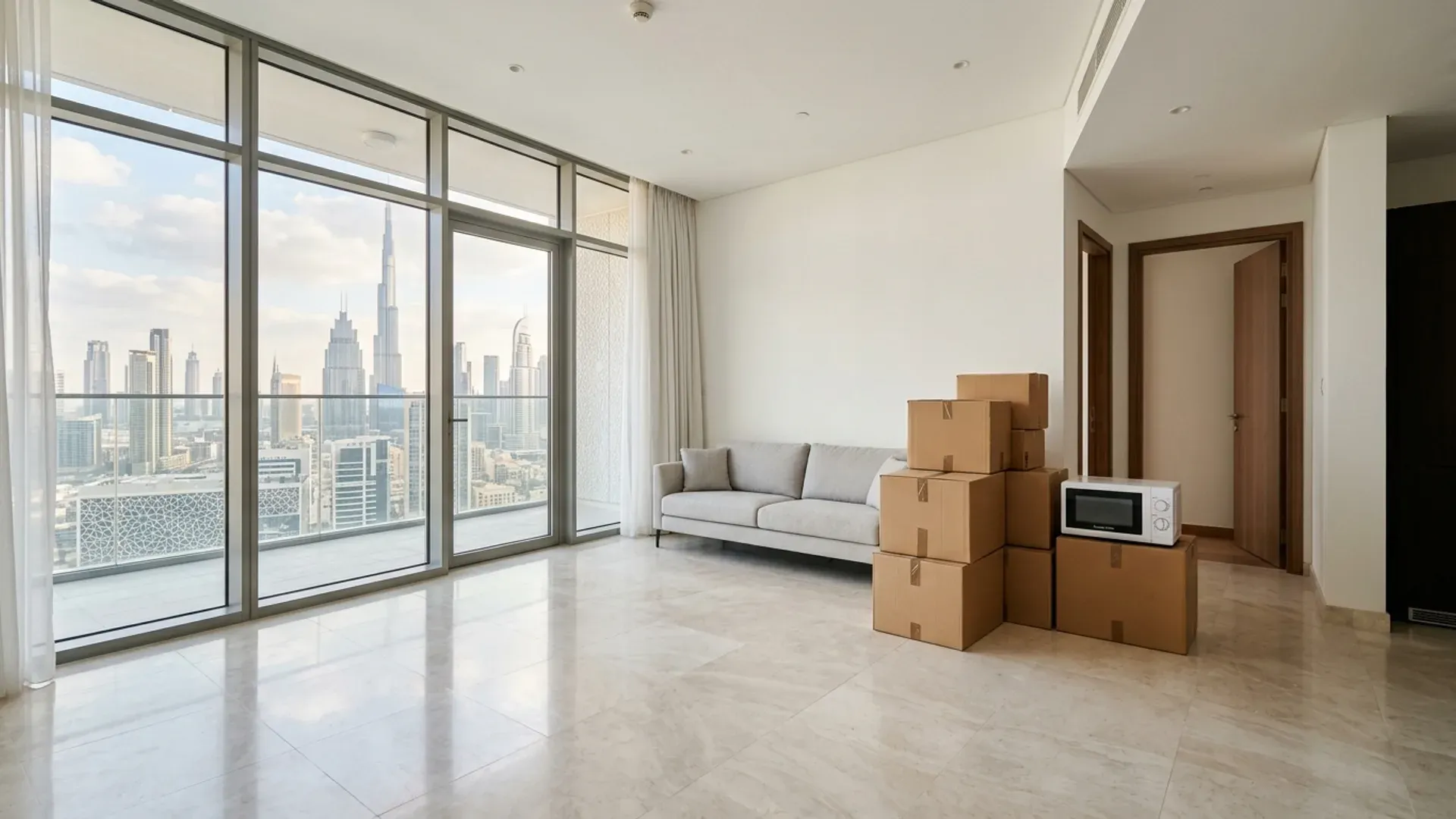
The picture is a sofa, boxes and an appliance by a doorway. It is not a musical keyboard, and it does not show an amplifier, a stand or a pedal. Use it only as a picture of a home doorway kept clear. Your own photos still have to show the keyboard and the amplifier as two objects.
Send five photos.
The first is the keyboard from above, keys visible, with nothing resting on the keys.
The second is the keyboard from the back or the end, so the width and any socket still holding a lead can be seen.
The third is the amplifier, front and back, case closed, power lead coiled with it or visibly bagged.
The fourth is the stand, the pedal bag and any other line, separate from the two main objects, or a sentence that those parts are staying.
The fifth is the doorway and the next tight point, with the numbers in the message.
Add whether a battery came out, whether the keyboard is still on the stand, and whether either item had no visible plug. Add that a piano is not included.
If either item is still fixed to the wall, send the photo of the fixing and do not ask for a collection time.
Take the photos with the room light on. A black corner behind a stand hides a second cabinet.
Book the pair as the items they are
A pickup for the music gear is the booking when both items are unplugged, named and yours to send. This is one keyboard and one small amplifier. It is not a workplace clearance, and it is not a renovation load.
In the message, say:
- that the items are one musical keyboard and one small amplifier
- that neither case has been opened, apart from a battery hatch you could open by hand
- whether the keyboard is off the stand, and what the stand is doing
- where the power leads are
- any pedal, bench, music stand or extra instrument, and whether it is staying or is a separate line
- that a computer keyboard, a piano and a drum kit are not included
- the measurements and the door
- any step or turn
- any lift note, or “no lift instruction yet”
- any battery you removed, or “battery not removed”
Do not write “music stuff” as the only line. A lead you have not followed is not a cleared pair.
If a larger pile of rubbish is leaving on the same visit, keep this pair out of that pile in the photos. The pile can be named. It should not hide the keyboard.
If you have not looked at the back of the amplifier, you are early. Look first. A collection booked from a front-on photo of the keys cannot see a lead still plugged into the amp.
The e-waste page remains the routes. The bulky-item page remains the general photo method. The waste page remains a project or site load.
On the morning they leave
Leave both items where the photos showed them. Do not stand the amplifier on the keyboard overnight. Do not put the stand back under the keys if you had lifted the keyboard off, unless you update the note and the measurements.
Point at what is staying: a guitar, a mixer, a television, a lead you traced to a router. Point at the pedal bag so it is not left on the floor. Point at a battery bag if you made one, so it is not thrown into a sack of other things.
Walk once to the door with the keyboard’s width in mind. A stool you moved and then put back is the new narrow point. A rug will catch a stand foot. Lift it before anyone carries the keyboard.
If the keyboard will not pass, stop. Do not turn it onto its keys to shorten the height, and do not remove the stand with a saw on the landing. Bring it back into the room and update the note. The measurements you took are the record.
When they have gone, look at the sockets. A lead you said was staying should still be there. The wall bracket you were not releasing should still be in the wall. The floor should have the stand gone only if you said the stand was leaving.
The useful record is the sentence from the first check: one musical keyboard, one small amplifier, both unplugged, case closed, and named apart from everything else in the room.