A freestanding kitchen trolley is a piece of furniture on wheels. It leaves only when nothing is fixed to it, the drawers are empty, and it is clear of the oven, the hood and the fitted cabinets. It is not a kitchen, and it is not an appliance.
A booking that says “the kitchen” will be read as units, a worktop and a cooker. If the object is a trolley, the note has to say trolley before anyone plans tools, a disconnection or a route.
Prove it is freestanding
Look at the back and both sides. A freestanding trolley stands on its own wheels or its own feet. It is not screwed to the wall, not trapped under a worktop, and not plumbed in. If you can see a screw into the wall, a bracket, a pipe or a cable that disappears into the carcass, stop. That object is not this page until the fixing is released by someone who is allowed to release it.
“On wheels” is not the same as “free”. A trolley can be on castors and still be tied to a shelf, a tall unit or a breakfast bar. Follow each side with your hand only as far as you can see. If a panel continues into a run of units, it is part of that run. Leave it. Fitted cabinets, a worktop and a splashback are not collected by calling them a trolley.
Write what you see: “metal trolley, four castors, no screw to the wall, stands in the gap beside the fridge” or “wood trolley, two drawers, handle on the short side, clear of the units on both sides”. If you cannot write a sentence like that, you have not checked the back.
If the trolley belongs to the landlord, or to a kitchen company that has not released it, leave it in place. A key to the flat does not decide a fitted or a leased piece. This page does not interpret a snagging list. If you are unsure, write “ownership not confirmed” and keep the trolley out of the booking.
The rest of the apartment, if the whole home is being cleared, is a room-by-room inventory. That inventory is the apartment furniture plan. The trolley is one line on it. Do not stretch this note into a plan for every room, and do not hide the trolley inside the word “kitchen”.
Empty it before it rolls
Open every drawer, door and shelf. Take out knives, glass, bottles, a chopping board, a tray of spices and any food. A trolley that looks tidy can hold a drawer of blades. Those blades are not furniture. Bag them or box them only if they are leaving as their own small line, and say so. Do not leave them in a drawer for the carry.
An appliance sitting on the trolley is not the trolley. A microwave, a kettle, a toaster or a small oven on the top shelf has its own plug and its own name. Unplug it. Lift it off. If it is leaving, it is a second line. If it is staying, put it on the worktop you are keeping, not back on the trolley after the photo. A booking for a trolley that arrives with a microwave still on it is a booking for two objects and one description.
Look under the bottom shelf. A crate of bottles, a bin and a tray of cables are easy to miss, and they change the weight. Take them off. A cable you do not recognise should be followed to both ends before you pack it. If one end is the fridge you are keeping, the cable stays.
Wipe or brush out loose food. Do not book a trolley that is still full of crumbs and an open jar and call it empty. Say “drawers empty” only when you have opened them. A drawer that will not open is a fact: write “one drawer stuck” and do not force it with a tool you do not know.
A knife slot in a butcher block, a rail of hooks and a hanging rack of utensils all need the same treatment. Hooks empty. The block bare. If the top is scarred or split, say so. You do not need to sand it. You do need the person carrying it to know the top is not a smooth slab if a piece is lifting.
Wheels, a top and a handle
Say how it stands. Four castors, two castors and two feet, or no wheels at all. If the wheels roll freely, say that. A trolley that moves when it is touched is a handling fact. Do not park it on a slope, on a ramp or at the top of a stair while you take the photo.
Brakes, if it has them, should be on while it waits, and you should say whether the brakes work. A brake that does not hold is the same as no brake. Do not remove the wheels to make the trolley shorter unless they come off by a fitting you can see, and you have a bag for the bolts. Wheels you have taken off become a separate handful that has to travel with the frame. If you are not sure they are meant to come off, leave them on and measure the height with them on.
Do not saw a handle, a rail or a leg so the trolley will fit a door. If it will not pass, the next step is to say so and to look at the route, not to cut the frame in the kitchen. Whether any piece of furniture should come apart is a separate decision, made before the day, and it is not the default for a trolley that is already a single frame.
Name the top. Wood, stone, tile, steel or glass are different carries. A stone or a concrete top is the heavy part. You do not need a weight in kilograms. You need the word “stone top” or “thick wood top” in the note, and a photo of the edge so the thickness shows. If the top is loose, say it is loose and do not slide it off unless it is already separate and you can set it flat. A loose slab is its own line.
A glass shelf in the trolley comes out if it is loose, the same way any loose glass comes out of a piece of furniture before a carry. Set it flat, photograph it, and keep it with the trolley only if you have a way to stop it sliding. If it is fixed, leave it and say “glass shelf fixed”. Do not tap it to see if it will shatter into a more convenient size.
The handle and any side rail count in the width. Measure to the outside of the handle, not to the shelf. A trolley that is narrow until the handle meets the door frame is wider than the shelf measurement you were about to send.
It is not the oven
A cooker standing next to the trolley is the oven’s own job. Built-in, freestanding, electric and gas are separated on the oven page. Do not unplug a cooker, pull a built-in oven or touch a gas fitting because you are making space for the trolley. If the trolley will not come out until the cooker moves, say that, and prepare the cooker on its own page first.
If the trolley is clear, book the trolley without adding the oven to the same sentence. “Trolley and cooker” is two visits’ worth of preparation unless both have been prepared and both have been accepted. The oven page keeps the disconnection. This page keeps the empty frame on wheels.
A fridge, a dishwasher or a washing machine in the same kitchen is the same kind of split. Name it or leave it out. Do not let “kitchen” become a list you have not written.
It is not the hood
A hood above the hob is not attached to the trolley by being in the same room. The canopy, the cupboard unit and the duct are the hood page. Leave the hood where it is. Do not climb onto the trolley to reach the hood, and do not treat the trolley as a step. The top is not a platform, especially if you have just emptied it and the brakes are the only thing holding it.
If a previous fitter stood on the trolley and the top is now split, say the top is split. That is a condition note, not a reason to start removing the hood.
Filters, a chimney cover and a cable into the hood stay with the hood page. They do not go in the trolley drawer to be helpful. Close the hood’s own questions there, and come back here when the only object left in the gap is the trolley.
Measure the gap it has to leave through
Measure the trolley at its widest, its tallest and its deepest, including wheels, handle and any overhang of the top. Then measure the kitchen door and the next door it has to pass. Write both sets of numbers. A trolley that lives in an open kitchen can still fail at the flat’s front door.
Walk the route while the drawers are empty and the wheels are free to roll only as far as you can control. Check a rug, a threshold, a floor mat and a change from tile to a sill. A castor that drops off a sill can tip a stone top. If there is a sill, say so. You do not have to build a ramp. You do have to mention the step.
If a wheel is stuck or a castor is missing, say that too. A trolley with three wheels does not roll the way the photo of a straight frame suggests. Photograph the missing wheel. Do not prop the corner on a book and call it stable for the carry.
The building’s lift, stair or loading door is part of the route only if you know which one you may use. Copy any instruction you have been given. If you have none, write “no lift instruction yet”. Do not assume a service lift because the building is a tower, and do not assume the stairs are acceptable because the trolley looks narrow. Ask, and keep the answer with the measurements.
A villa door onto a step-down is the same kind of fact as a tower landing. Name the step. The trolley rolls until it reaches that step, and then it has to be carried. Say which.
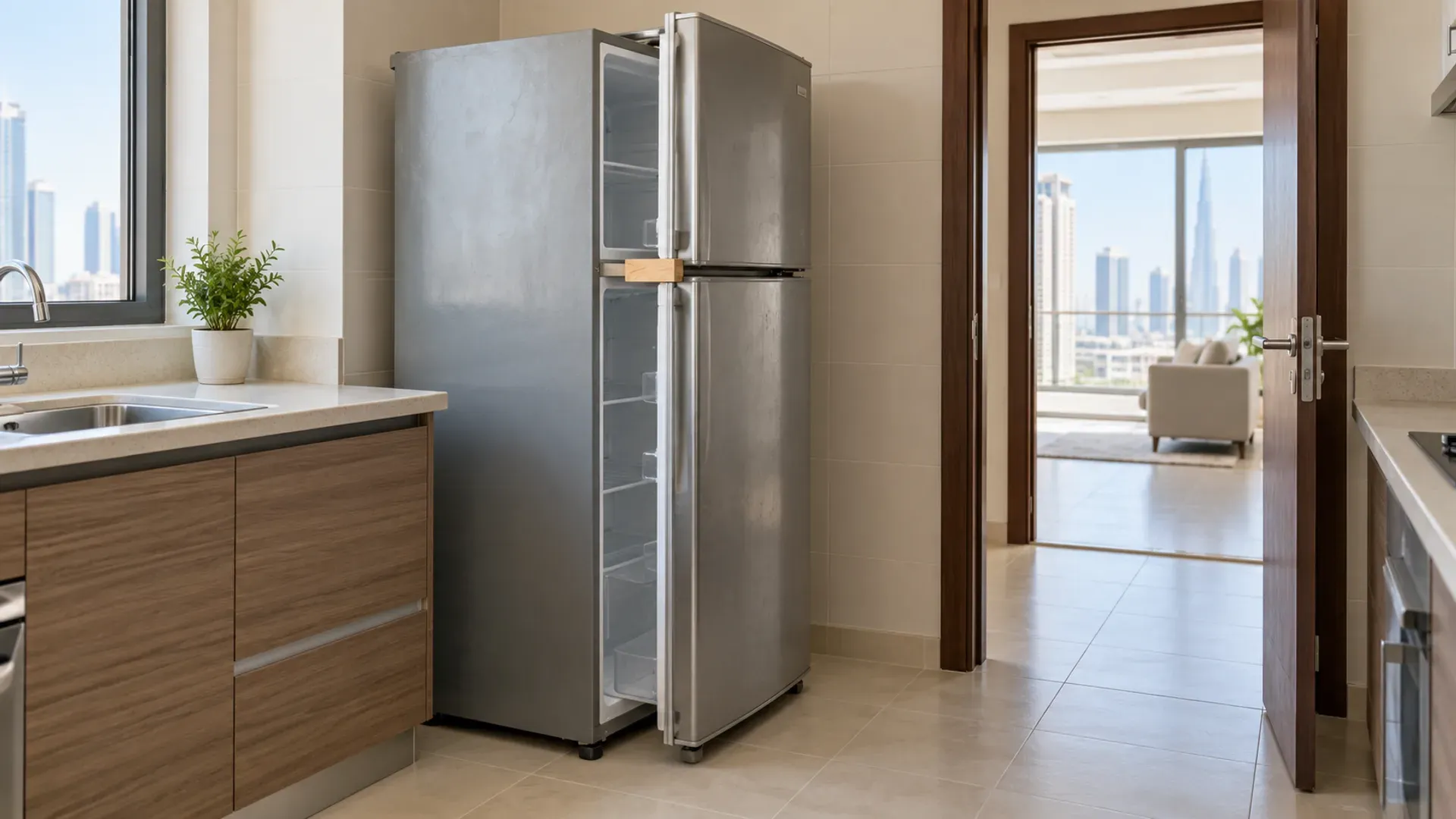
The picture is a refrigerator by a kitchen door. It is not a trolley, and it does not show wheels, a drawer or a worktop. Use it only as a picture of a kitchen doorway kept clear. Your own photos still have to show the trolley from the side, with the drawers open.
What else is in that gap
The gap a trolley stands in often holds a bin, a crate and a stack of trays. Those are not the trolley. If they are leaving, give them their own line. If they are staying, move them before you photograph the trolley, or the photo will include them.
A tall pantry unit, a breakfast bar and an island that is built to the floor are not trolleys. An island on castors, with no fixing, can be this page if you have checked the underside and the ceiling for a power feed or a bracket. Look up as well as down. A pendant you can unplug is different from a feed that goes into the top of the island. If a cable goes into the furniture and you cannot see a plug, stop and say “cable enters the top”. Do not cut it.
Shelves you added, a rail you screwed on and a butcher-block top you dropped on are part of the trolley if they will travel with it. If the top is a separate slab you are keeping, take it off only when it is already loose, and say the trolley is leaving without it. Measure what is actually leaving.
Do not start unscrewing adjacent cabinets so the trolley has a wider gap. Those cabinets are the fitted kitchen. They stay unless a different job, with its own permission, has already released them. Making a gap by damaging a unit is not preparation.
If the floor is the landlord’s and the castors have marked it, the marks are not repaired by this collection. Photograph them if you need a record. The booking is the trolley, not a promise to restore the tile.
Photograph the empty trolley
Send four photos.
The first is the whole trolley from the side, including the wheels and the handle, with a drawer open so it is obvious the drawer is empty.
The second is the back or the side that faces the units, so a screw, a bracket or a clean gap can be seen. This is the photo that shows it is freestanding.
The third is the top, including the thickness if it is stone or a thick block, and any appliance you have lifted off, now sitting somewhere that is labelled “staying” or “separate”.
The fourth is the kitchen door and the next tight point, with the numbers in the message.
Add whether the brakes work, whether a wheel is missing, and whether a drawer is stuck. Add the sentence that the oven and the hood are not part of this visit, or name them as separate lists if they are.
If the trolley is still screwed to the wall, send the photo of the screw and do not ask for a collection time. A time booked against a fixed piece is a visit that cannot lift it.
Take the photos with the room light on. A black gap beside the units hides the very fixing you need to show is absent.
Book the trolley with the furniture
Take the trolley with the furniture when it is free, empty and yours to send. This is one trolley. It is not a fitted-kitchen strip-out, and it is not an appliance disconnection.
In the message, say:
- that the item is one freestanding trolley, and what the top is
- how many wheels, and whether they turn and whether a brake holds
- that the drawers and the top are empty
- any appliance that was on it, and whether that appliance is staying or is a separate line
- that it is not fixed to the wall, or the reason it still is
- the three measurements and the door it has to pass
- any step, sill or missing wheel
- any lift note, or “no lift instruction yet”
- that the oven and the hood are not included, unless you have named them on their own pages
Do not write “kitchen trolley and bits” as the only line. Name the trolley. A drawer you have not opened is not empty.
If the whole flat is leaving, the apartment plan remains the inventory, and this trolley remains one prepared line inside it. Do not send two descriptions that disagree about whether the oven is included.
If you have not looked at the back, you are early. Look first. A collection booked from a front-on photo cannot see a bracket.
The oven page remains the cooker. The hood page remains the hood. The apartment page remains every other room.
On the morning it leaves
Leave the trolley where the photos showed it, brakes on if they work, path clear, drawers empty. Do not reload it with the bin and the bottles overnight. Do not put the microwave back because the worktop looked crowded.
Point at the oven, the hood and the cabinets that are staying. Point at any appliance that is a separate list so it is not lifted with the frame. Point at a loose glass shelf or a loose top if you set one aside.
Walk once to the door with the width in mind. A bin you moved and then put back is the new narrow point. A rug you meant to lift will stop a castor. Lift it before anyone rolls the trolley.
If the trolley will not pass, stop. Do not tip it onto two wheels through a door you have not measured for that tilt, and do not take a saw to the handle on the landing. Bring it back into the kitchen and update the note. The measurements you took are the record. A harder push is not a new measurement.
When it has gone, look at the gap. The cabinets on either side should be as they were. A screw you were not releasing should still be in the next unit, not in a pocket. The floor should have the trolley gone and the bin where you said it would stay.
The useful record is the sentence from the first check: freestanding, empty, and clear of the oven and the hood.