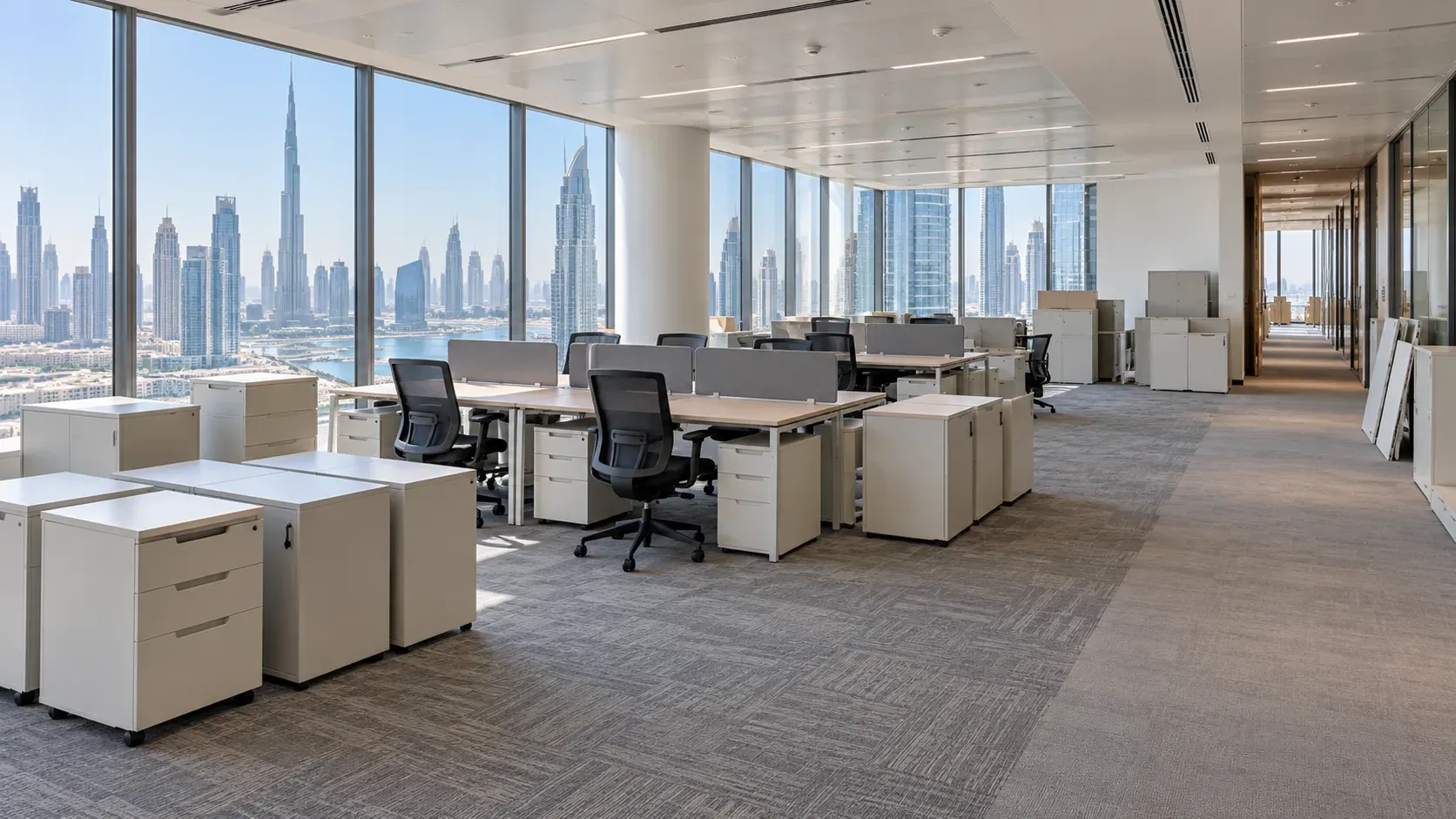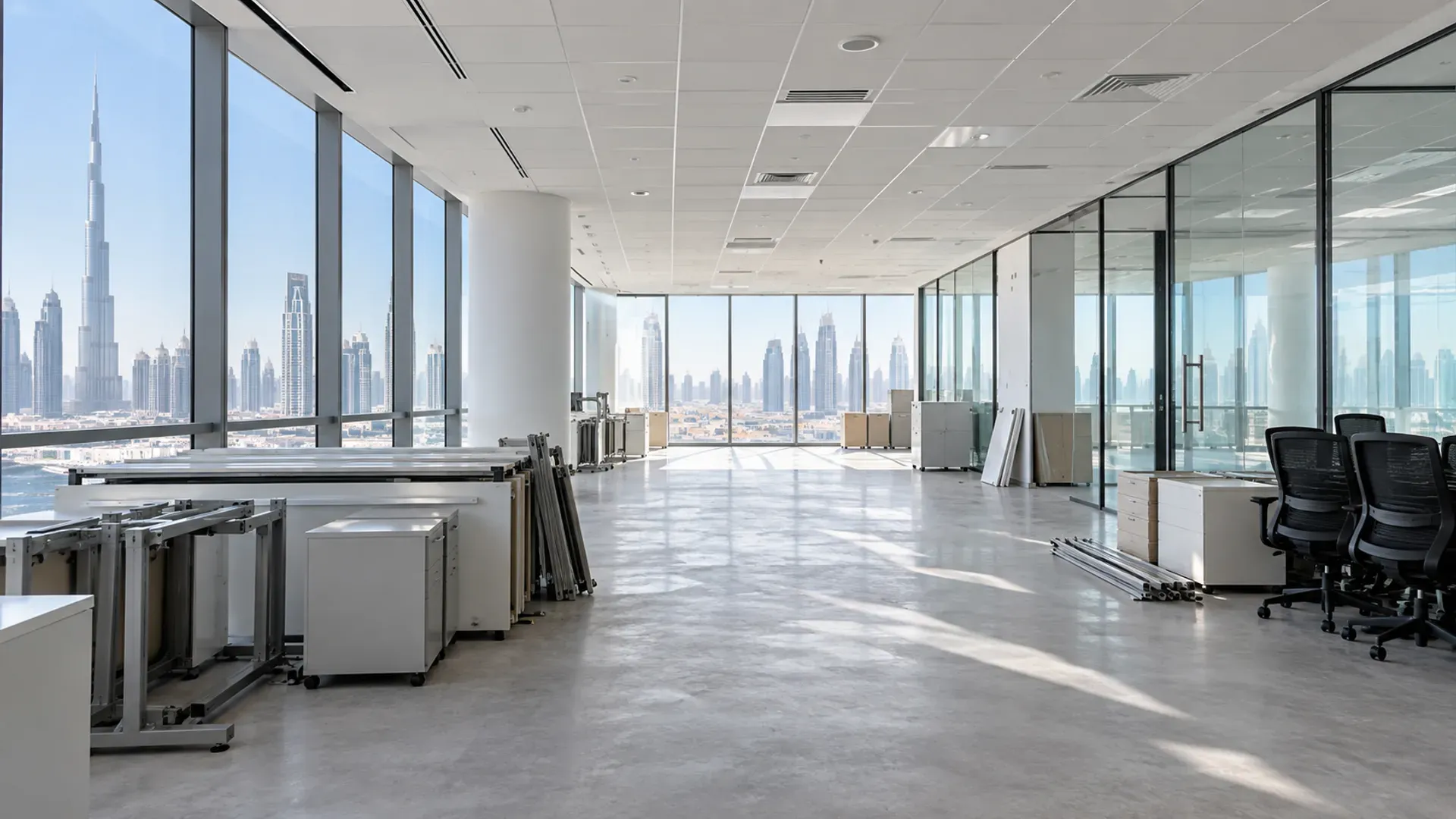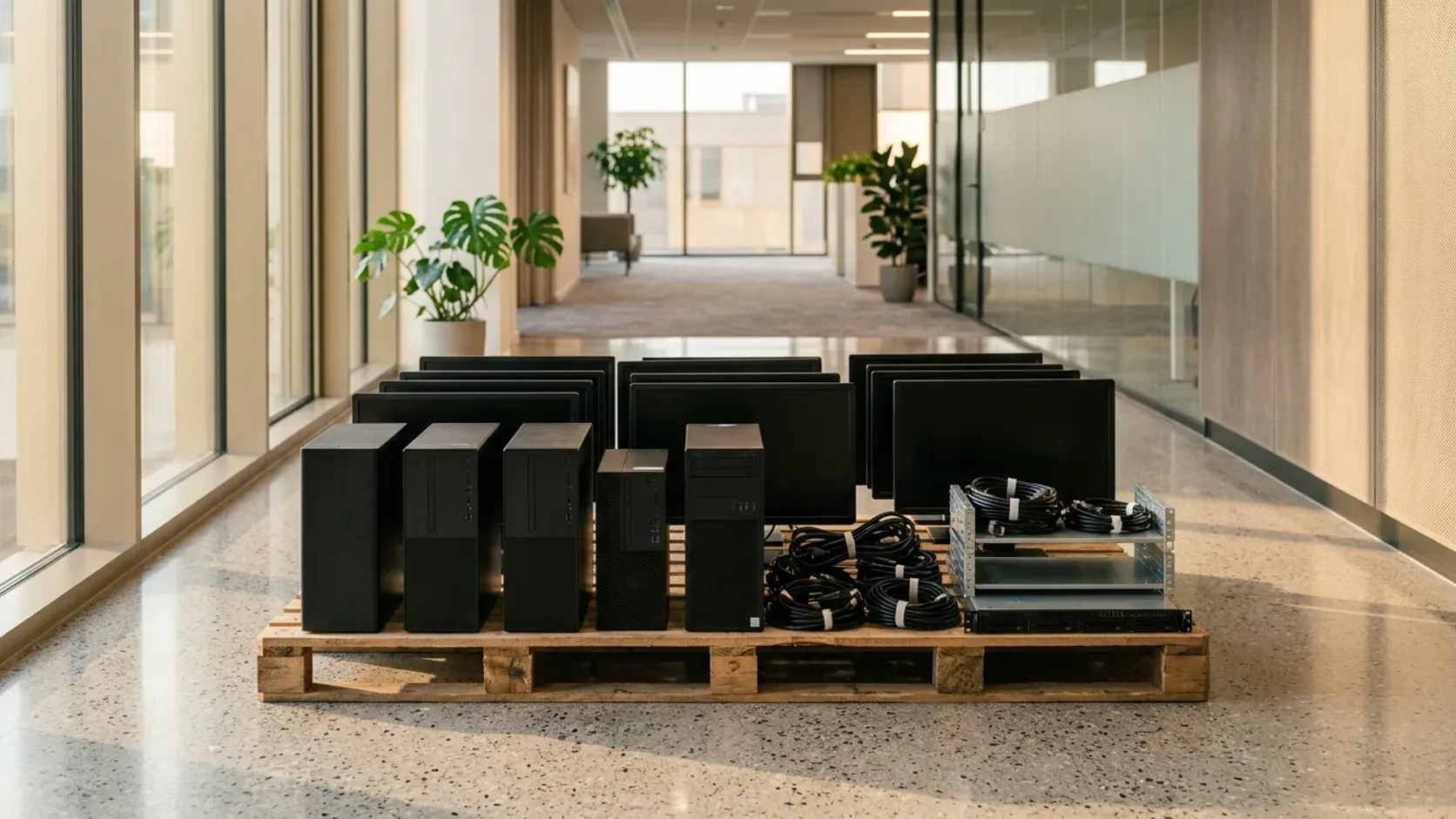
Decommissioning office computers, monitors, network switches and server racks in Dubai involves two separate responsibilities that should never be confused. The first responsibility is information security, which requires removing, sanitising or physically destroying data-bearing media before hardware leaves your commercial custody. The second responsibility is environmental logistics, which requires clearing bulky electronic equipment down shared commercial service lifts, out through security loading bays and into licensed recycling streams rather than municipal general waste bins.
Too many office managers conflate these two processes. They assume that booking a commercial clearance team or an e-waste collector automatically discharges their data protection liabilities, or conversely, that wiping hard drives solves the physical problem of moving forty heavy workstations before a lease expires. In reality, successful office IT disposal requires clear sequencing. Your internal IT or technical team handles data protection first, and a licensed commercial junk removal service handles the physical extraction, heavy lifting and segregated transport second.
Clarifying data sanitisation versus physical removal
The most critical operational rule in office IT disposal is establishing what the clearance crew actually provides. Our commercial clearance service collects decommissioned electronics, server racks, peripherals and monitors, safely removes them from office floors and routes them to licensed material handlers and recycling facilities. However, the business does not provide certified cryptographic data erasure, forensic disk wiping or certified hard drive shredding.
This distinction is fundamental. When an office in Business Bay, DIFC or Dubai Silicon Oasis replaces its computer estate, confidential records, banking credentials, customer databases and employee files remain stored on solid-state drives, magnetic hard disks and server arrays. Handing an intact, unwiped hard drive to an ordinary clearance team creates severe legal and regulatory vulnerabilities for your company. Under UAE Federal Decree-Law No. (45) of 2021 on Personal Data Protection (PDPL), data controllers bear strict legal responsibility for ensuring that sensitive personal data is protected against unauthorised exposure or unlawful processing.
Before booking any physical collection, your internal IT department or a specialised certified data destruction firm must decommission the drives. This means physically unmounting hard drives from desktop towers, extracting NVMe and SATA SSDs from laptops, pulling disk arrays from NAS units and clearing flash memory from high-end multi-function printers and managed routers. If company policy mandates certified destruction, contract a specialised certified shredding contractor who issues cryptographic certificates of destruction on-site. Once all data-bearing drives are removed or verified sterile, the residual chassis, monitors, cables, stands and peripherals can be scheduled for clearance.
Classifying office IT hardware into distinct handling streams
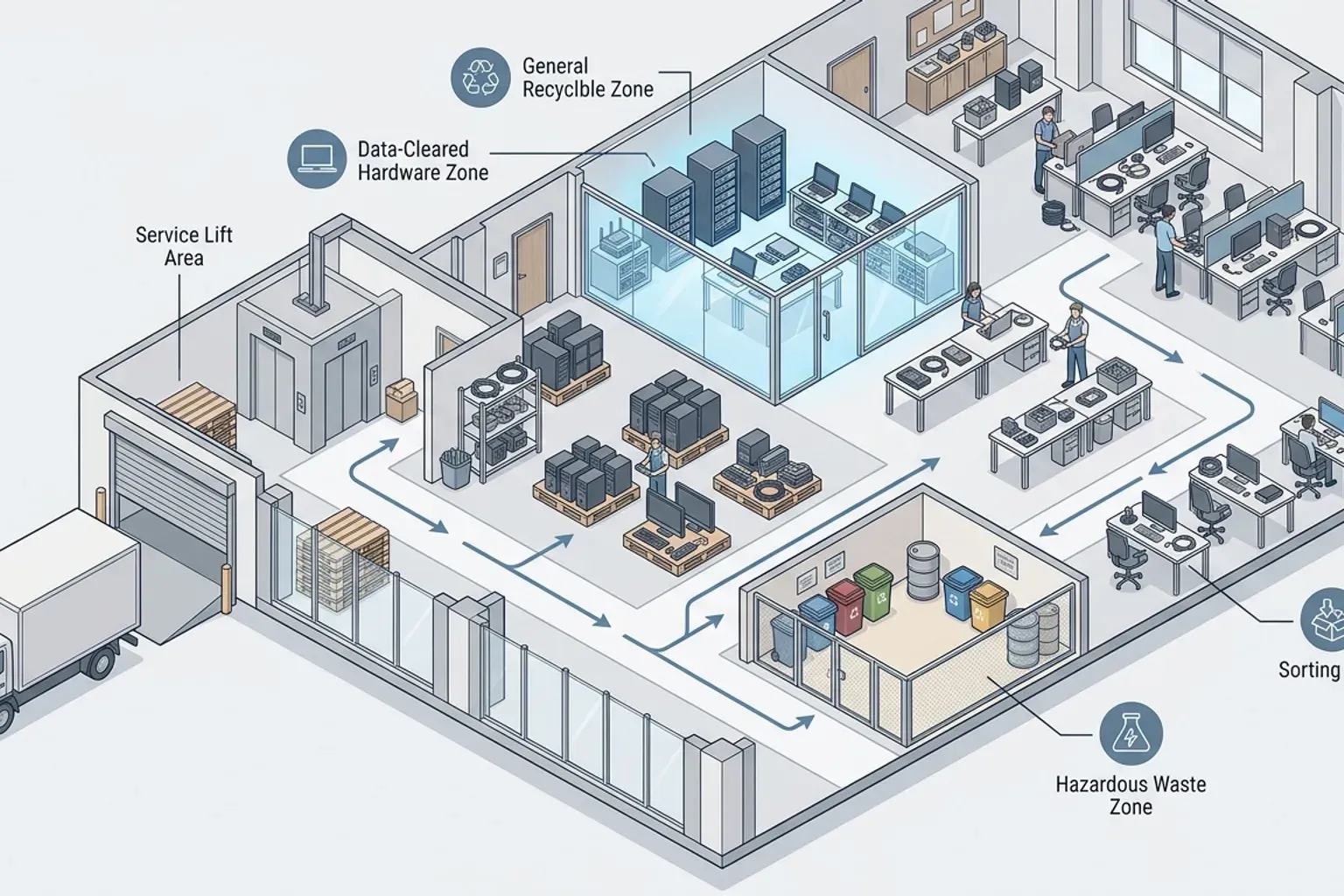
Commercial office electronics cannot simply be tossed into a single skip or piled indiscriminately onto a truck bed. Under Dubai Municipality's Waste Segregation Guide and Technical Guideline No. 5 on Waste Classification, electrical and electronic equipment (WEEE) constitutes a specialised waste stream that must be segregated from commercial general waste and construction debris. Commercial tenants who mix electronics with ordinary refuse or dump equipment in building basements risk municipal fines under Law No. (18) of 2024 Regulating Waste Management.
To ensure efficient handling and transparent quoting, office managers should categorise equipment into four distinct operational streams:
- Desktop towers, laptops and docking stations: These units contain sheet metal chassis, copper heat sinks, printed circuit boards and plastic fascias. Once storage drives are extracted, these units represent valuable e-waste material for component recycling. Bundle power adapters with their corresponding laptops where possible, as intact power bricks simplify secondary processing.
- Computer displays and flat-panel monitors: Liquid crystal displays, light-emitting diode panels and older cathode-backlit monitors contain glass, backlight assemblies, polarising filters and delicate circuit boards. They are fragile and require careful stacking during transport to prevent glass breakage in service lifts and freight corridors. Cracked screens present sharp-edge hazards for handling teams and should be set aside with marked protective padding.
- Server racks, networking cabinets and UPS units: Server hardware represents significant weight and physical density. Standard 42U server racks can weigh well over one hundred kilograms even when empty. Uninterruptible power supply systems house heavy lead-acid or lithium-ion battery arrays. Batteries must be identified and isolated in advance; leaking or damaged batteries require hazardous waste protocols rather than standard electronic transport.
- Peripherals, cabling and loose accessories: Keyboards, mice, telephony handsets, patch panels and ethernet cables create dense tangles if left loose. Gather loose cables into taped bundles or clear heavy-duty sacks. Copper cabling is highly recyclable, and keeping it organised prevents trip hazards along the removal path.
Navigating Dubai commercial building regulations and permits
Moving sixty monitors and thirty desktop towers out of a commercial tower in Downtown Dubai, Business Bay or Dubai Internet City is radically different from residential junk collection. Commercial facilities managers enforce strict operational gatekeeping to protect elevators, lobby floors and business operations.
Planning your collection requires coordinating three formal permissions at least three to five business days before collection day:
Building move-out permit and contractor clearance
Almost all Grade A and Grade B commercial properties in Dubai require an official No Objection Certificate (NOC) or gate pass before external contractors can access the building with clearance vehicles. Property management portals require submitting the trade licence, vehicle registration numbers, driver Emirates IDs and third-party public liability insurance of the removal company. The office tenant must also verify that all building service charges and tenant liabilities are settled before management issues the contractor pass.
Service lift reservations and protective cladding
Passenger lifts are strictly off-limits for bulky office furniture and computer hardware. Commercial buildings restrict clearance activity exclusively to dedicated freight elevators or goods lifts. Facilities teams typically mandate installing approved protective wall padding and floor plywood sheets inside the lift car before heavy trolleys enter. Goods lift bookings in commercial towers are tightly scheduled—often restricted to two-hour or four-hour windows—making pre-staging essential. Our service lift booking guide details how to avoid timing forfeits.
Loading bay clearance and vehicle height restrictions
Commercial loading docks in major Dubai business districts often feature underground access ramps with strict height clearances, commonly between 2.4 and 3.8 metres. Standard high-cube box trucks cannot enter subterranean bays that lack sufficient vertical clearance. Confirm your building's maximum underground clearance with security. The removal crew can then dispatch the appropriate covered 3-ton flatbed or medium-wheelbase truck that clears the ramp safely.
Step-by-step preparation timeline for office managers
Executing a smooth IT clearance requires disciplined sequencing. Leaving hardware preparation to the day of arrival guarantees delays, forfeited lift slots and elevated labour costs.
Two weeks before collection: Inventory and asset audit
Perform a comprehensive physical count of all equipment destined for clearance. Create an asset disposal register listing equipment types, quantities, model numbers and physical locations across the office floor. Tag each item clearly with colour-coded labels: green for cleared hardware, red for retained assets, and yellow for pending drive extraction. Verify whether any equipment was supplied on an operating lease; leased enterprise copiers, server blades and telephony hardware must be returned to the leasing company rather than scrapped.
One week before collection: Data decommissioning and cable disconnection
Have your technical support team or outsourced IT provider remove all storage drives, optical media and flash memory from servers, workstations and multi-function printers. Reset managed network switches to factory defaults to clear internal configuration scripts and corporate IP details. Disconnect all equipment from wall sockets, patch panels and desk grommets. Coil power cables and tape them securely to their respective units to prevent dragging along corridors.
The day before collection: Staging along accessible pathways
Consolidate all decommissioned hardware into a designated staging area adjacent to the main office exit, such as an unused conference room or break area. Ensure that primary fire exit routes, corridors and emergency doorways remain completely unobstructed. Stack computer towers no more than three units high to prevent tipping. Box smaller peripherals like mice, keyboards and power strips into sturdy moving cartons. If server racks are being dismantled, verify that all internal shelves and heavy components are unbolted before the crew arrives.
Collection day: Supervision and loading bay handover
Designate an authorised office representative to remain on-site throughout the collection. This person walks the floor with the lead crew member, verifies the inventory against the marked staging area, signs the building security register and facilitates access through security turnstiles and service lift lobbies. Once all items are loaded, the representative performs a final walkthrough of the cleared space to ensure no cables, components or debris remain behind.
Why commercial e-waste cannot go to municipal bins
Disposing of office electronics in communal dumpster bins or leaving server chassis in basement car parks is strictly prohibited across Dubai. Under Law No. (18) of 2024 Regulating Waste Management, commercial entities that discard electronic waste in unauthorised locations face severe financial penalties, with corporate fines starting at AED 10,000 and escalating up to statutory caps of AED 500,000 for repeat offences.
Beyond legal penalties, electronic hardware contains hazardous substances including lead solder, cadmium, brominated flame retardants and mercury backlights. When dumped in open landfill environments, these toxic heavy metals can leach into soil and groundwater. Furthermore, electronic components represent dense concentrations of recoverable commodities, including high-grade copper, aluminium heat spreaders, steel chassis and precious metals on printed circuit boards.
Licensed commercial removal ensures that sorted electronic assets are routed directly to accredited Dubai recycling facilities and specialized recovery operators. At certified processing hubs, equipment undergoes mechanical shredding, magnetic ferrous separation, eddy-current non-ferrous recovery and chemical extraction. This ensures that valuable metals re-enter the industrial manufacturing chain while dangerous elements are safely neutralised under environmental oversight.
Integrating IT clearance with wider office strip-outs
Decommissioning IT infrastructure rarely happens in total isolation. In most corporate relocation or lease termination scenarios, computer clearance forms one phase of a broader property exit that includes office furniture removal, partition dismantling and ceiling restoration.
Coordinating these overlapping workstreams prevents costly bottlenecks:
- Sequence IT before furniture dismantling: Clear sensitive computers, monitors and desk cables before carpentry crews begin unbolting modular desks and workstations. Trying to dismantle desk pods while computer towers and fragile screens still occupy desk surfaces leads to damaged screens and tangled cabling hazards. For full details on furniture sequencing, review our office furniture removal guide.
- Isolate server room infrastructure from general waste: Server rooms often contain heavy-gauge copper cabling, overhead cable trays, raised access flooring and dedicated crack-down air conditioning units. Treat server room de-rigging as an isolated project phase separate from general cubicle clearance. Our office strip-out guide details how to handle commercial fixtures and base-building handovers.
- Coordinate with out-of-hours building rules: Many commercial towers in the Dubai International Financial Centre and Downtown prohibit moving bulky equipment during standard business hours (8:00 AM to 6:00 PM) to avoid crowding goods lifts while other corporate tenants receive deliveries. Schedule your collection during approved evening or weekend windows. Read our out-of-hours clearance guide to understand how off-peak scheduling operates.
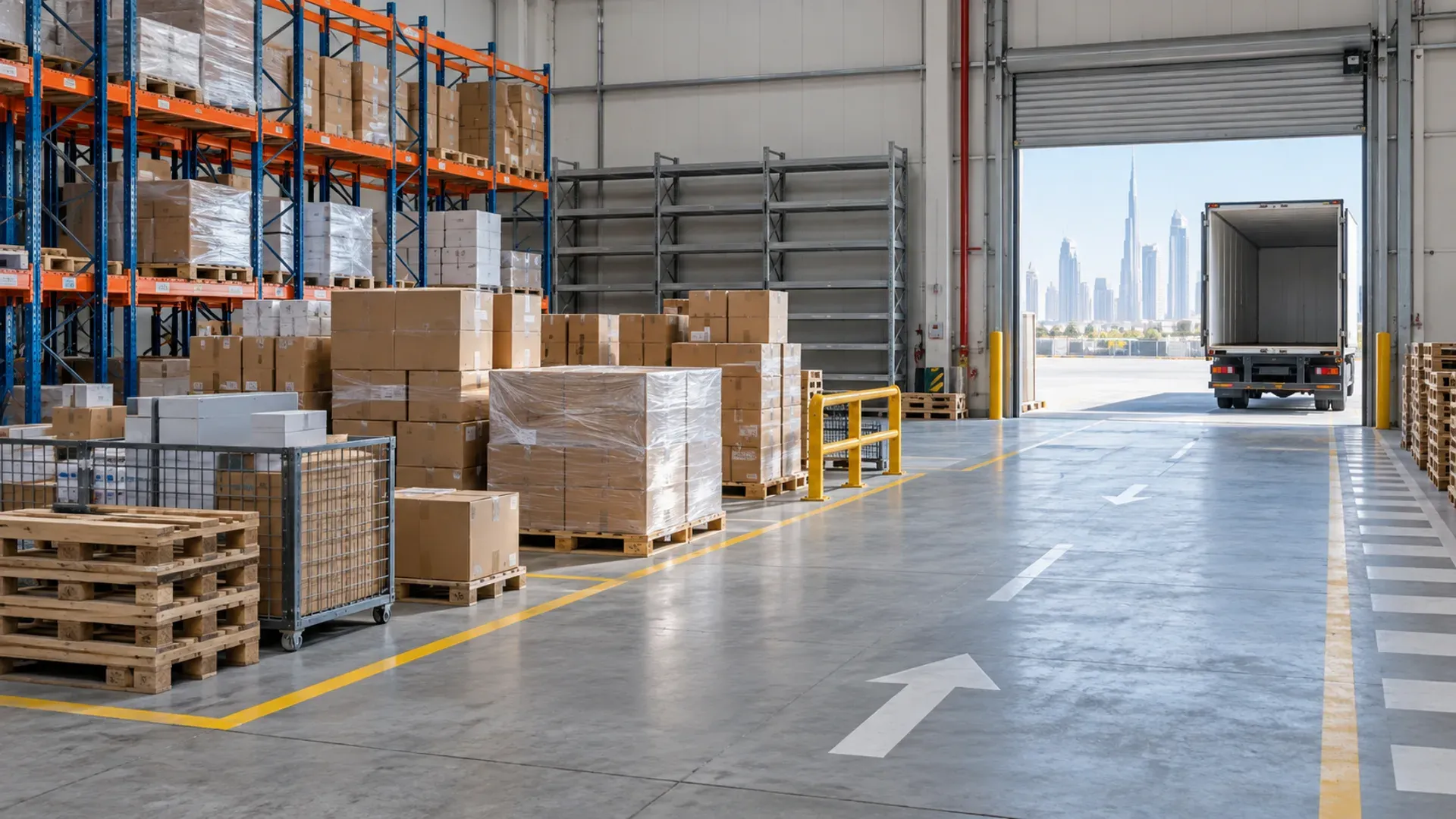
- Manage warehouse and storage stock: Where IT hardware has been stored in off-site warehouses in Al Quoz or Dubai Investment Park, access and loading requirements differ significantly from office towers. Ground-level roller shutters allow direct vehicle access, but items must be segregated from commercial inventory. Consult our warehouse clearance guide for industrial site logistics.
What information is needed for an accurate collection quote
Obtaining an honest, transparent quotation for office IT clearance requires providing specific operational details rather than vague estimates:
- Itemised inventory breakdown: Specify the approximate count of desktop towers, monitors, laptops, server chassis, printers and peripherals. A quote for ten pallets of assorted electronics is far less reliable than forty-five desktop towers, fifty monitors, two half-height server racks and ten boxes of cables.
- Building location and access logistics: Provide the exact building name, commercial zone, floor level, goods lift availability and loading bay clearance height. If the collection requires carrying equipment down stairs because the lift cannot accommodate a heavy rack, state this in advance.
- Dismantling requirements: Clarify whether server racks and heavy UPS enclosures are already unbolted and stripped of internal components, or whether the clearance crew needs to supply tools and labour for mechanical dismantling.
- Target collection timeline: Indicate whether the clearance must occur during normal working hours, after 6:00 PM on a weekday, or across a weekend slot. Specify any fixed handover deadlines tied to lease expiration.
When you send clear photographs of the staged hardware alongside your loading bay access details, our team can provide a precise quote and allocate the appropriate vehicle capacity and crew strength for a single-visit clearance.
Resolving common office IT disposal dilemmas
Can our business sell decommissioned computers to staff or charitable organisations?
While donating or selling used equipment to staff is common, it requires strict internal diligence. Every device must still undergo complete, verified data sanitisation and operating system reinstallation to prevent data leakage. Furthermore, older office hardware is frequently obsolete, lacking software support or battery health. Donating broken or unusable IT merely transfers an e-waste disposal problem onto a non-profit organisation that lacks the budget to scrap it responsibly. Only donate equipment that is verified fully operational, safe and cleanly formatted.
What should be done with obsolete uninterruptible power supplies?
Uninterruptible power supplies contain heavy internal lead-acid or lithium batteries designed to provide emergency backup power during electrical grid interruptions. UPS units should never be dropped, inverted or exposed to extreme heat. If the internal batteries show signs of swelling, corrosion or acid leakage, alert the collection team before booking. Damaged batteries must be segregated into leak-proof hazardous containment containers for specialised chemical disposal rather than standard scrap transport.
How are heavy multi-function office copiers handled?
Commercial multi-function printers and floor-standing copiers often weigh between 80 and 200 kilograms. They contain heavy toner cartridges, optical glass scanning beds and delicate internal print drums. Before removal, remove all loose toner bottles and waste toner collection boxes to avoid severe chemical powder spills in office corridors. Verify that the copier is owned outright by your company rather than leased through an equipment vendor who retains ownership of the serial number.
How should miles of tangled office data cables be prepared?
During major office strip-outs, contractors often pull kilometres of Category 6 ethernet cabling, patch cords and power distribution wiring from false ceilings and underfloor raceways. Leaving loose, snaking wires across an office floor creates severe tripping hazards for contractors and cleaners. Cut tangled cables into manageable two-metre lengths, bundle them tightly with heavy tape or cable ties, and place them into heavy-duty reinforced sacks. Clean, segregated copper cabling can then be weighed and processed efficiently for metal recycling.
Who is responsible for disconnecting network patch panels?
Network racks in server rooms house sensitive patch panels, fibre optic runs and high-density switches. The commercial clearance team should only touch hardware that has been cleanly uncoupled from the building infrastructure by qualified network engineers. Cutting live power conduits or tugging fibre patch leads risks triggering building fire alarms or interrupting internet connectivity for neighbouring tenants sharing commercial risers.
Are server cabinets reusable or scrap metal?
Standard 19-inch server cabinets with intact perforated steel doors, functioning locks and undamaged mounting rails possess strong secondary reuse value. When decommissioned carefully without bending the frame, these enclosures can be transferred to emerging businesses or equipment resellers. Conversely, dented cabinets or those with stripped mounting threads are dismantled into sheet metal components for industrial steel smelting.
Summary: A structured, professional approach to office IT clearance
Disposing of commercial IT hardware in Dubai requires balancing regulatory data security compliance with structured logistical execution. By removing and destroying data-bearing media in-house, sorting hardware into recognised e-waste streams, securing commercial building permits and scheduling freight lift access with care, office managers can complete corporate relocations and handovers without data security breaches, building disputes or municipal fines.
When your office hardware is decommissioned, inventoried and ready for collection, professional clearance provides the physical labour, specialised transport and licensed e-waste routing needed to clear the floor cleanly in a single scheduled visit.