
Downsizing works when the capacity of the new home controls every decision. Record what the smaller property can actually hold, inventory the current home, choose what will move, confirm any recipient transfers, and place the final unwanted group into a house clearance plan. Do not begin with removal. Begin with the rooms, storage and daily routines you will have after the move.
The useful sequence is keep, move, transfer, remove. A mover carries the approved moving inventory. A clearance crew takes the approved outgoing inventory. Neither should be asked to decide what your next home needs, and this guide does not provide selling or valuation advice.
Start with the smaller home
Obtain a floor plan or take reliable measurements of the new property. Record room dimensions, door openings, lift or stair access, built-in storage and any furniture already supplied. A piece may fit inside the room but fail at the entrance, corridor turn or lift.
List the function of each room. A smaller bedroom may need to support sleep, clothing storage and a desk. A compact living room may not have space for both a large dining set and several lounge pieces. Make the functional choice before arranging transport.
Count storage by usable dimensions, not by the number of doors. Deep cupboards with fixed shelves, low kitchen cabinets and awkward balcony stores may hold less than expected. Note items that cannot be stored safely in heat or outdoors.
Check the new tenancy or building inventory where applicable. If the home already includes appliances or furniture, decide whether your own equivalent has a real place. Do not pay to move a duplicate simply because its final route has not been chosen.
Mark the route into the new home as carefully as the route out of the old one. Large pieces that leave one villa easily may not enter a tower apartment. Measurements made now prevent a clearance decision being postponed until the delivery vehicle is outside.
Build one complete inventory
Walk the current home room by room and include hidden zones: wardrobes, kitchen cabinets, balcony cupboards, storage lockers, garage shelves, utility rooms and under-bed storage. Photograph wide views and list large items individually.
Use one inventory, not several conflicting family lists. Give each item a location, owner and next action. For groups of small objects, use a clear category such as “two boxes of kitchen equipment” instead of “miscellaneous.”
Separate property that does not belong to you. Landlord furniture, employer equipment, borrowed objects, building access devices and a flatmate’s belongings cannot be treated as downsizing stock. Record who controls each item and the return deadline.
Protect documents, passports, keys, medication, jewellery, data-bearing devices and irreplaceable personal items at the beginning. Keep them in a secure zone that no mover, recipient or clearance crew will enter.
The inventory becomes the control document for every later stage. Without it, items drift between move, transfer and removal groups, and the final load cannot be quoted accurately.
Make keep decisions from capacity
Assign each retained item to a specific room and purpose in the smaller home. “Keep for now” is not a destination. If no room or storage location can be named, the item remains undecided.
For furniture, compare both dimensions and function. A smaller table that seats the household may be more useful than a larger table kept because it once suited the old room. A tall cabinet may provide storage efficiently, but only if it clears the new doorway and ceiling.
For duplicates, choose one that fits the new space and daily use. Review duplicate appliances, bedding sets, cookware, side tables, lamps and occasional chairs. Condition matters, but fit and purpose matter too.
For seasonal and sentimental items, set a physical limit such as one shelf, one cabinet or a defined group of boxes. The limit should reflect real storage in the destination. It turns a vague intention into a decision that can be completed before moving day.
Do not let the moving quotation decide for you. Paying to transport an item does not create room for it. Complete the capacity test first, then ask movers to quote the resulting inventory.
Keep recipient transfers separate
An item intended for family, a friend or a donation route is not complete until the recipient accepts it and the handover is arranged. Record the person or organisation, collection date, transport responsibility and fallback deadline.
Keep these items physically separate from both the moving and clearance groups. Label them with the recipient and do not allow an unconfirmed promise to delay the whole property schedule.
Set a decision date early enough to use the fallback. If the recipient cannot collect by that date, choose whether the item moves with you or joins the approved removal inventory. The fallback should not be invented on handover morning.
Do not make unsupported assumptions about what another party will accept or what happens after transfer. Condition alone does not guarantee reuse. Confirm the actual route with the actual recipient.
This site does not advise on selling furniture or values. If you pursue a private transaction independently, treat it as confirmed only when the transfer has genuinely completed. Until then, the item still occupies the home and must remain in the schedule.
Separate movers from the clearance crew
Movers handle the possessions travelling to the new home under their agreed scope. A clearance crew removes items approved to leave the household. Keeping the inventories and staging zones separate protects both jobs.
Use visible labels that cannot be confused: MOVE, RECIPIENT and REMOVE. Avoid colour codes known only to one person. If rooms contain mixed decisions, mark individual pieces and brief both providers during their arrival walk-through.
Schedule the main removal after most keep decisions are final but before deep cleaning and handover. Depending on the project, clearance may happen before or after movers. The correct order is the one that keeps routes open and prevents wanted possessions being mixed with the outgoing load.
If clearance comes first, retain enough essential furniture and equipment for the remaining occupancy. If movers come first, inspect the emptying rooms immediately and add overlooked unwanted items to a documented final scope rather than assuming the clearance quote expands automatically.
Do not ask either provider to hold uncertain belongings in a vehicle while you decide. Create an indoor hold zone and settle it by a fixed deadline.
Work backwards from the final deadline
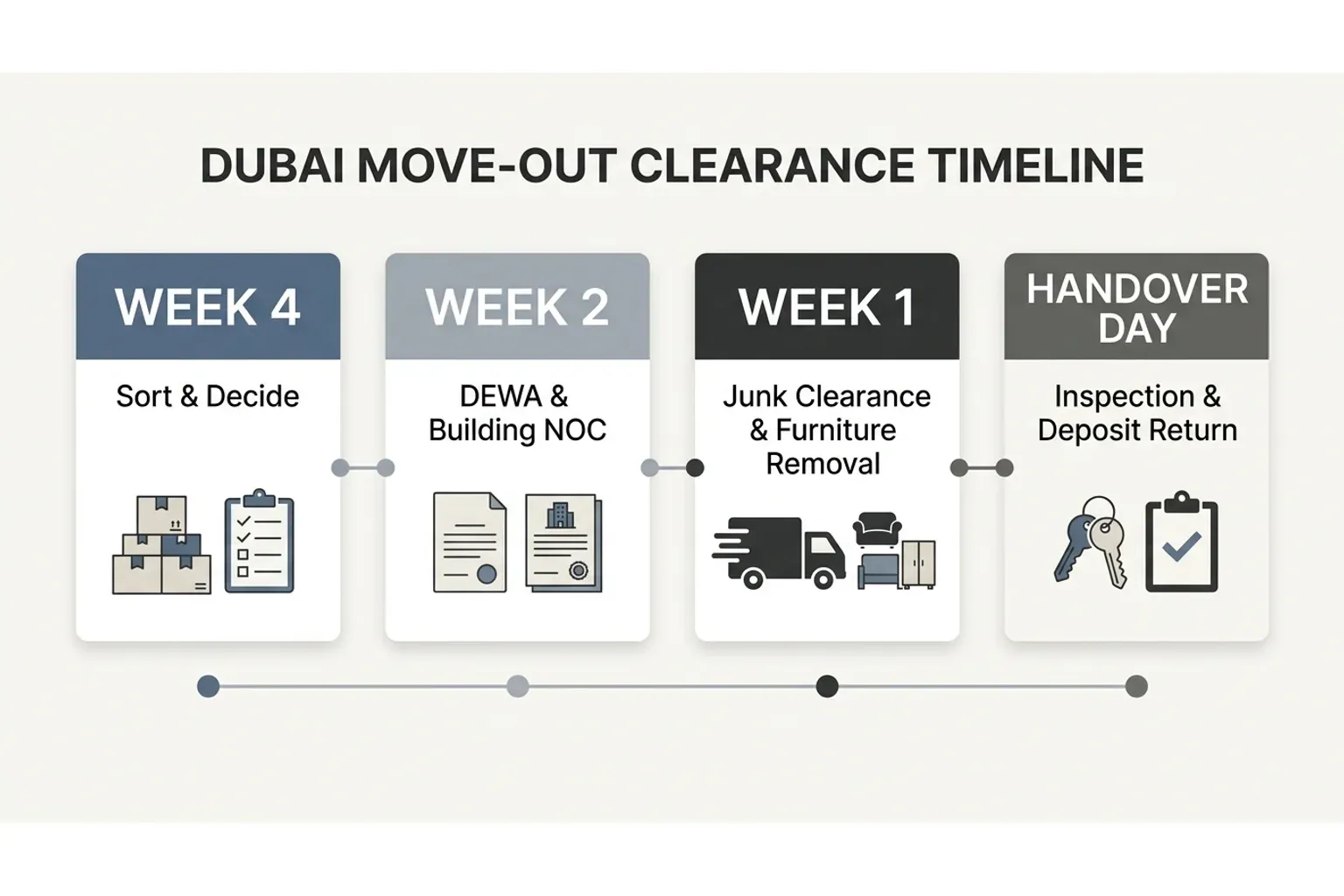
Set the date by which the old property must be clear, not merely the moving date. Include any cleaning, repairs, inspection, key return or landlord walk-through that follows removal. These later tasks need empty rooms and working access.
Three to four weeks before
Measure the new home, complete the first inventory and identify ownership questions. Ask the old and new buildings about their current move procedures, service lifts, loading areas and permitted windows. Begin recipient conversations with clear deadlines.
Survey large furniture against both routes. Identify appliances that need specialist disconnection and fitted items that may belong to the property. Request moving and clearance assessments from separate, finalising inventories.
Two weeks before
Freeze most keep decisions and book the relevant access windows. Confirm which provider handles which items. Arrange competent release of hard-wired, plumbed, gas-connected or fixed equipment where required.
Photograph the removal group and show the route to the vehicle. Include upper floors, long carries, stairs, basement restrictions and community gates. Update the scope if recipient transfers fail.
One week before
Pack and label the moving group. Complete confirmed transfers. Empty furniture and appliances that are leaving, and check every container for documents or personal belongings.
Keep cleaning supplies, keys, chargers, medication and handover documents in the protected essentials zone. Do not pack building access cards or lift approval references.
Final days
Complete the mover and clearance walk-throughs against their respective lists. Inspect every cupboard, balcony, store and service area after loading. Leave time for cleaning and any agreed repairs.
The leaving Dubai clearance checklist covers a broader departure project. For a local move to a smaller home, use only the steps relevant to your property and providers rather than assuming departure formalities apply.
Plan large furniture first
Large pieces consume space, control the carrying route and create the greatest risk of paying to move something that cannot be used. Decide beds, sofas, dining tables, wardrobes and cabinets before boxes of small possessions.
Measure each piece in the configuration it will travel. If dismantling is planned, identify the largest rigid component. Check whether the construction is designed to separate and keep hardware with the retained item.
Compare measurements with both properties. Include doors, corridor turns, lift openings, cabin depth and stairs. The item must have a complete route out and in.
Where a large piece will not move, decide its route early. A confirmed recipient needs time and transport. A removal provider needs photographs and access details. Leaving the choice until the mover rejects it puts the entire timetable at risk.
Do not assume fixed cabinets, wall-mounted units or built-in furniture belong to the moving inventory. Confirm ownership and who releases any attached work. Collection should start only after the item is safely free under the agreed scope.
Reduce boxes before packing
Packing undecided belongings hides the decisions and transfers the problem to a smaller home. Review categories before they enter boxes: kitchenware, books, clothes, linens, decorations, paperwork, toys and hobby equipment.
Use destination-based labels for retained boxes, such as “new kitchen—daily cookware” or “bedroom wardrobe—winter clothes.” A box labelled only “miscellaneous” has no clear storage destination.
Do not overload boxes with books, tools, weights or dense kitchen items. Use sound containers and disclose dense removal boxes to the clearance provider. A small carton is not necessarily a light carton.
Keep outgoing small items visible as complete groups. If the whole box is approved for removal, check it once, close it and mark it clearly. Do not mix confidential papers, batteries, liquids, medication or unknown containers into ordinary household discards.
Set a maximum number of boxes for categories with limited storage. Capacity-based limits prevent the spare room or balcony in the new home becoming a permanent holding area.
Prepare appliances and specialist items
Check whether the new home includes a fridge, cooker, washing machine or other appliance. Confirm size, connection type and ownership before deciding what travels.
For an appliance leaving through clearance, empty it and identify the disconnection responsibility. Unplug only ordinary plug-connected units when safe and appropriate. Arrange qualified help for hard-wired, plumbed, gas-connected or technically fixed equipment unless a provider has explicitly accepted that work.
Drain and dry units where relevant and secure loose shelves or accessories. Photograph the appliance and its route. Do not hide liquids, chemicals, gas cylinders, batteries or unknown materials inside cabinets or machines.
Data-bearing electronics need a separate decision. Back up required information, sign out of accounts and complete appropriate data handling before release. Do not assume a removal provider supplies certified erasure.
Pianos, safes, very heavy stone, fixed gym systems and other specialist items need explicit assessment. They should never appear as an unmentioned addition on collection day.
Control apartment and villa access
For apartment moves, ask both buildings about the service lift, move permits or NOCs, protective measures, loading bays and approved hours. A permission at the old address does not cover the new one.
Keep the clearance appointment distinct from the moving appointment unless building management and both providers have agreed the sequence. Two vehicles and teams competing for one lift can block each other and compress the approved window.
For villas and gated communities, confirm the correct gate, vehicle process, driveway access and any community restrictions. Keep items within the property until the responsible provider begins loading.
At both addresses, protect common routes. Remove small obstacles, control doors, keep fire exits clear and prevent unattended staging in corridors or pavements.
Nominate one contact who can approve scope questions and speak with security. Conflicting instructions from several household members are especially risky when move and removal inventories sit close together.
Avoid common downsizing failures
Do not estimate the new home from memory. Measure it.
Do not keep furniture merely because it was expensive or once useful. Give it a destination and function in the smaller home.
Do not count an unconfirmed recipient as a completed transfer. Set a fallback date.
Do not pack first and decide later. Boxes conceal volume and make the new home carry the unfinished work.
Do not merge mover and clearance lists. Their purposes are different, and a shared vague instruction increases the chance of error.
Do not forget external and hidden storage. Balconies, lockers, garages and utility cupboards often hold the final unplanned load.
Do not schedule clearance, cleaning and inspection without buffers. Access delays or a changed scope can affect the next appointment.
Do not leave ownership questions to collection day. Uncertain items belong in the hold zone, not the removal path.
Final downsizing checklist
- Measure the new rooms, storage and access route.
- Inventory every room and hidden storage area in the old home.
- Record the owner and destination of each large item.
- Protect documents, valuables, keys and essential supplies.
- Assign retained items to real rooms and storage locations.
- Confirm recipients, handover dates and fallback decisions.
- Keep MOVE, RECIPIENT, REMOVE and HOLD groups separate.
- Give movers and clearance crews different final inventories.
- Arrange technical release of connected or fixed items.
- Confirm lift, loading and gate access at both properties.
- Complete removal before cleaning and final inspection.
- Check every cupboard, balcony and store after loading.
Downsizing is not a race to discard the most. It is a capacity plan for the home you will actually occupy. Measure that home, make every destination explicit, and use clearance only for the final approved load. That sequence protects wanted possessions, keeps providers in their proper roles and prevents the smaller home from inheriting the same unresolved decisions.