Moving out of Dubai involves an extensive list of administrative and personal tasks, from closing bank accounts and cancelling residency visas to packing suitcases and booking international flights. Yet when expatriates reflect on what created the greatest stress during their departure, property clearance and tenancy handover almost always top the list.
A smooth exit from Dubai requires planning your home clearance backwards from your final handover inspection. Unwanted furniture, delayed building permits and unresolved utility accounts can derail your travel schedule and trap thousands of dirhams in unreturned security deposits.
Why property clearance is the critical bottleneck when leaving Dubai
Unlike a local move within Dubai where you can temporarily store excess items with friends or return to resolve minor maintenance issues over the following weekend, an international departure has a rigid, immovable deadline: your departure flight.
Property clearance in Dubai is characterized by strict sequential dependencies where each administrative step relies on the successful completion of the previous one:
1. The utility and permit dependency chain
You cannot obtain a building move-out permit or community NOC until your utility account with the Dubai Electricity and Water Authority has initiated a move-out request and the property service charges are cleared. In turn, building security will not permit moving vehicles or clearance teams into the loading bay without an approved permit.
2. Handover inspection requires an empty home
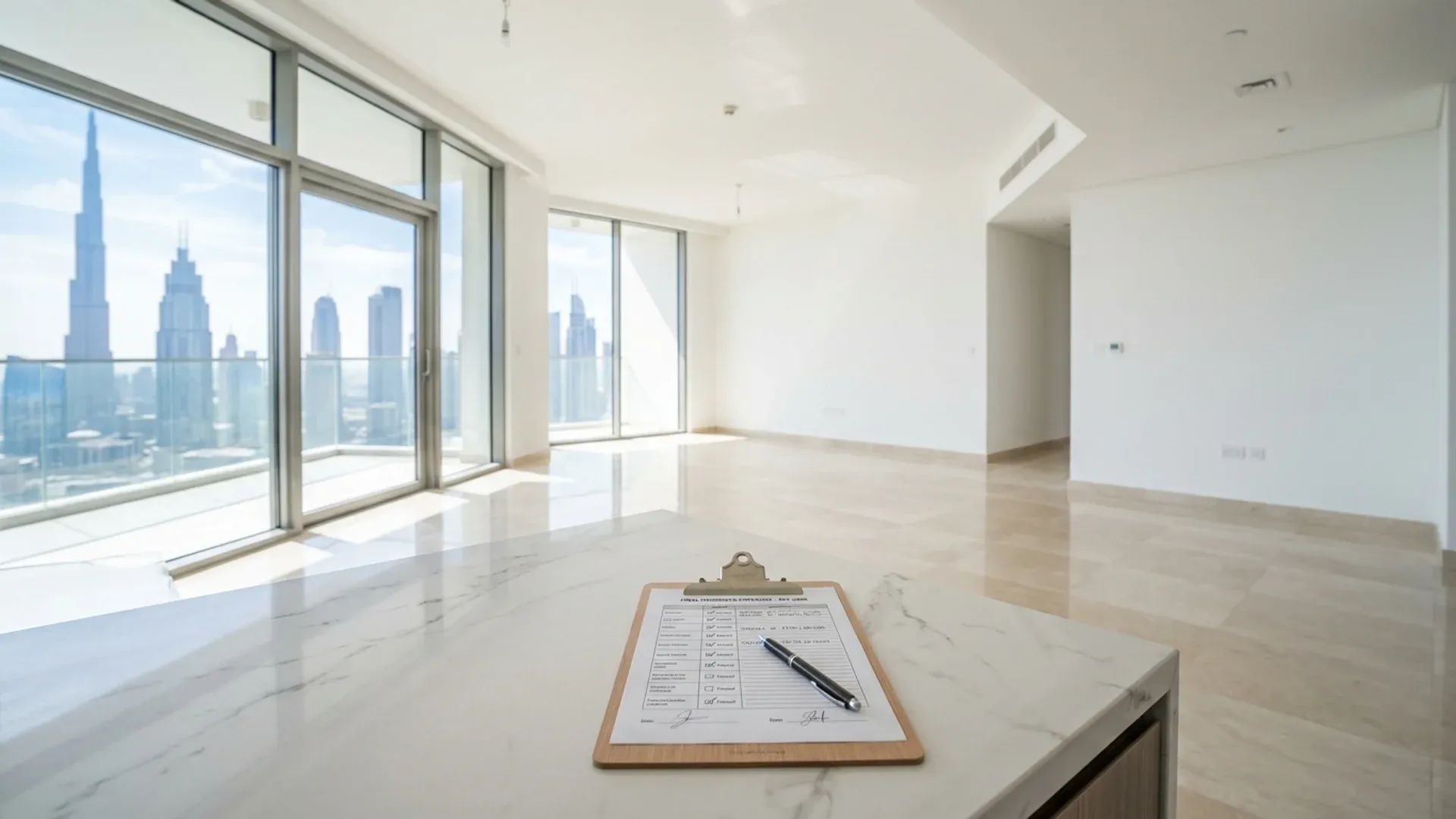
Landlords and property management agents will not conduct a final handover walkthrough while personal belongings, furniture and rubbish remain inside the property. Deep cleaning, wall patching and painting cannot take place until all furniture is completely removed.
3. Financial settlement hinges on handover sign-off
Your landlord will not sign the final handover document, initiate your tenancy deposit refund, or agree to Ejari cancellation until the property is inspected and verified as vacant. If unwanted furniture remains on your final day, landlords are legally permitted to hire emergency clearance crews at inflated rates and deduct the costs from your security deposit, as explained in our analysis of whether a landlord will deduct deposit for furniture left behind.
4. Severe penalties for illegal dumping
Under Article 6 of Law No. (18) of 2024 Regulating Waste Management in the Emirate of Dubai%20of%202024%20Regulating%20Waste%20Management.html), abandoning furniture, appliances or domestic waste in public spaces, building corridors or outside waste enclosures is strictly prohibited, with substantial statutory fines and enforcement. Leaving unwanted furniture beside communal bins on your way to the airport is not a legal disposal route.
Four weeks out: The inventory and sorting phase
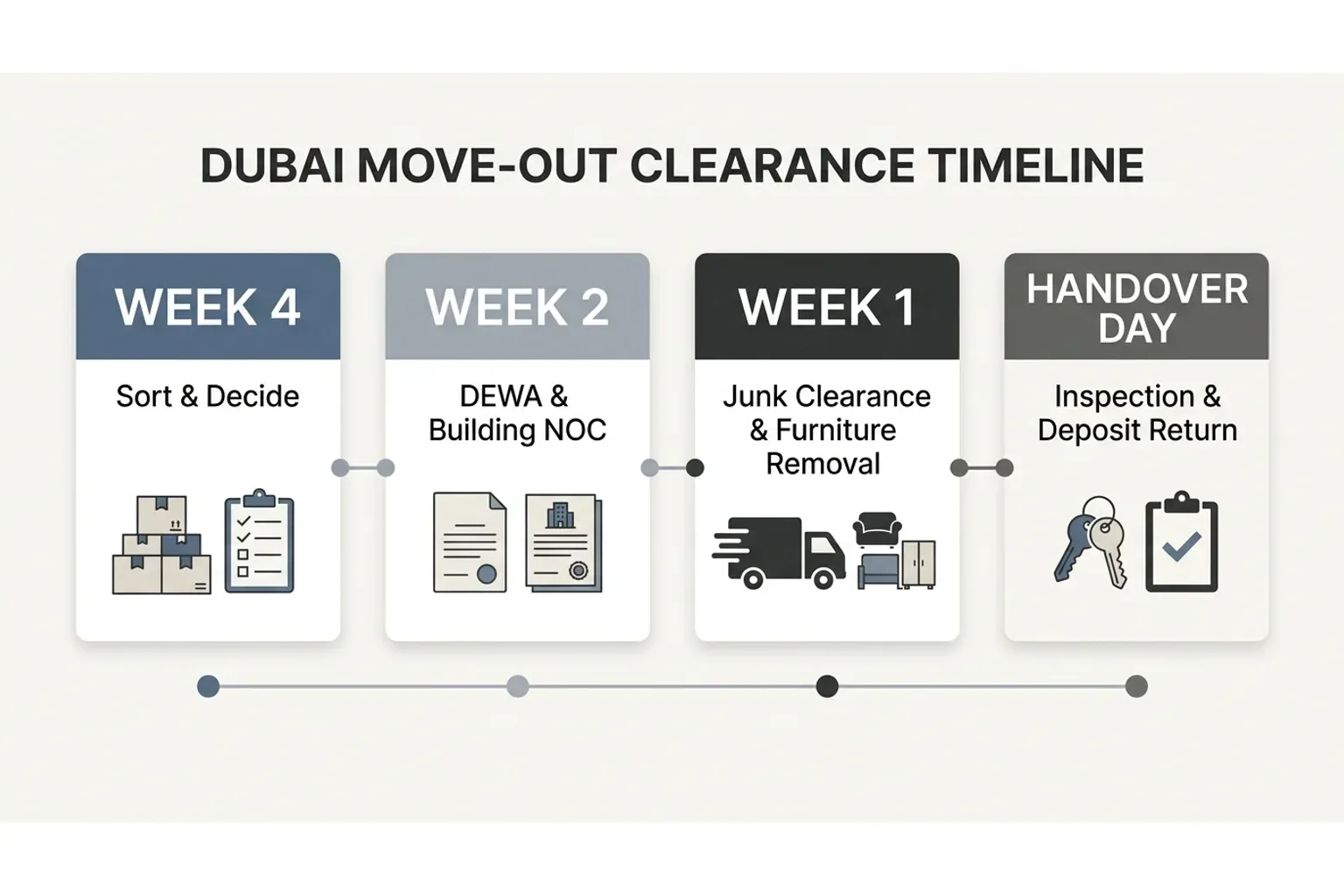
A successful relocation clearance begins four weeks before your scheduled departure date. The goal of this phase is to establish complete clarity on what will physically happen to every item in your home.
Walk through every room with a notebook and divide your household contents into four distinct, realistic categories:
Group one: Keep and ship internationally
These are valuable personal possessions, sentimental items, family heirlooms, important paperwork and high-quality furnishings that justify the cost of international container shipping or air freight. Obtain quotes from international moving companies early, as shipping surveyors need to assess volume to schedule packing dates.
Group two: Sell locally
Many residents plan to sell a large portion of their household furniture on online classified platforms or social media groups to recoup cash before leaving. While this is reasonable for high-demand, high-value items, be realistic about the time and effort required. Selling second-hand goods in Dubai involves managing inquiries, dealing with frequent buyer no-shows, and handling price negotiations. Set a strict deadline: any item that has not sold and been collected by two weeks before your flight should immediately be transitioned to the donation or clearance category.
Group three: Donate to confirmed charitable recipients
If you have clean, undamaged furniture, wearable clothing, functioning small appliances and books, consider donating them. However, ensure that collection dates and recipient acceptance criteria are confirmed in advance. Registered charities and donation initiatives often have specific collection schedules and cannot always guarantee same-day or last-minute pickups.
Group four: Dispose and clear
This category includes items that are broken, heavily worn, damaged, non-standard, or simply unwanted: worn mattresses, damaged flat-pack wardrobes, old kitchenware, worn rugs, accumulated balcony planters, obsolete electronics and general household junk. These items require a professional house clearance or villa clearance service to remove in an organized, legal manner.
The hidden spaces that people forget to audit
When compiling your initial inventory, do not limit yourself to main living rooms and master bedrooms. Expatriates frequently overlook storage areas that harbor massive amounts of clutter:
- Balconies and terraces: Weathered outdoor chairs, rusted clothes drying racks, dead potted plants, concrete planters, and artificial grass turf that must be scraped and removed.
- Maid rooms and utility closets: Accumulated cardboard boxes, broken vacuum cleaners, spare paint tins, leftover renovation tiles, and unwanted cleaning supplies.
- Kitchen cabinetry and pantry shelves: Half-used food containers, expired dry goods, cleaning chemicals, and surplus plastic storage ware.
- Wardrobe top shelves: Luggage bags, extra bedding, old pillows, and winter garments accumulated over years in the UAE.
Three weeks out: Logistics planning and contractor booking
Three weeks before departure is the optimal window to lock in all professional service providers and confirm logistical dates.
Booking your international movers and local clearance crew
Coordinate the exact sequence of moving and clearance appointments:
- International packing dates: Your international shipping crew should pack and collect your shipping consignment first, typically five to seven days before your tenancy ends.
- Property clearance booking: Schedule your residential junk removal appointment for the day immediately following your international packers. This ensures that everything left behind after the packing crew departs is collected in a single organized operation.
- End-of-tenancy maintenance: Schedule painting, minor wall patching and deep cleaning services for the final forty-eight hours before inspection, when the home is completely empty.
Understanding building permissions and moving requirements
Contact your building facilities management office or log into your community portal to review the specific move-out rules for your property. As outlined in our detailed guide on obtaining an NOC to move furniture in Dubai, you must determine:
- Whether your building requires an online move-out permit application or a physical form.
- The exact documentation required from your removal and clearance contractors (commercial trade licenses, driver Emirates IDs, vehicle registration).
- Building-specific moving hours and restrictions on weekend access.
- Elevator reservation requirements and refundable building security deposits.
Two weeks out: Utility disconnection and building NOC submission
Two weeks before departure is the critical administrative window where official paperwork must be initiated.
Initiating the DEWA Move-Out request
Dubai Electricity and Water Authority provides a dedicated online DEWA Move-Out service for departing tenants:
1. Log into your DEWA customer portal using your UAE Pass or DEWA user account. 2. Select the Move-Out option and specify your departure date and preferred final meter reading date. 3. Provide your bank account details or preferred refund channel for your DEWA security deposit (typically two thousand dirhams for apartments or four thousand dirhams for villas). 4. Settle the final bill once generated. DEWA will issue an official Final Clearance Certificate, which is required by landlords and building management to approve lease termination.
Important tip on utility timing: Do not schedule your electrical disconnection for a date prior to your furniture clearance and deep cleaning. Clearance crews require functioning service lifts and corridor lighting, and cleaning contractors need running water and electricity to complete handover preparations.
Submitting building move-out permit applications
Submit your move-out NOC request through your developer portal (such as Emaar One, Nakheel Community Management, or Concordia in JLT) or directly to your building supervisor. Attach all required documents:
- Tenant passport, visa and Emirates ID copies.
- Landlord signed No Objection Certificate.
- Ejari certificate copy.
- Confirmation of DEWA move-out request.
- Removal contractor trade license and crew Emirates ID copies.
Simultaneously, book your dedicated service elevator slot and reserve parking in the loading bay for your clearance team.
Telecoms and internet service cancellation
Contact your telecommunications provider (du or e&) to cancel your home internet and television subscription:
- Schedule disconnection for forty-eight hours before handover.
- Locate the original fibre optic modem, television set-top box, power adaptors and remote controls. Providers charge hardware penalty fees if original equipment is not returned to an authorized branch.
- Request an official service termination clearance letter.
One week out: The primary clearance and sorting execution
Seven days before departure, your home transitions from an occupied residence into a staged clearance project.
Executing the clearance run
Once your international movers have packed and loaded the items you are retaining, your clearance appointment takes center stage:
- Walk through the property with the clearance team lead before work begins, identifying every item, fixture and box that must be removed.
- Ensure that large wardrobes, bed frames and dining tables are safely dismantled by the crew.
- Verify that bulky mattresses, old sofas and redundant white goods are trolleyed carefully down the service lift without scuffing common corridor walls.
- Confirm that outdoor balconies and storage utility rooms are completely emptied.
Our guide on what to do before the junk removal crew arrives provides a helpful checklist for preparing pathways and separating personal essentials from disposal items.
Managing hazardous materials and non-standard waste
Certain household materials cannot be cleared through standard bulky waste channels:
- Unused paint cans and chemical solvents: These cannot be poured down domestic drains or thrown into communal waste chutes. Professional clearance services manage compliant disposal routes.
- Gas cylinders: If your kitchen or outdoor barbecue uses gas cylinders, arrange for their return to authorized local gas distributors or specialized collection channels.
- Electronic waste: Old computers, smartphones, cables and tablets should be separated for proper e-waste recycling, ensuring all personal data is erased prior to collection.
Handover week: Final inspection, keys and deposit refund
The final three days before departure are dedicated to the physical handover of the property and financial settlement with your landlord.
Completing handover repairs and cleaning
Under Dubai rental agreements, properties must be handed back in clean, habitable condition:
- Minor wall repairs: Fill holes left by picture hooks, wall anchors and TV brackets with matching spackle filler, and apply touch-up paint matching the original wall color.
- Deep cleaning: Have the property cleaned thoroughly, including kitchen appliances, bathroom tiles, window tracks and balcony floors.
- Light fittings and fixtures: Ensure all light fixtures have functioning bulbs and that smoke detectors and AC thermostats are operational.
The handover walkthrough inspection
Attend the handover inspection in person alongside the landlord, property manager or their authorized real estate agent:
- Bring your original signed move-in condition report and inventory list for comparison.
- Test all air conditioning units, plumbing fixtures, door locks and window handles together.
- Open every cupboard, closet and cabinet to confirm that no personal effects or debris remain.
- Take comprehensive, time-stamped photographs of every single room, wall, ceiling and floor. These photographs serve as vital evidence should an unjustified deposit dispute arise after you travel.
Signing the checkout form and deposit agreement
Once the inspection is complete:
- Sign the agreed handover inspection document, noting any minor items agreed upon in writing.
- Document the agreed security deposit refund amount clearly on the handover form.
- Agree on the refund payment method. If you are closing your UAE bank account, arrange for the deposit to be returned via international wire transfer, a manager cheque handed to an authorized representative, or a direct transfer before you board your flight.
- Hand over all sets of property keys, access cards, parking barrier remotes and letterbox keys.
Ejari cancellation
Once handover is completed and keys are returned, the tenancy contract must be officially cancelled in the Dubai Land Department system. The landlord or tenant can initiate cancellation via the Dubai REST mobile application or at an authorized real estate services typing centre. An active Ejari cannot remain in place if a new lease is to be registered for the next tenant.
Avoiding common moving-out clearance pitfalls in Dubai
Expatriates leaving Dubai frequently encounter predictable clearance challenges that can easily be avoided with proper foresight:
Underestimating the volume of accumulated junk
Residents living in Dubai for several years almost always accumulate significantly more possessions than they realize. Wardrobe tops, storage lockers, and kitchen cupboards hold vast quantities of items that are only discovered during the final packing phase. Always overestimate the volume of your clearance to ensure your removal contractor dispatches an adequately sized truck.
Relying on online marketplace buyers at the last minute
Waiting until forty-eight hours before departure to sell furniture on classified platforms is the single most common cause of handover crises. Buyers frequently renegotiate prices on arrival, fail to bring appropriate transport, or cancel at the last moment, leaving departing tenants stranded with bulky items on handover morning.
Forgetting balcony and outdoor clearances
Balconies are the most common source of inspection disputes. Heavily stained outdoor tiles, decaying planter boxes, and weathered furniture left outside will prompt landlords to deduct professional cleaning and clearance charges. Clear outdoor spaces early.
Leaving air conditioning filters and remotes unaccounted for
Ensure that every air conditioning remote control, ceiling fan control and appliance instruction manual is gathered and placed neatly on the kitchen counter alongside unit keys.
Comprehensive moving-out clearance summary checklist
Follow this summary checklist to track your clearance progress through to departure day:
- Four weeks out: Conduct a full household inventory; separate items into Ship, Sell, Donate, and Clear categories; book international moving survey.
- Three weeks out: Book your professional clearance crew; confirm building moving bylaws, permitted moving hours, and elevator booking protocols.
- Two weeks out: Submit your DEWA move-out request; apply for your building move-out NOC; book dedicated service lift slots; cancel home telecoms and internet subscriptions.
- One week out: Pack international shipping consignment; complete your furniture and junk clearance run; empty storage rooms, cupboards and balconies.
- Three days out: Complete minor wall patching, touch-up painting and deep cleaning.
- Handover day: Attend final inspection walkthrough with landlord or agent; take time-stamped photographs of all empty rooms; sign handover form and confirm deposit refund details; hand over all keys and access cards.
- Departure: Receive DEWA final clearance; verify Ejari cancellation; travel with complete peace of mind.
For further practical details on ensuring a successful property exit, review our comprehensive end-of-tenancy clearance guide and our operational advice on residential junk removal.