The chairs are leaving. The table is not. Count the chairs that are actually going, name the room they sit in, and write “table staying” on the same note. A booking that says “the dining set” will be read as the table and the chairs together. This note is the chairs only.
A dining table, its top, its leaves and the chairs that leave with that table stay on the dining-table guide. Come back here when the table is staying and the open question is the chairs. An adult armchair, including a recliner, stays on the armchair guide. A whole flat, room by room, stays on the apartment furniture guide. A child’s high chair, with a tray and a fold, is the high-chair note. A pair of tables beside a bed is not this set. That pair is the bedside-table note.
Count the chairs that are leaving
Stand where you can see every chair that belongs with the table, including any that have been moved to another room. Count them out loud. Write the number, then write how many of that number are leaving. “Six chairs, four leaving, two staying” is a count. “The chairs” is not.
Give each leaving chair a name you can point at. “Chair nearest the window”, “chair with the torn seat”, “chair stored in the spare room”. If two chairs look the same, say what separates them: a mark, a loose leg, a cushion that does not match. A photo of one chair does not describe the others.
If a chair is staying, say so and keep it out of the leaving photograph. A chair you are keeping can stay at the table or move to a wall. Do not stand the keepers in the doorway you will later measure. If you cannot tell which chairs are staying, you are early. Decide, then count again.
Look under the table and along the walls. A chair pushed in is easy to miss. A chair used at a desk in another room is still this set if it came from this table and it is leaving. Write the room it is in now. Do not assume the person reading the note will search the flat.
A bench that sits at the table is not a chair. If the bench is leaving and the table is staying, write “bench, separate” and say whether it is one piece. If the bench is staying, write “bench staying”. Do not hide a bench inside the chair count. This page does not become a bench guide.
A stool that was used at the same table is not one of these chairs either. Name it as a stool, or leave it. Do not add it to the chair number to make the set look complete. This page does not cover stools.
Write where the table is, and that it is staying. “Table in the dining room, staying” is enough. Do not describe the top, the leaves or the base as if they were part of the chair job. If you later decide the table is leaving too, stop using this note and follow the dining-table guide for the set. A half-updated message that still says “table staying” is the wrong message.
If one chair is already outside the flat, in a store or on a balcony, it is still a chair in the count if it is leaving from this address. Name the place. Do not leave it out because it is not at the table today.
What each chair is
Look at one leaving chair at a time. Say what you can see: wood, a metal frame, a plastic seat, upholstery, arms, or no arms. You do not need a brand. You do need the thing that changes the carry.
A wooden chair with a hard seat is one line. If the joints wobble, write “wobbles”. If a leg is cracked, write “leg cracked” and say which leg as you look at the chair: front left, front right, back left, back right. Do not pull a cracked leg off to make the chair shorter. If the chair will not stand, write “will not stand” and say how it rests.
An upholstered seat changes the chair. Look at the fabric or the leather. A tear, a stain or a sag is part of the description if you can see it. Write what you see. Do not write a condition you have not looked at. A loose seat pad is not the same as a seat that is fixed to the frame. If the pad lifts off, set it with that chair and write “pad off”. If it is fixed, write “pad fixed”.
A metal chair may have a tube frame and a hard seat, or a metal frame with a cushion. If a plastic foot is missing, write “foot missing” and say which leg. Do not book the chair as standing level if it rocks. A chair that folds, and whose hinge already closes with your hands, can be folded. Write “folded”. If the hinge will not move, write “will not fold” and leave it open. Do not hit the hinge. Do not saw a tube.
Arms make the chair wider. If the arms are part of the frame, they stay. Measure across the arms, not only across the seat. If an arm is loose, write “arm loose” and say which side. Do not unscrew an arm because a narrower chair would be easier to describe. If the arm already lifts off a bracket you can release by hand, you may lift it off, keep it with that chair, and write “arm off, by hand”. If you need a tool you do not already have, leave the arm on.
A chair with a swivel seat is still a dining chair if it belongs to this table and the table is staying. Write “swivel”. Do not call it an armchair because it turns. If it plugs in, stop and say so. A powered chair is not a plain dining chair. Name the cable. Unplug it only at the wall, coil the cable, and write “unplugged”. Do not cut the cable.
Look at the feet before you slide a chair. Felt pads, plastic glides and bare wood mark the floor in different ways. If a glide is loose in your hand, bag it with that chair or press it back only if it already fits. Write “glide loose” if it will not stay. Do not drag a chair with a missing glide across a floor you are trying to leave unmarked, if you can lift it instead. This page does not promise the floor will be unmarked. It asks you to say what the feet are.
If a chair is broken into pieces already, count the pieces with that chair. “Seat, back and four legs, one chair, already apart” is honest. A pile of unnamed wood is not a count. Keep the pieces of one chair together. Do not mix the legs of two chairs in one bag and then guess.
Parts that already come off
A cushion that is not attached comes off. Set it on that chair or bag it and write “cushion with chair nearest the window”, using your own name for the chair. A cushion you are keeping moves out of the photograph. A cushion that is leaving stays with the chair it came from, or in a bag you have named.
A seat that lifts out of a frame when you pick it up can travel on the frame or beside it. Write “seat loose”. If the seat is screwed and the screws turn with your fingers, you may leave them as they are. Do not start a dismantling job because a screw is visible. The general question of whether furniture should come apart is the dismantling guide. That page is a wardrobe, a bed frame, a table. A dining chair that already stands as one chair is not that job. Do not take the back off the seat to make a smaller parcel.
If the back is held by bolts you can see, leave the bolts. Write “back still bolted”. A crew that collects furniture can see a bolt in a photo. A chair you have half-undone, with the back leaning on the table that is staying, is a worse description than the chair whole.
Stretchers between the legs stay unless they are already detached. If a stretcher is loose, write “stretcher loose” and keep it with the chair. Do not snap it off.
Look on the seat before you call the chair empty. A magazine, a toy, a charger, a place mat. If you are keeping them, they leave the photograph. If something is leaving and it is not the chair, name it or take it out of the shot. This page does not require a washed chair. It requires an honest one.
A cover that zips off can come off if you want it off. Bag it with the chair and write “cover off”, or leave it on and write “cover on”. If the zip will not move, leave the cover. Do not cut the fabric.
A chair tied to another chair with a strap you added can be untied. Untie it so each chair can be counted. If the chairs were built to hook together, and the hook releases by hand, you may separate them and write “unhooked”. If they will not separate, write “still hooked” and count them as the number you can see, not as one object.
Do not stack chairs unless they were made to stack and they stack without falling. A stack you made by balancing seats on seats is not a stack. Write the number of chairs, not “one stack”, unless they lock in a stack and you can say how many are in it. Photograph the stack from the side so the number is visible. If you cannot see the number, unstack them for the photo and restack only if they are meant to stack.
The doorway, with the table left alone
Walk the path the chairs have to take. Open each door as far as it opens. The clear width is the gap you can see, not the width of the door while it is shut. A rug in the opening is part of the width until you move the rug. Move what you are keeping, then look again.
The table is not a door. If the table stands in the path, you do not dismantle it on this page to clear a route. You walk around it, or you write “table in the path” and say which way the chairs can still leave. Do not take the top off. Do not remove a leaf. Do not unscrew a leg of the table because a chair is behind it. If a chair is caught on the table, lift the chair clear. If you cannot, write “chair still at the table” and name that chair.
Measure the widest leaving chair across the arms or the back, whichever is wider, and measure its height as it will travel. If the chairs differ, measure the largest one and say which name that is. A smaller chair does not prove the wide one will pass. If you have no tape, write “not measured”. Do not invent the numbers. This page does not keep a standard door size.
Name the door that limits the chairs. If a second door is tighter, name that one too. A chair that leaves the dining room and stops at the front door has not left. If you have already been given a lift instruction, add it: which lift, and any note about a booking. If you have no lift note, write “no lift instruction yet”. Do not invent a lift size.
The apartment guide remains the whole flat. Use it when many rooms of furniture are leaving and the building route is the job. Use this page when the dining chairs are the furniture that is leaving and the table is staying. A floor lamp, a picture or a trolley in another room is not a dining chair. Leave those on their own notes if they have them, or name them as their own lines. Do not add them to the chair count.
If the chairs have to pass a corridor where other people walk, do not leave them there overnight as a way to save the dining room. The corridor is not the gap you photographed. Leave the chairs in the room until the collection, stacked only if they truly stack, with the table still in place.
What is not this set
A high chair has a child’s seat, a tray or the place a tray clipped, and legs that stand higher than these chairs. That fold, tray and straps are the high-chair note. Do not list a high chair as one of the dining chairs because it stood near the table. If it is leaving, it has its own line.
An armchair has arms, a back and a seat at adult height, and it is not one of a matching set around this table. A wingback, a swivel base that belongs to a lounge chair, and a recliner stay on the armchair guide. A dining chair with open arms is still a dining chair. If you are unsure, look at whether it belongs with this table. If it does, and the table is staying, it stays on this page. If it is the only soft chair in the living room, it does not.
A chair you are moving to another address to keep using is not a collection. This note is for chairs that are leaving the property. If someone is taking them to a new home to keep, say that to the person who is moving them. Do not use a disposal booking as a way to relocate chairs you still want.
If a tenancy list or a written note says the chairs stay with the property, leave them off the booking. A worn seat is not permission. The person who may release them writes that release. This page does not interpret a contract.
A chair from a bedroom, used at a desk, is not this set unless it came from this table. Name it on its own if it is leaving, or leave it. A pair of tables beside a bed is the bedside note, not a short dining set.
A bar stool, a counter stool and a balcony stool are not these chairs. This page does not cover them. If one is leaving, it is its own line, with the word stool, and it is not added to the dining-chair count.
An office chair on wheels is not a dining chair. Name it as an office chair if it is leaving, or leave it. This page will not become that chair.
A whole children’s room, with a cot, a bed and bags of toys, is not four dining chairs. If the only object from that room is one small chair that matches the dining table, you may count it here and say which room it is in. If the room is being cleared, use the room’s own list. Do not turn this note into the room.
Whether another household could use a sound chair is not decided here. This page does not add a test or a standard. If you have decided the chairs are leaving, the count and the table are the work. If you have not decided, do not book them.
The table is not leaving on this booking. Point at it only to show that it stays. Do not add “and the table” at the end of the message because the chairs look incomplete without it.
Photos of the chairs, not the tabletop
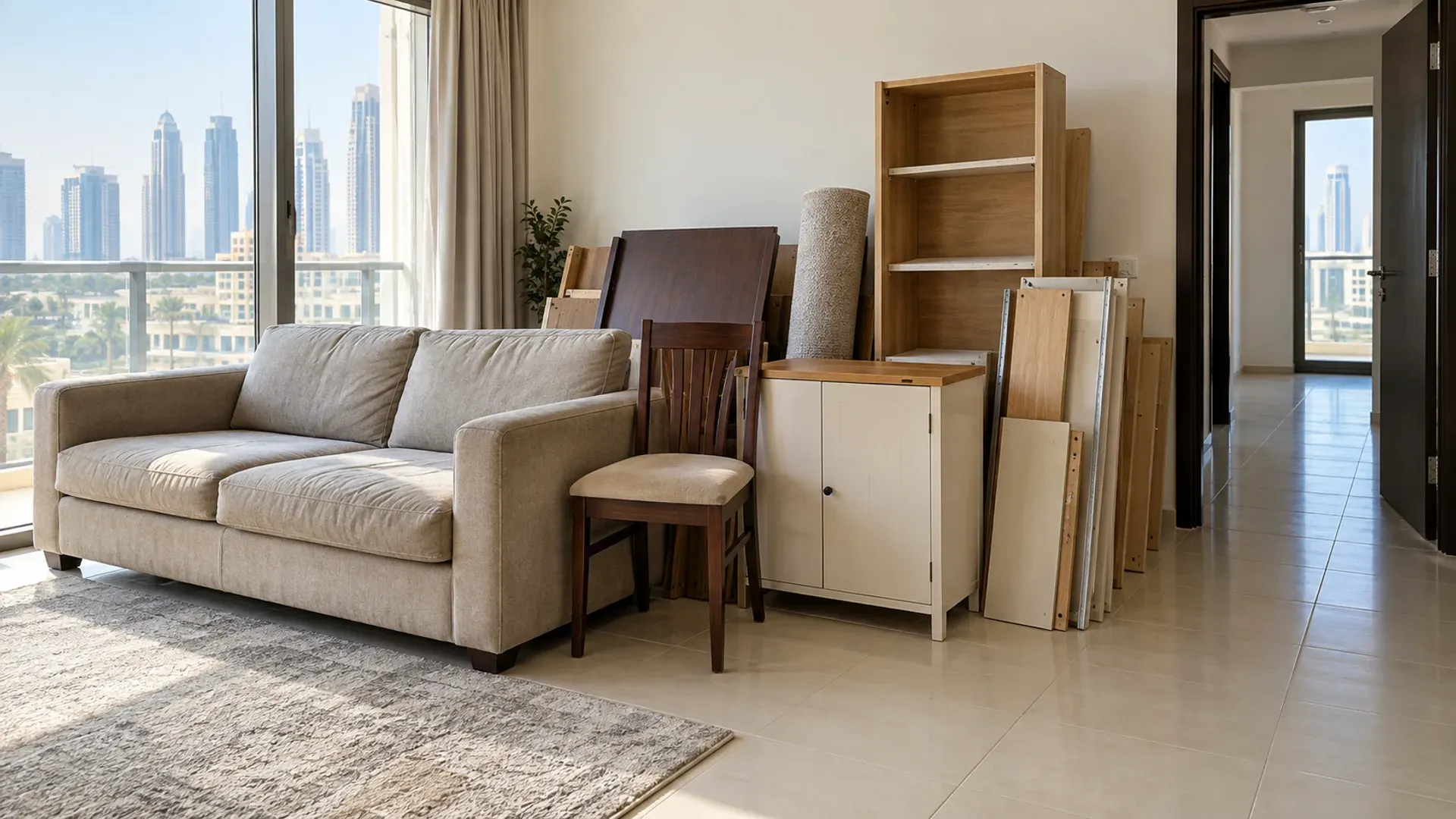
The picture is a sofa, one ordinary chair, a cabinet and shelving beside an apartment doorway. It does not show a counted set of dining chairs, and it does not show a table that is staying. Use it only as a reminder that one chair among other furniture is not this set. Your own photos still have to show the chairs that are leaving, and the table left out of that group.
Send these views.
- The chairs in the room before you move them, with the table visible enough to show it is not in the leaving group.
- Each leaving chair, or a clear group in which every leaving chair can be counted.
- Any chair that is staying, labelled in the note as staying, so it is not assumed to be in the load.
- A torn seat, a cracked leg, a missing foot or a loose arm, if you can see one.
- Cushions or pads off, or still on, for the chairs that have them.
- The doorway the widest chair has to pass, open as far as it goes.
Add the room name and the floor. Add a lift or loading note you have already been given. Add the number leaving and the number staying. Add the width and height of the largest leaving chair, and the clear width of the door that limits it. Add the words “table staying”.
If a chair is in another room, photograph it there and use the same name in the note. A photo of the table alone does not show the chairs. A photo of the tabletop does not show a wobbly leg.
If you have no tape, write “not measured”. Take the photos in the light the room already has. If that light does not work, say so.
One line in the booking
You can remove the chairs only once the number leaving is written, the table is marked as staying, and each leaving chair is a chair rather than a pile of unnamed parts. That page is the furniture leaving the room. It is not a request to take the table apart, and it is not a request to saw a chair down to the doorway.
If other household items are leaving in the same visit, and they are not these chairs, say so as separate lines. Do not hide a sofa, a high chair or a bag of mixed items inside the chair count. Those lines are not this set.
Say, in one message:
- how many dining chairs are leaving, and how many are staying
- the room, and any chair that is in a different room
- wood, metal, upholstered, arms or no arms, for the chairs that differ
- folded, will not fold, or not a folding chair
- pads or cushions off, or still on
- a crack, a wobble, a missing foot or an arm that is loose, if you can see it
- the width and height of the largest leaving chair, and the clear width of the doorway that limits it
- table staying
- anything that is not this set: a high chair, an armchair, a bench, a stool, a bedside table
Do not write “the dining set” as the only words. Do not write “table staying” if you have since decided the table is leaving. Do not ask for a chair to be cut because the figure is larger than the gap. The figure is the report.
If the chairs are still mixed with the ones you are keeping, you are early. Separate them, or name the keepers. Send the count you can stand in front of and check.
The dining-table page remains the table and any chairs that leave with it. The armchair page remains an adult lounge chair. The apartment page remains the whole flat. The high-chair page remains the child’s chair. This page remains the dining chairs that leave while the table stays.
The morning the chairs leave
Count them again. If someone moved a keeper into the leaving group, take it out and correct the number. If a leaving chair was put back at the table and you still want it to go, it is still leaving. Check the name matches the chair.
Look at the table. It should still be the table you photographed, with its top and its legs as they were. If someone has taken a leaf out, or unscrewed a leg, you no longer have the same “table staying” note. Stop and describe what changed, or put the table back to the state you wrote down if you can do that without a new repair. This page does not ask you to rebuild a table.
Open the door to the gap you measured. A box in the opening changes the width. Move it before you treat the old figure as current. If the widest chair is a different chair from the one you measured, measure again or say which chair is now the wide one.
Point at the leaving chairs as the chairs. Point at the table only as the table that is staying. Point at a high chair, an armchair or a bedside table only if it has its own line. Leave a bench and a stool out of the chair count unless you have named them as separate lines.
Do not line the chairs along a shared corridor the night before. If the only place they can wait is the room they are already in, leave them there, clear of the doorway, with the keepers obvious.
When they have gone, look at the table. A cushion you meant to include is still a cushion if it is on the seat you are keeping. A chair you meant to keep is a problem only if it left. The useful record is the sentence from the first count: the chairs that were leaving, the chairs that were staying, the table left as a table, and the doorway’s clear width written beside the widest chair.