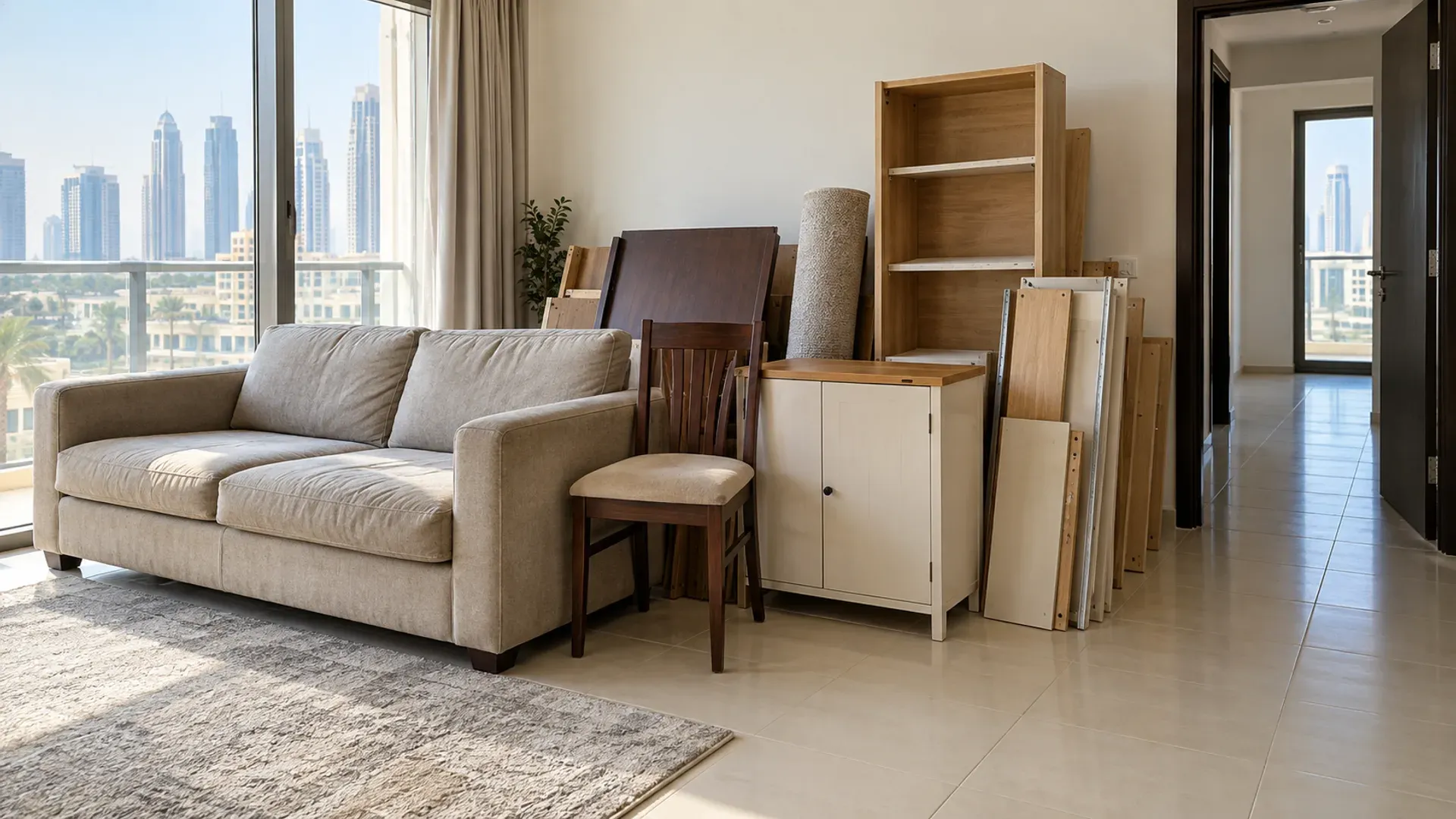
An armchair looks like the easy part of a clear-out, but its shape and what is inside it decide how it leaves. Before you book anything, work out what kind of chair it is, close and lock any reclining part, unplug and coil any power cable, and measure the chair at its widest point against the narrowest door on the way out. Then choose one route: a person who has agreed to take it, the Municipality's bulky-waste service if your address qualifies, or a paid collection. Keep the chair inside your home until that route is ready.
Work out what kind of armchair it is
The type of chair changes how it is carried, whether it can be taken apart and whether any part needs a separate disposal question. Match it to one of the groups below.
Fixed armchairs and accent chairs
A fixed armchair has a frame, upholstered seat and back, and arms built into the frame. Accent chairs and occasional chairs are similar, with slimmer arms and often exposed wooden or metal legs.
Check the legs. Some screw into a plate under the seat and can be removed by hand, which reduces the height and protects the legs from snapping in a doorway. Others are glued, doweled or part of a continuous frame and stay where they are.
Wingbacks and high-backed chairs
A wingback has side panels projecting forward from the top of the back. That shape makes the chair deeper and taller than its seat suggests. A wingback that fits through a door upright may catch at the top of the frame, and turning it on its side can put the wings in the way instead. Measure the back height and the distance between the wing tips, not only the seat width.
Swivel, rocking and glider bases
Swivel chairs sit on a metal turntable. Rocking and glider chairs sit on curved runners or a sliding base. These bases add weight low down and can move unexpectedly when the chair is tipped. A swivel base may be bolted to the underside of the seat. A glider base may have exposed moving arms that can pinch fingers. Note the type of base when you describe the chair, and avoid tipping it with someone's hand near the moving parts.
Manual recliners
A manual recliner has a lever, pull handle or push-back action that extends a footrest and tilts the back. Inside is a folding metal mechanism. When the chair is tilted or carried at an angle, a recliner that is not fully closed can open partway. That is where hands, fingers and doorframes get caught.
Close the recliner fully before anyone lifts it. If the footrest will not stay down, tie it closed with a soft strap around the chair, not around the mechanism itself. Some recliners have a removable back that lifts off brackets. Photograph it in place first, and only remove it if the instructions or the chair's own design make that clear.
Powered recliners and lift-assist chairs
A powered recliner uses an electric motor to move the back and footrest, with a handset or buttons in the arm and a cable to a wall socket. A lift-assist chair adds a motor that raises the whole seat forward to help someone stand. Both are heavier than they look, and both contain electrical parts.
Return the chair to the closed, seated position while it is still plugged in. Then switch off at the wall, unplug it, and coil the cable and handset so they cannot trail or snag. Tape the coiled cable to the chair's back or bag it with the chair. If the motor does not work and the chair is stuck open, say so in your quote request. A chair stuck in the reclined position takes much more space and should not be forced closed with tools.
The motor, wiring and handset raise an electrical waste question that a plain fabric chair does not. The e-waste guide explains why electrical items are treated differently from ordinary household waste.
Pairs, sets and chairs that match a sofa
Armchairs may come in pairs or as part of a suite with a sofa. Decide whether every piece in the set is leaving or only one. If only one chair goes, mark the one that stays so it is not loaded by mistake. If the matching sofa is leaving at the same time, describe the whole suite in one request. A sofa brings its own doorway and lift questions, which the sofa removal service is set up to deal with. A sofa that unfolds into a bed has its own preparation steps, covered in the sofa bed guide.
Why a small chair can still be awkward to move
A single armchair takes up less floor space than a sofa, but that does not make the carry simple. Several features make a chair harder to move than its size suggests.
- Wide arms set the width. The seat may be narrow, but rolled or padded arms can make the arms the widest part of the chair.
- The back can be the tallest point. A high back or wingback can catch on a door frame or the top of a lift opening.
- Fixed legs add height and snap easily if the chair is dragged or turned against a frame.
- A mechanism adds weight and can move. Recliners, swivels and lift chairs are heavier at the base and can shift when tipped.
- Upholstery gives no grip. Fabric and leather are slippery, and there are few solid handholds on a rounded chair.
For a tower apartment, the route out matters as much as the chair. Measure the chair's width, depth and height. Then measure the bedroom or living-room door, any corridor turn, the front door and the lift opening. The narrowest point on that route decides whether the chair leaves whole, with its legs off, or not at all through that route.
Check the condition before deciding on reuse
Reuse is realistic only for a chair that someone else would actually want to sit in. Inspect the chair in good light before you offer it to anyone.
- Structure: rock the chair gently. A loose joint, cracked frame or broken spring that you can feel through the seat means the chair is not ready for another home.
- Upholstery: look for tears, worn patches, staining and sagging cushions. A small mark may not matter; a split seam or flattened seat matters more.
- Hygiene: check for odours, pet hair, signs of moisture and anything living in the seams. If you are unsure, do not pass it on.
- Mechanism: open and close a recliner or lift chair fully. A mechanism that sticks, jerks or makes grinding noises is a fault the next owner inherits.
- Completeness: make sure the cushions, legs, cable and handset are all present.
If a chair is cracked, broken or unsafe, treat it as damaged furniture rather than a donation. The broken furniture guide covers how to make a damaged piece safe to handle and how to describe it.
A good-condition chair still needs a specific person or organisation that has agreed to take it, with a date. A chair that is "probably donatable" but has no confirmed recipient is still in your home on collection day. The furniture donation guide explains what usable means in practice and how to confirm a collection before you rely on it.
Prepare the chair before anyone lifts it
A little preparation makes the carry safer and the quote more accurate.
Empty the chair. Feel down the sides of the seat cushion and between the cushion and the arms. Phones, remote controls, keys, coins and jewellery collect in these gaps. Recliners have extra space under the seat and inside the footrest housing where small items can drop.
Close and secure any moving part. A recliner should be fully seated and, where the footrest will not stay closed, tied with a soft strap around the outside of the chair. Swivel and rocking chairs can be steadied by whoever is carrying them, but tell the crew about the base.
Deal with power. Return a powered chair to the seated position, unplug it, and coil the cable and handset. Do not cut the cable or try to remove the motor.
Remove screw-in legs only if they unscrew by hand and you can keep them together. Put them in a bag taped to the chair. Do not saw off fixed legs or force a joint apart to make the chair smaller. Furniture removal includes dismantling where an item will not fit, so leave anything that needs tools to the crew and say in your request that it may need taking apart.
Choose one route for the chair
There are three realistic routes for an armchair you no longer want. Pick one, confirm it, and keep the chair inside until it is ready.
A confirmed recipient
If the chair is clean, sound and complete, someone you know or a community group may take it. The arrangement is only real once the person has agreed, a date is set, and you know who is carrying it out. Ask whether they will collect it themselves, and from which door. If the arrangement falls through, you still need another route before your deadline.
The Municipality bulky-waste service
Dubai Municipality provides a bulky-waste service for household furniture and electrical appliances. The Dubai Municipality services directory lists it as "Dispose of Household Appliances and Furniture", describes the service as free with a three-working-day service time, and excludes investment zones. Check whether your address is covered and how the chair must be presented before relying on it. The guide to the Municipality bulky-waste service explains eligibility and preparation in more detail.
This route suits a chair that you can present as the service requires and that is not needed gone by a particular hour. If the chair is on an upper floor, check what the service expects you to do about bringing it down.
A paid collection
A paid collection suits a chair that has to leave on a set day, that sits several floors up, that is heavy or powered, or that is one piece among other items leaving at the same time. The crew carries it out from where it stands, dismantles it where needed and loads it by hand. If you want an armchair carried out and taken away with the rest of the furniture, send photos and the access details so the quote covers the actual job.
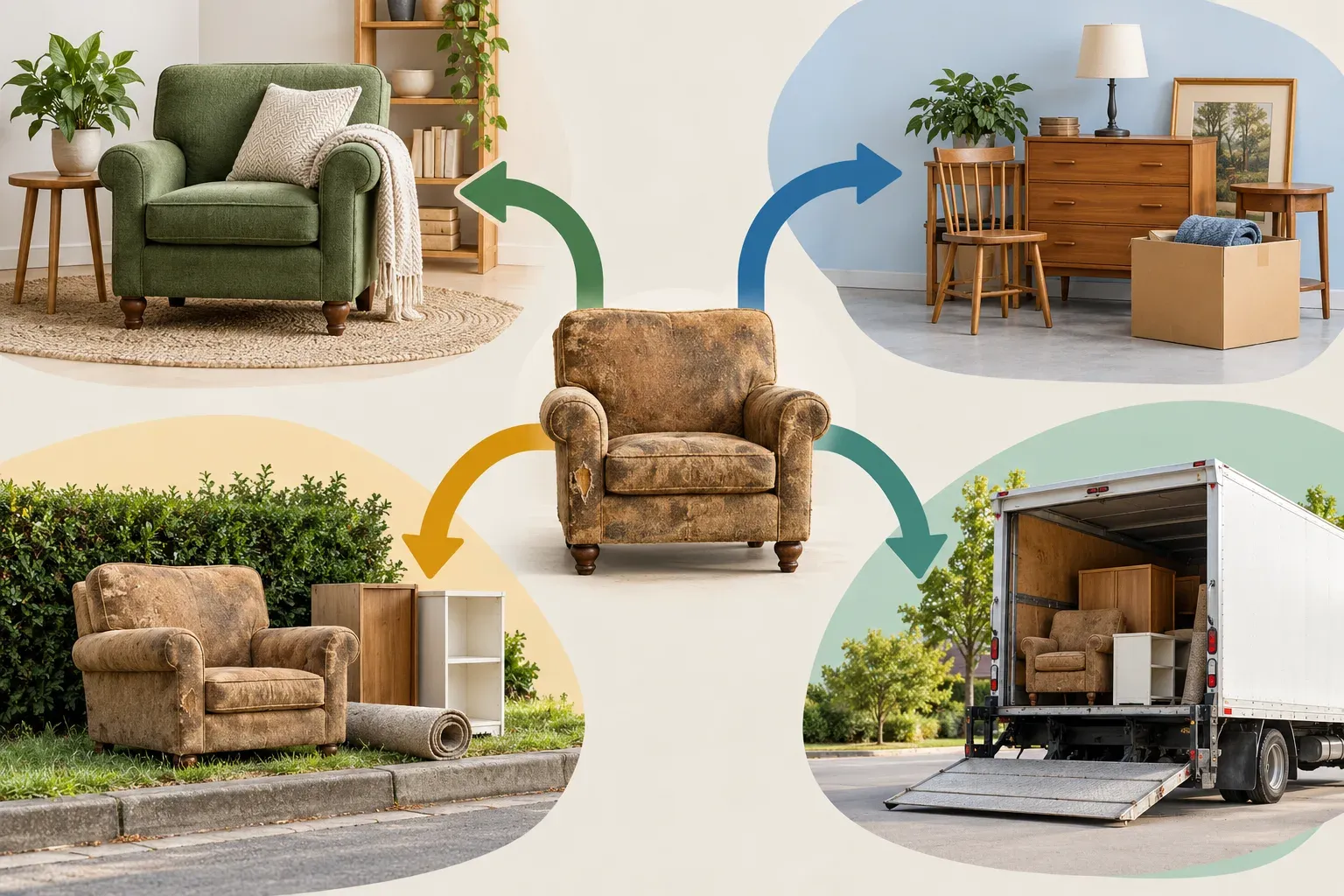
If you are still deciding which route suits the furniture as a whole, the old furniture disposal guide compares the routes in more depth.
Combine the chair with anything else that is leaving
A single armchair can be collected on its own. If other items are leaving soon, though, one collection covering everything is simpler than several. Photograph them together with the chair and include them in one request. If an old dining set is part of that load, the dining table guide explains how to describe glass and stone tops.
Mention a matching footstool or ottoman separately. It belongs with the chair visually, but it is a separate item to carry and load. If the chair is leaving because a new one is being delivered, plan the collection before the delivery so the old chair is not in the way of the new one.
Plan the building access
In a tower, the armchair has to travel from the room to the loading point. Where your building requires a service-lift booking or a move-out notice for furniture, arrange it before you confirm a collection time. Rules differ by building, so ask management what applies to a single chair as well as to a larger move. The service-lift booking guide lists the questions to ask.
In a villa or townhouse, the questions are stairs, gates and parking. A chair coming down an internal staircase needs a clear path and enough room to turn at the landing. Tell the provider about steps at the entrance, a narrow side gate or distant parking.
Keep it inside until it is collected
Leave the chair in your home until the route you chose is ready. Do not move it to a corridor, lift lobby, bin room, car park or roadside to wait. Shared spaces are not storage, and furniture left there obstructs other residents and may breach building or Municipality rules. The guide to dumping rules in Dubai explains why leaving bulky items in shared or public spaces is a problem.
What to send when you ask for a quote
A clear request lets the provider confirm the job without guessing.
- A photo of the whole chair from the front and the side.
- A close photo of anything unusual: a mechanism, a swivel or rocking base, damage, or a power cable.
- The chair's width, depth and height, measured at the widest points.
- The type: fixed, wingback, swivel, manual recliner, powered recliner or lift chair.
- Whether a powered chair still closes, or is stuck open.
- The floor, lift and parking details, and any building booking you have made.
- Anything else leaving at the same time.
- The date it needs to be gone.
The answer you need back is whether the chair can be taken, what the collection covers, and when it can happen. A request is not a booking until the scope and time are agreed.
Questions about armchair removal
Do I need to take the legs off first?
Only if they unscrew by hand and you can keep them together. Do not cut or force fixed legs. Mention in the request that the chair may need taking apart.
My recliner is stuck open. What should I do?
Do not force it closed with tools or by standing on it. Photograph it in the stuck position, note whether it is manual or powered, and send that with your request so the crew knows what to expect.
Is a powered recliner treated differently?
The chair is still furniture, but the motor, wiring and handset are electrical parts. Unplug and coil the cable, mention that it is powered, and ask how the electrical parts will be handled.
Can I put the chair out by the bins for the Municipality?
Do not leave it in a shared or public area while you wait. Check how the Municipality service needs the item presented at your address, and keep the chair inside until the collection is confirmed.