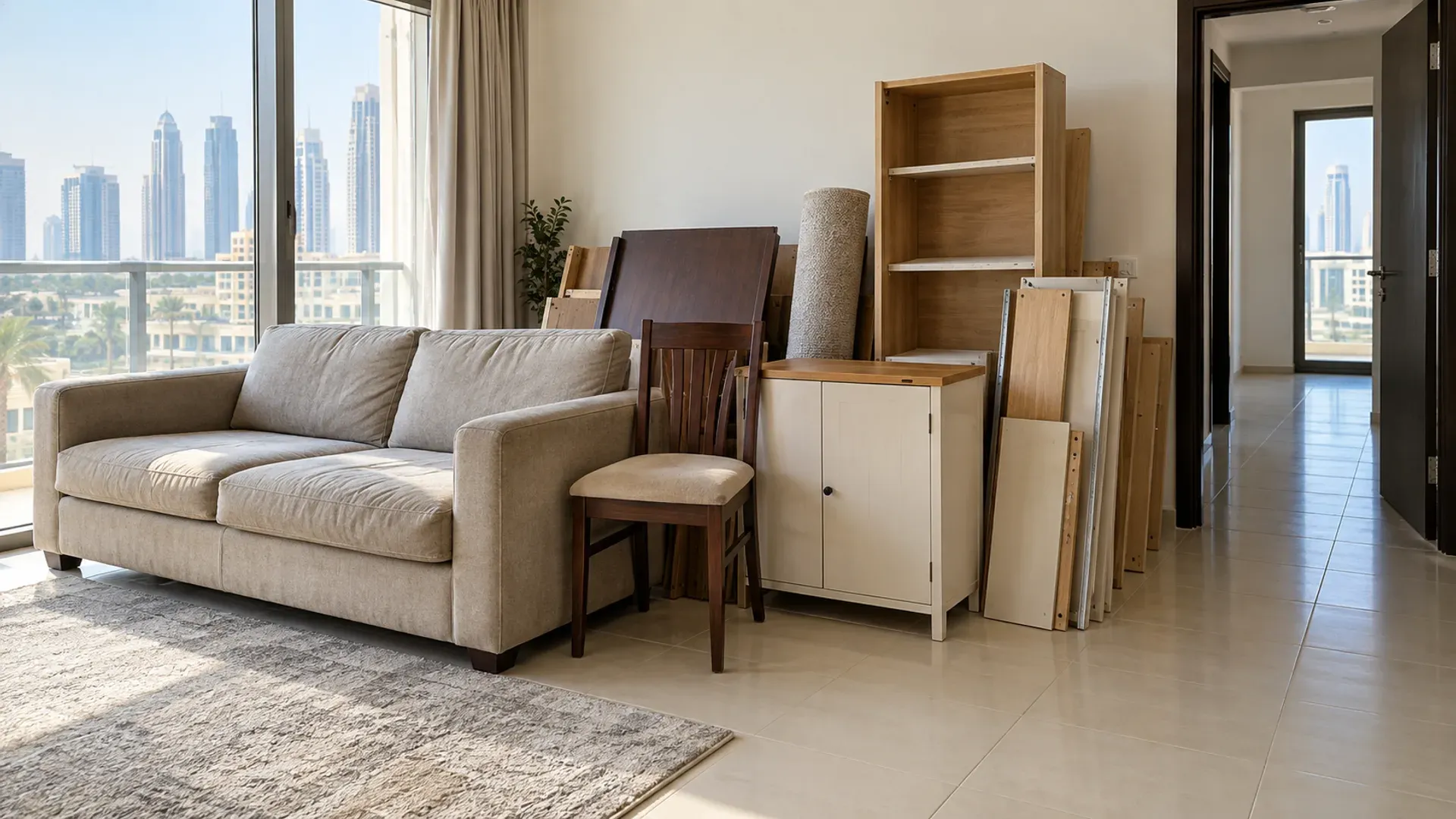
The top decides how a dining table leaves. Look at what it is made of and how it sits on the base before you think about the doorway. A wooden top bolted to its legs can be taken apart and carried in pieces. A glass top resting on a frame has to be lifted off and carried separately. A marble or sintered stone top is heavy and can crack if it bends, so it needs careful handling. Count the chairs, benches and any extension leaves as part of the job, measure the longest piece against the route out, and then choose a route that suits the set's condition.
Start with the tabletop
The planning follows from one question: what is the top, and how is it attached? Tip a corner of the tablecloth back, look underneath the edge and check whether the top is fixed to the frame or simply resting on it. Do this before anyone lifts the table or shifts it across the floor.
Solid wood and veneered tops
A solid wood top is heavy for its size and is usually screwed or bolted to an apron or frame underneath. Veneered tops look similar but have a thin wooden surface over a board core, such as MDF or chipboard. Both can usually be separated from their legs with the right tools. The difference matters if the table is going to someone else: veneer chips at the edges and lifts where water has soaked in, while solid wood can often be sanded and refinished. Photograph the surface in good light so marks, burns and water rings are visible.
Glass tops
A glass dining table may use a top that rests on rubber pads or small suction cups on a metal or wooden base. The top is not bolted down, which means it can slide if the table is tilted. Lift a glass top straight up with enough people to hold it level, then stand it on its edge on a folded blanket against a wall where nobody will knock it. Never carry the base with the glass still on it. Check the edges and corners for chips; a chipped glass top is weaker than it looks and should be described honestly when you ask for a quote.
Marble, granite and sintered stone tops
A stone or sintered top is the most demanding part of a dining set to move. They are heavy, and a large slab can crack under its own weight if it is lifted from one end or allowed to bend in the middle. Some stone tops are bonded to a board or frame underneath; others sit loose on the base. Do not slide a stone top across the base or along the floor, and do not try to lift it off alone or with one helper. If you are not sure how the top is fixed, leave it in place and say so when you request collection. A crew can then decide how many people the lift needs and whether the top should travel separately.
Extendable tables, pedestals and other bases
An extendable table has moving parts that are easy to forget. Find every leaf before collection day. Leaves are often stored inside the table, in a sideboard drawer or at the back of a cupboard. A missing leaf makes a table harder to pass on, and a leaf found after the collection becomes another item to deal with. Close the table fully before it moves, and tape or tie the runners so the halves cannot slide open while it is tilted.
Pedestal tables have one or two central columns instead of four legs. The pedestal may be bolted through a plate under the top, and a heavy stone or cast base can weigh more than the top itself. Four-legged tables usually have legs bolted into corner brackets, which makes them easier to separate. Trestle bases, metal frames and table-height benches each have their own fixings.
Whatever the base, keep the fixings together. Put bolts, washers and brackets in a bag, label it with the table, and tape it to the underside of the top or to one of the legs. If the table is going to a new home, a set with all its hardware is far more useful than a pile of parts. If it is going for disposal, loose bolts still need to be collected rather than left on the floor.
Count the whole set, not just the table
Chairs, benches and stools are part of the same job. Count them and note how they differ: upholstered chairs, wooden chairs, metal chairs, armchairs at the ends of the table. If an upholstered armchair is going too, the armchair removal guide covers recliners and wide-armed chairs. Stack chairs only if they are designed to stack, and only to a height that will not topple. Put loose seat cushions in a bag. If a chair is broken, keep it apart from the sound ones so it is not offered for reuse by mistake.
A sideboard, buffet or display cabinet that matches the table may also be leaving. Empty it completely before collection day, including the drawers and the shelves behind any glass doors, and remove loose glass shelves so they do not slide when the cabinet is moved. If it has a mirror or glass doors, mention them separately. A matching rug under the table may be leaving too; that is a different item with its own handling, and it is easier to roll once the table and chairs are out of the way.
Check whether any of the set belongs to the property. In a furnished rental, the dining table and chairs may be on the landlord's inventory. Do not dispose of them without written agreement from the landlord or agent, even if they are worn.
Decide what comes apart and what stays whole
Taking a table apart is not always the right answer. A small wooden table with fixed legs may pass through every door intact and be quicker to carry whole. A long table with a stone top almost certainly needs the top and base handled separately. A glued joint or an old dowelled frame may not come apart cleanly at all, and forcing it can split the timber.
As a rule of thumb for your own preparation, remove only what is designed to come off and can be removed safely: leaves, loose glass tops resting on pads, and legs held by visible bolts. Leave stone tops, glued joints and anything under tension to whoever is collecting. The furniture removal service includes dismantling, with the crew bringing tools and taking pieces apart on site, so there is no need to struggle with a stubborn fixing yourself.
Keep the parts together once they are separated. Lean the top against a wall on a blanket, stand the legs beside it and keep the hardware bag with them. A table split into pieces across three rooms is harder to quote and slower to load than one that is grouped in one place.
Measure the longest piece against the route
The top is usually the longest piece, and its length is what has to pass the route. Measure its length, width and thickness, and the length of any assembled base. Then measure the narrowest door the piece must pass, including the clear width with the door fully open, and look at every turn between the dining area and the exit.
A long top that fits through a doorway may still fail at a tight corridor corner or at the lift. When a piece has to turn, its diagonal matters more than its length alone. Measure the lift door width, the inside depth and the inside height, because a long top may need to stand on end inside the lift car. If the top is longer than the lift is tall, it may not travel in the lift at all, and the building may need to offer another route.
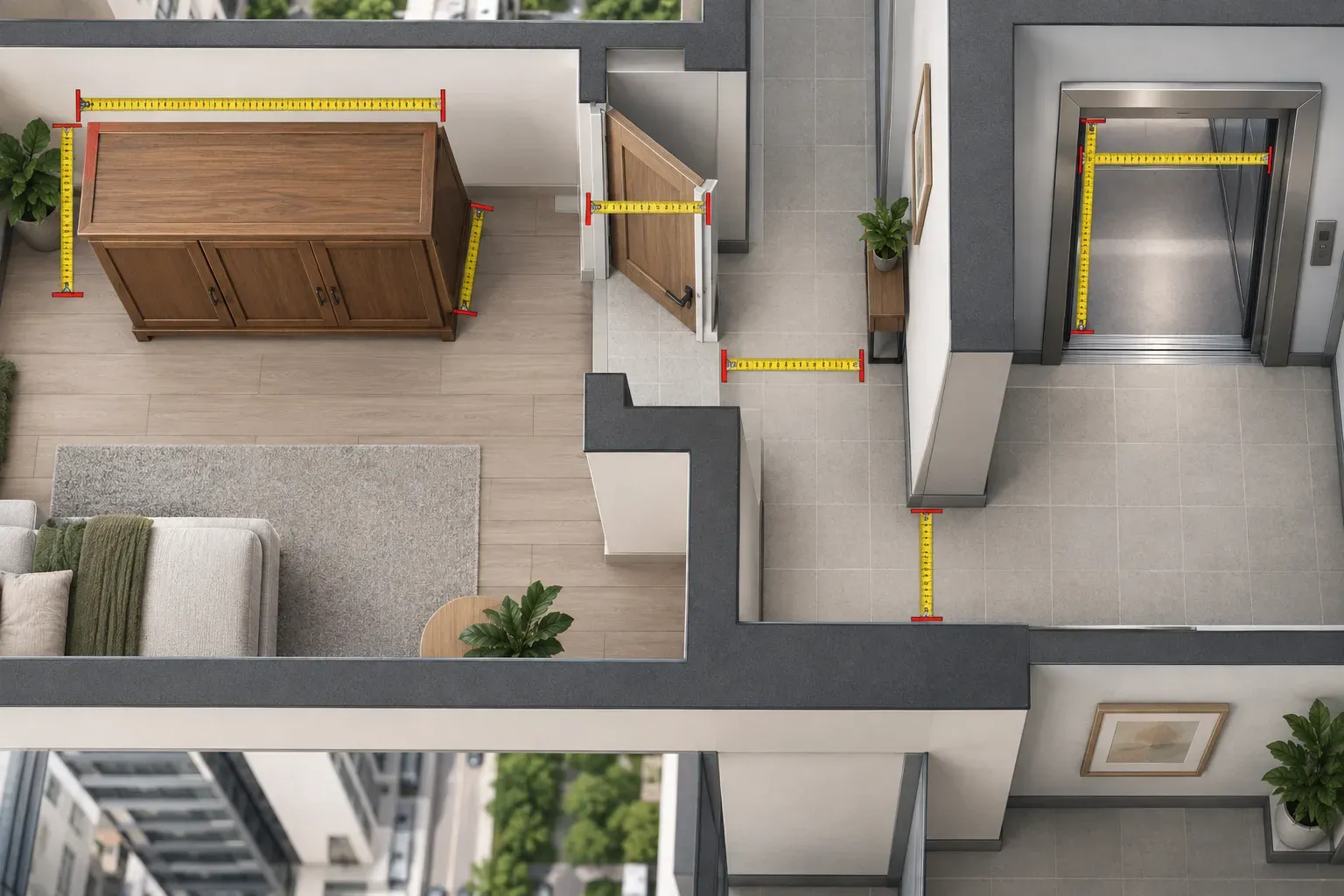
Write the measurements down and photograph the route from the dining area to the front door. The guide to getting bulky items out of a tower explains how to measure turns and lift openings in more detail. If a measurement is uncertain, say so in your request rather than guessing; an honest approximate figure is more useful than a confident wrong one.
Protect glass, stone and finishes while the table moves
Glass and stone need different protection from wood. Glass should travel on its edge, never flat, and should be wrapped so the edges and corners are covered. A blanket or thick card taped around the edges helps prevent chips. Stone should also travel on its edge with its weight supported along the full length, because a slab carried flat and unsupported can crack in the middle.
Wooden tops scratch and dent easily at the edges. Wrap them before they leave the room, especially if they are being passed on. Protect floors where the table will be set down, and clear the route of rugs, shoes and small furniture so carriers can see their footing.
If a glass top is already cracked, treat it as broken rather than fragile. Tape the crack, keep the top on its edge and tell the collector before they arrive. The guide to broken furniture explains how to make damaged pieces safe to move.
Be realistic about reuse
A sound table with matching chairs can be useful to another household, but only if someone has actually agreed to take it and can collect it before your deadline. Missing chairs, chipped glass, swollen veneer or a cracked stone top make reuse much less likely. Do not offer a set as a donation just because it looks good from across the room.
If you want to try, photograph the set clearly, state how many chairs come with it, mention any damage and give a firm collection date. The furniture donation guide explains what makes a piece genuinely reusable and why recipients turn items down. Flat-pack tables that have already been assembled and moved may not survive another rebuild; the flat-pack furniture guide covers how to judge that.
Choose a route for the set
There are three realistic routes for a dining set that is leaving the home.
A confirmed recipient
A friend, colleague or neighbour who has agreed to take the set and will collect it is the simplest route for a usable table. Agree who carries it, when, and through which building route. Keep the hardware with the table so it can be reassembled.
The Dubai Municipality bulky-waste service
Dubai Municipality lists a free service for disposing of household furniture and appliances. Its services directory states that the service is completed within three working days and that investment zones are excluded, so eligibility depends on the address. The bulky-waste service guide explains how the request is made. Confirm the current terms before relying on it, and check how the table and chairs will reach the collection point if the service does not carry items out of the home.
A paid collection
A paid collection suits a set that needs dismantling, a stone or glass top that needs careful handling, a tower route with a lift booking, or a deadline that cannot wait. Ask the provider to confirm the full scope: the table, every chair, any leaves, a matching sideboard, and whether dismantling is included. For other ways to deal with old furniture, the old furniture disposal guide compares the routes side by side.
Keep the set inside until it is collected
Do not move the table or chairs into a corridor, lift lobby or bin room to wait for collection. Shared areas are not storage, and furniture left there can block access and create a problem for the building. The guide to illegal dumping in Dubai explains why leaving bulky items in shared or public spaces is a risk. Keep everything inside the home, grouped near the exit, until the collector arrives.
Fit the removal around a new set
If a new dining set is being delivered, the old one has to be out first, or at least out of the dining area. Book the removal before the delivery date, not on the same morning, and leave space for the building's own arrangements. Where a building requires a service-lift reservation for furniture, check whether both the removal and the delivery need their own slot. The service-lift booking guide lists the questions to ask management before fixing either time.
Check the delivery company's written terms too. Some retailers offer to take an old table away, but do not assume this includes chairs, a sideboard or a stone top unless it is stated.
What to send when you ask for a quote
A clear request lets the collector confirm the job before arrival. Send:
- a photo of the whole set as it stands, including every chair
- a close photo of the top's surface and edge, showing any chips, cracks or water damage
- the top's material: wood, veneer, glass, marble, granite or sintered stone
- the length, width and thickness of the top, and whether it extends
- the number of chairs, benches and stools, and any matching sideboard or cabinet
- whether the table has already been taken apart
- the floor, lift access, parking and any building booking requirements
- the date by which the dining area must be clear
State anything you are unsure about, such as whether a stone top is bonded to its base. That uncertainty is useful information.
Once the set has gone, check under where the table stood for felt pads, loose bolts or a forgotten leaf, and look inside the sideboard space for anything left behind.
Questions about dining table removal
Do I need to take the table apart before collection?
No. Dismantling is part of the furniture removal service. You can remove extension leaves and lift off a loose glass top if it is safe to do so, but leave stone tops and stubborn fixings to the crew.
Can a marble table go in the lift?
That depends on the length of the top and the size of the lift car. Measure both, including the lift's inside height, and send the figures with your request so the route can be checked before collection day.
Will someone take a dining set with a chipped glass top?
It is less likely. Describe the damage honestly to any potential recipient. If nobody agrees to take the set by your deadline, plan for removal instead.
Should the chairs be quoted with the table?
Yes. Count every chair, bench and stool and include them in the same request, so the vehicle space and carrying time reflect the whole set.