
A BBQ grill is ready for disposal only when it is cold, empty, freestanding or properly released, and separated from every fuel source. Photograph the complete grill, identify whether it uses gas, charcoal, electricity or another fuel, and show the route from the patio to the collection vehicle. For gas grills and patio heaters, detach the cylinder and keep it with you: the removal crew does not collect gas cylinders.
Do not hide a cylinder inside the cabinet or call the whole setup “one barbecue.” The grill body, side shelves, warming racks, grease tray, charcoal, ash, cover, tools and fuel are different parts of the preparation. Outdoor smokers and patio heaters add their own doors, chimneys, heavy bases and loose accessories. A clear inventory prevents a collection from stopping at the fuel connection.
Identify the grill before you prepare it
Begin with one wide photograph showing the complete item where it stands. Add pictures of the front, back, both sides, control panel, lower cabinet and maker's label if it is readable. Keep the photograph honest: do not close a cabinet around a cylinder or cover a damaged leg with a storage box.
Use a description that matches the item:
- freestanding gas barbecue with a separate cylinder;
- charcoal kettle or rectangular charcoal grill;
- outdoor smoker with a separate firebox or chimney;
- electric tabletop or freestanding grill;
- portable camping grill with its fuel removed;
- freestanding patio heater with a detachable cylinder;
- built-in barbecue, outdoor-kitchen insert or fixed masonry unit.
The last category is not an ordinary loose-item collection while it remains installed. A grill built into a stone counter, connected to fixed gas, hard-wired to the property or attached to an outdoor kitchen must be isolated and released by the appropriate responsible person before it can be assessed as a loose object. Collection is not demolition, gas work, electrical work or repair to the surrounding counter.
Record the approximate width, depth and height. Include side shelves, handles, lid hinges, chimney caps and wheels in the measurement. A shelf that folds down may reduce the width; a welded shelf does not. If a shelf is loose or damaged, say so instead of forcing it into a folded position.
Keep every outdoor appliance on its own line
If the patio holds a grill, smoker and two heaters, list four items. “BBQ set” is not enough. Each object has its own fuel boundary, base, shape and carrying route. A heater may be taller than the gate opening, while a smoker may be short but much heavier at the firebox.
Garden furniture is a separate group even when it was bought for the same entertaining area. The garden-furniture disposal guide covers tables, chairs, loungers and cushions. A full outdoor clear-out across several zones belongs in the villa-garden waste plan. This page owns the fuelled cooking or heating item and the preparation it needs before collection.
List covers, rotisserie parts, racks, pizza stones, side burners and tool hooks only if they are leaving. Small loose parts should be placed in a visible box after they are cool and clean enough to handle. Do not put a fuel canister, lighter fluid or unknown bottle in that box.
Remove the gas cylinder from the collection
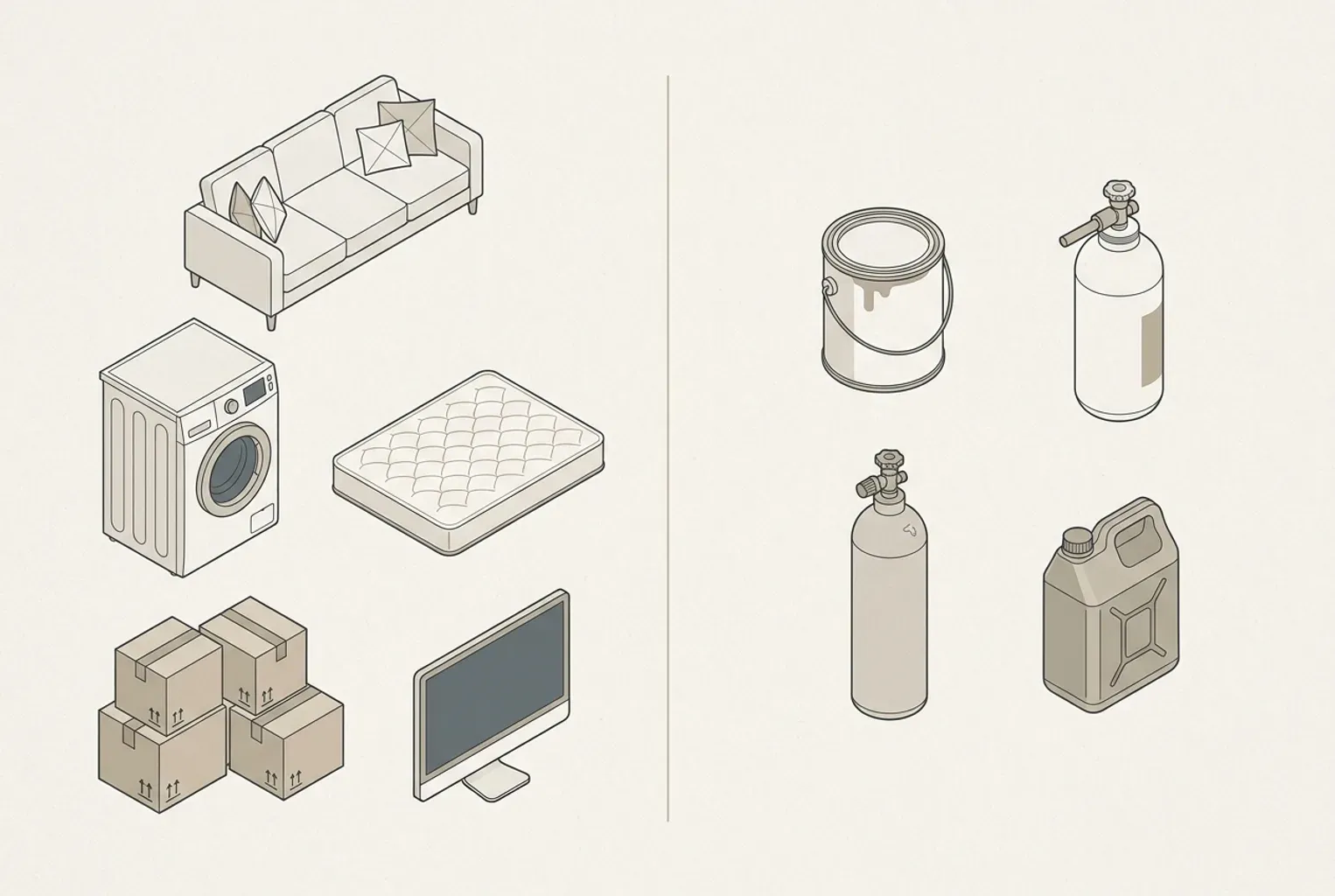
The gas-cylinder boundary is simple: the crew collects the approved grill, smoker or patio heater, but not the cylinder. Detach it before the visit and keep it with the customer for the supplier or other route that accepts it. This is the collection service's operating boundary; it is not a claim that every supplier follows the same return process.
Photograph the grill with the cylinder removed so the provider can see the final collection condition. If you do not know how to detach it, if the valve appears damaged, or if you smell gas, do not improvise. Keep people away from the area and contact the cylinder supplier or an appropriate qualified provider. The removal crew should not be asked to diagnose a leak or make a fuel system safe.
Do not empty gas into the air, transfer it between cylinders, cut a hose or conceal a small canister in a drawer. A disposable camping cartridge is still fuel and does not become acceptable because it fits inside the grill. State what is present and keep all cylinders and fuel containers out of the removal load.
Separate hoses and regulators without guessing
A flexible hose and regulator may belong to the customer, the cylinder supplier or the appliance. Photograph the connection before deciding what stays. If the cylinder can be detached through its normal connector and you know how to do that safely, keep the cylinder and its supplier-owned parts together. If the connection is unfamiliar, damaged or fixed, ask the supplier or an appropriate technician to release it.
Do not assume a patio heater is empty because the flame has stopped. Do not use the control knob as proof that the fuel source is disconnected. The collection request should show a physically separate cylinder and a heater or grill that no longer depends on a fuel connection.
For a built-in gas line, stop. The appliance needs to be isolated and released through a qualified person responsible for that installation. A loose barbecue with an ordinary detachable cylinder and a built-in appliance connected to property services are different jobs.
Let the item cool and remove cooking residue
Collection should be planned after the final use, not while the grill is hot. Allow the grill, charcoal, stones, racks and grease tray to cool completely. The crew cannot safely load an item with live coals, hot ash, hot oil or a warm firebox. “The flame is out” does not prove that every internal part is cool.
Remove food, disposable plates, foil and loose rubbish from the shelves and cabinet. Scrape or cleaning work is not part of the removal appointment. You do not need to restore an unwanted grill, but it must be stable enough to move without spilling grease, ash or food across the patio and vehicle route.
Empty the grease tray through an appropriate separate household or specialist route; do not pour grease into a drain, garden or soil. This article does not prescribe a universal disposal route for cooking residue. Its collection boundary is narrower: the tray should not be full, leaking or hidden when the grill is carried.
Show ash and charcoal as a separate material
Open the firebox and photograph what remains. Cold ash, unused charcoal, briquettes, wood chunks and smoker pellets are not the metal grill body. Remove them before the collection unless the provider has expressly accepted a separate, contained material group.
Do not place warm ash in a plastic bag or bin. Do not rely on the colour of a coal to decide it is cold. If the grill was used recently, delay preparation until the material is fully cooled and can be handled through the appropriate household route without creating heat or dust in the carrying path.
Lighter fluid, fire-starting gel, alcohol fuel and other ignition products stay outside the ordinary grill collection. Keep them upright, labelled and away from the load. If a container is damaged or its contents are unknown, disclose it rather than putting it under the cover.
An outdoor smoker may hold more residue than a simple grill: water pans, drip trays, wood, grease and ash can be spread across several levels. Empty each compartment and count any removable racks or heat deflectors that are leaving with the smoker.
Check whether the grill is loose or fixed
A freestanding grill normally rests on legs, castors or a cabinet base. It may still have a chain, anti-tip strap or hose that needs attention, but it is not built into the property. Photograph behind and underneath it before it moves.
A built-in grill can be surrounded by masonry, stone, timber cabinetry or a metal outdoor-kitchen frame. It may have fixed gas, electricity, lighting or water nearby. Do not pull it out to discover the connection. Confirm ownership and arrange release through the appropriate trade or responsible party. Only then can the loose appliance be assessed for collection.
In a rented villa, furnished property or managed community space, check who owns the equipment. A barbecue supplied with the property may appear on the inventory even if it is movable. A common-area grill is not a tenant's item to discard. Get written permission if ownership is unclear.
Treat damaged metal and glass as visible risks
Photograph rusted legs, loose wheels, sharp cabinet edges, cracked handles, broken glass and missing fasteners. A lid that no longer stays open should remain closed. A cabinet that leans should not be filled with accessories. Damage changes how the item can be lifted and should be part of the quote.
Some grills and heaters have glass doors, viewing panels or fragile ceramic parts. Name them. Remove a loose cooking stone or ceramic plate only if you can do so without dropping it, then box it visibly. If it is stuck or cracked, leave it in place and disclose the condition.
Do not wrap the entire grill before taking condition photographs. A cover can hide a cylinder, sharp shelf or broken wheel. Photograph first, then use a cover only if the provider agrees and the cover does not conceal the final fuel-free condition.
Empty and identify a patio-heater base
A patio heater may have a broad weighted base, a tall pole, a reflector and a cylinder cabinet. Measure its full standing height and the width of the reflector. Show whether the pole separates through its designed connection or remains one long rigid section.
Some bases are solid. Others may be filled with water or sand. Do not guess from appearance. Look for a cap or maker's instruction and state what you know. A filled base can be much heavier than the same shell shown empty in a product photograph. If it is designed to be drained and you can do that without spilling across the route, prepare it as instructed. If the contents or opening are uncertain, leave it and ask.
The cylinder must still be detached and retained by the customer. Photograph the empty cylinder compartment and any hose or regulator that remains with the heater. A heater is not ready because the top looks clean; the collection boundary is decided at its fuel connection and base.
Keep reflector sections and fasteners together when normal dismantling is agreed. Do not bend a reflector merely to pass the gate. Measure it and show the joint so the provider can decide whether the intended separation is enough.
Measure the largest rigid part and the entire route
Measure the item as it will be presented for collection. If side shelves fold through their designed hinges, record the folded width and show the hinge. If the chimney, heater pole or reflector separates through normal fasteners, measure the largest remaining part. Do not promise that a welded body will become smaller.
Walk from the cooking area to the point where the collection vehicle can stop. Measure the patio door or side gate, narrow garden passage, villa gate and any turn between walls. Photograph steps, gravel, slopes, irrigation lines, plants and low roofs. Wheels help only on a firm, level route; they do not make a rusted cabinet safe to roll down steps.
If the grill is on a balcony or roof terrace, include every internal door, corridor, lift and building access requirement. The fuel boundary remains the same indoors: no gas cylinder enters the removal load. For the building side, the bulky-item pickup guide explains how to photograph each restriction and the loading point.
In a gated community, confirm the gate and vehicle instructions before fixing the collection time. The gated-community clearance guide lists the access questions, but the current answer must come from your community or property manager.
Clear the route without creating a second load
Move toys, hoses, pots and retained furniture away from the carrying line. Do not stack those items beside the grill unless they are also on the inventory. A narrow path through an outdoor dining set is not a clear route.
Protect a clean indoor route if the item must pass through the villa. Grease residue, ash and loose rust should already be controlled before the grill crosses a floor. Tell the provider if stairs or an internal route are unavoidable so the carrying plan is based on the actual property.
Make parking available where the property permits. A patio-to-gate route is incomplete if the vehicle has no approved loading point outside. Send the location pin, gate number and parking instruction with the photographs.
Book the grill as a prepared outdoor item
Once the item is cold, empty, fuel-free and loose, send the evidence with a request for garden waste removal. The service can include freestanding barbecue grills, outdoor smokers and patio heaters in an approved outdoor load. Send the item count, fuel type, photographs, dimensions, damage notes, largest rigid part and route details.
State clearly that the gas cylinder will remain with you. If a supplier collection or another cylinder route is still being arranged, that does not prevent the loose grill from being quoted, but keep the cylinder physically separate from the outgoing group. Do not leave it beside the grill in a photograph labelled “all goes.”
Freeze the inventory before the appointment. Adding outdoor chairs, bags of soil, branches or another heater changes the load. Photograph any addition and get it accepted before the crew arrives. A quote for one prepared grill is not a quote for the whole patio.
On collection day, show the crew the empty cabinet, identify loose glass or damaged metal, and keep children and pets away from the route. If a hidden fixed connection or cylinder is discovered, stop and resolve it. The safe boundary does not change because the vehicle is already outside.
The useful preparation is straightforward: identify the exact appliance, separate the fuel, cool and empty every compartment, release fixed work correctly, and prove the route. Once those facts are visible, the collection is about one prepared outdoor item rather than an unknown fuelled appliance.
Common questions about BBQ grill disposal
Will the crew take the gas cylinder with the barbecue?
No. Detach the cylinder and keep it with you for the supplier or another route that accepts it. The crew collects the approved grill or patio heater, not gas cylinders. Do not conceal a cylinder in the cabinet or substitute a small fuel canister without declaring it.
Can a charcoal grill be collected with ash inside?
Prepare it empty. Allow all ash and charcoal to cool completely, then remove the residue through the appropriate separate route. The collection item should not contain hot material, loose ash, lighter fluid or food waste.
Do you remove built-in outdoor grills?
Only after the appliance has been properly isolated and released as a loose item and the collection scope has been confirmed. Fixed gas, hard-wired electricity, masonry, counters and outdoor-kitchen demolition are not assumed parts of grill collection.
Can a patio heater go in the same visit?
Yes, when it is listed, photographed and accepted before the visit. Detach and retain its gas cylinder, identify whether its base contains sand or water, and measure the pole and reflector against the route.
Does the grill have to be cleaned before collection?
It does not need to be restored, but it must be cold, empty and controlled. Remove food, loose ash, charcoal and leaking grease. Photograph rust, broken glass and sharp edges so the provider can plan how it will be handled.