Shredded paper leaves in its own sacks. It does not ride inside a pedestal, a drawer, a filing cabinet or a bag of furniture. A desk that still holds paper is not an empty desk, and a sack of shreds is not a workstation.
A booking that says “the office” will be read as desks, chairs and a fit-out. If the problem is paper that has already been shredded, and that paper would otherwise leave inside the furniture, the note has to split the two before anyone plans a crew.
Two lines, not one load
Walk the floor and point at two groups. The first is furniture that is leaving: desks, pedestals, cabinets, chairs. The second is shredded paper that is leaving: sacks, a bin of shreds, loose strips in a drawer. Write both groups in the same message. Same morning is not same object.
Count the sacks you can see. Count the drawers you have not opened. A corner that looks tidy can still hide a liner full of strips. Open it. A pedestal with the key in the lock is not empty until each drawer has been pulled and looked into.
This page is that split. It is not a whole floor of workstations, and it is not the packaging left after a house move. The office furniture guide is the desks, the chairs and the ownership of those pieces. Stay on that page when the question is which furniture leaves. The one-off office waste guide is a defined loose load for a floor, a room or a marked zone. Stay on that page when the question is the whole one-off collection, including what is not paper. Come back here when the only risk is shredded paper still sitting inside the furniture.
A sack of strips from a move, used as packing filler around crockery or a lamp, is not office records. Bag it so it cannot spill, and keep it with the other packaging. The packing guide is that filler. Do not describe packing shreds as a records sack to put them on this note.
Pull the paper out before the furniture is called empty
Start at one desk. Open the shallow drawer, the file drawer and any tray under the top. Lift the liner if there is one. Paper that has fallen behind the drawer is still in the desk. Sweep it into a sack you are sending, or into a tray you are keeping. Do not push the drawer shut and call the desk clear.
A locked drawer is not clear. If you have the key, open it and do the same check. If you do not have the key, write “drawer locked, paper not seen” on that pedestal and leave the pedestal out of the furniture line. Do not force the lock. Do not drill it. The person who may open it is the office’s own contact, not a collection crew. Existing office copy on this site already says a locked pedestal is either unlocked or accepted with its contents uninspected, and that records stay the office’s decision. This page does not add a way to break a lock.
Look under the desktop, behind the modesty panel and in the bin that sits at the foot. A small bin of shreds is a sack in all but the name. Tip it into a sack you can close, or label the bin itself if the bin is leaving and say “bin of shreds, not the desk”. A bin you are keeping stays in the room, empty of shreds, out of the photograph of the furniture.
A filing cabinet is not a desk, and it is not a sack. Open each drawer you are allowed to open. If the drawer holds folders that have not been shredded, stop. Those folders are still a records decision. Put them where the office keeps records it has not released, and write “unshredded files, not in the furniture line”. Do not tip a hanging file into a sack because the cabinet is heavy. If the drawer holds only shreds, move the shreds to a sack and leave the drawer empty.
A cardboard box of shreds sitting on a chair is the paper line, not the chair. Lift the box off. If the box is split, move the shreds into a sack that closes. The chair, if it is leaving, is furniture and needs an empty seat in the photo.
Loose strips on the carpet, under a foot and along a skirting board, belong in a sack before anyone moves a desk. A desk dragged across loose shreds will carry them into the corridor on its feet. Sweep the patch you can see. If a patch is under a desk you cannot shift alone, say “strips still under the desk” and do not book that desk as clear.
Toner, a spare cartridge, a battery, a spray bottle and a half-full mug are not shredded paper. Take them out of the drawer on their own. Do not bury them in a sack of strips to make the drawer look empty. A cartridge left in a sack of paper is a different object in the wrong bag.
A computer, a screen and a printer are not this paper. They need their own line. Do not hide a drive or a memory stick in a sack because it was in the same drawer as the shreds. Take it out and hand it to the person the office has named for devices.
Sack what is already shredded
This page starts when the paper is already in strips or small pieces, and the office has decided those pieces may leave. It does not tell you which documents to shred, how long to keep a file, or what a destruction certificate should say. If the office needs a certificate, that arrangement is made with whoever the office uses for that, before this booking. A general collection does not prove secure destruction. The office-waste guide already states that limit. This note does not soften it.
If the paper is still whole, leave it whole and out of the furniture. Write “not shredded”. Do not tear a stack on the floor to make it fit this page, and do not ask a crew to decide that a folder is finished. The office’s own person does that, away from the loading bay.
When the shreds are ready, put them in sacks you can close. A sack that will not close is too full. Split it. Tie or tape the neck so a lift does not pour strips down a stair. A loose heap on a desktop will not stay a heap once a desk is tilted.
Label each sack in writing you can read in a photo: “shredded paper, leaving”. If one sack is staying because the office has not finished with it, label that one “not leaving” and move it out of the furniture photograph. Two sacks that look the same, with no labels, will be read as one decision.
Say what the pieces look like, in ordinary words. Long strips. Small chips. A mix. You do not need a brand of shredder, and you do not need a security grade. The description is so the person looking at the photo can see that the sack is paper, not mixed rubbish.
Keep the sacks off the desks. Stand them in one place you are allowed to use, against a wall inside the office, not in a fire exit, a lift lobby or a shared corridor. A sack in a common route is not a prepared load. If the only space is a room you are clearing, put the sacks on the side of that room that is not the path of the furniture, and say so.
Do not put the sacks inside a pedestal “so they are contained”. That is the mistake this page exists to stop. The pedestal then looks like furniture and arrives with paper still in it. The photo has to show an empty drawer and a sack that is not inside that drawer.
Do not mix food, a wet cloth, a plant pot or a torn carton of strips into the same sack. Wet paper is a different condition. If a sack is damp, say “damp” and keep it apart from the dry sacks. Do not claim it is the same as a dry sack because both are paper.
A clear sack lets the photo show the contents. An opaque sack needs the neck open for one photo, then closed again, so the strips are visible once and then contained. Do not leave it open on the day.
What else must stay out of both lines
Personal items in a drawer — a wallet, a medicine strip, a set of keys, a lanyard — come out before the paper is sacked. They are not furniture and they are not the shreds. Put them with the person who sits at that desk, or with the contact the office named.
Access cards and a stamp are the office’s. They do not go in the sack. A card left in a drawer will leave with the pedestal if you called the pedestal empty.
Whole notebooks, a contract still in a sleeve, and a pile of invoices that have not been through the office’s own process stay out of the sack. Shredded paper is the released pieces. A document you can still read as a page is not released by being near a shredder.
Packing film, a foam corner and a flattened carton can sit in the same room. They are not this sack. If they are leaving, name them as packaging. If the carton is only a container for shreds and it is splitting, move the shreds and deal with the carton as cardboard, not as paper records.
A waste bin of ordinary desk rubbish — cups, wrappers, food — is not a records sack. Keep it out of the photograph of the shreds. If that bin is also leaving, say “desk rubbish, separate”. Do not pour it onto the shreds.
If the floor is a workplace with asset numbers, a facilities approval and more than this paper, you are on the office furniture guide or the office waste guide for the rest of the load. This note stays the paper that must not ride inside the pieces. Do not retitle a floor strip-out as a paper job because one pedestal had shreds in it.
A home desk with a few strips from one letter is not this page. Put those strips in the household waste the home already uses, or keep them if the letter is not finished. A sack large enough to hide inside a pedestal, holding paper from an office, is this page even if the desk stands in a flat the company uses. Say that the paper is office paper, and name the desk as furniture only after it is empty. Packing shreds in that same flat stay with the packing guide.
A DIFC pedestal is still a records decision
The DIFC office page already says paper left in a pedestal is a records decision, and that it is not tipped into a sack because a floor is being handed back. This note does not add a tower, a dock rule or a new building name. It uses that sentence for one situation: the paper is already shredded, and the risk is that it still leaves inside the furniture.
If the desk is in that district, write “DIFC office” only when that is the address, and still split the lines. The sacks are the paper. The empty pedestal is the furniture. Do not ask for the paper to be tipped out of the pedestal on the day. Empty it before the photo. If you cannot empty it, the pedestal is not on the furniture line.
No other district is added here. A desk in another office uses the same split without a new area page. The building name and the floor still belong in the booking, because a district name is not a loading plan. Copy any dock or lift instruction you have already been given. Do not turn one building’s note into a rule for the next building. If you have no instruction, write “no lift instruction yet”.
Photograph the sacks apart from the desks
The photos have to show two subjects. A closed row of desks does not show whether a liner still holds strips, and a sack photographed inside a drawer is still inside the furniture.
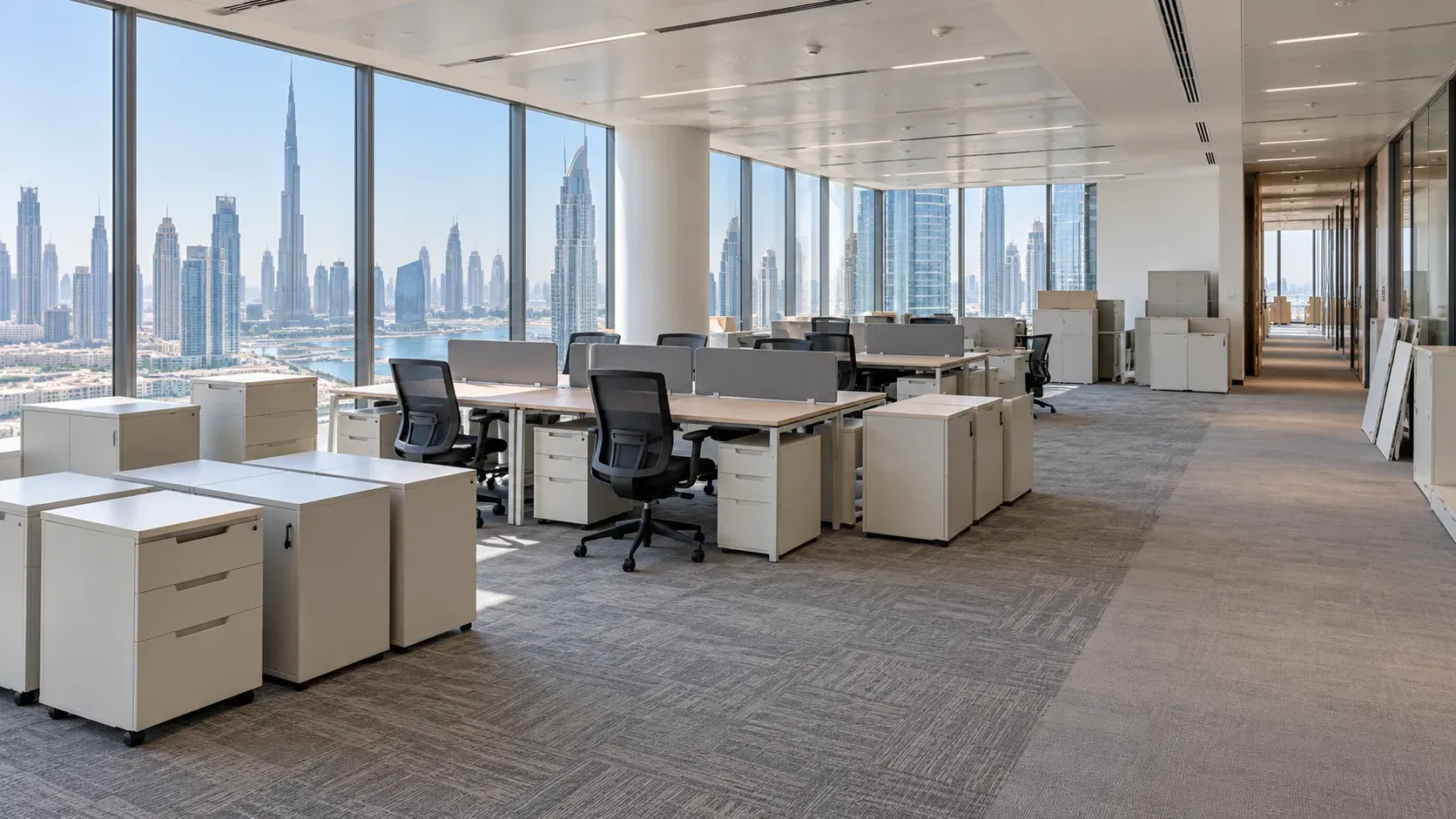
The picture is a workplace floor of desks, chairs and cabinets. It does not show a sack of shredded paper, an open drawer or a labelled bag. Use it only as a reminder that a floor of furniture is a different picture from a paper sack. Your own photos still have to show the sacks and the empty drawers as two subjects.
Send five photos.
The first is the sacks together, labels readable, necks closed, none of them inside a pedestal or a drawer.
The second is one sack open enough to show strips or small pieces, then closed again before you leave it.
The third is one desk or pedestal with a drawer open and empty, so the furniture line is visibly clear of paper. If a drawer is locked, photograph the lock and the words “paper not seen”.
The fourth is anything that must not be in the sacks: a cartridge, a battery, a whole file, a device. Include it in the frame or say it has been removed.
The fifth is the place the sacks are waiting, and the door the furniture has to pass, so the two groups are not stacked on the same path.
Add the counts: how many sacks, how many desks or pedestals on the furniture line, how many drawers still locked. Add whether any sack is damp. Add that a destruction certificate is not part of this booking, if the office still needs one from somewhere else.
If a drawer you called empty still has strips in the liner, do not ask for a collection time for that piece. Empty it and take the photo again.
Take the photos with the room light on. A closed pedestal photographed from the front hides the drawer you needed to show.
Book the sacks on their own
You can ask for a waste collection for the paper sacks when the sacks are closed, labelled and out of the furniture. That page is a paid project or site load. It is not a municipal bin contract, not clinical waste, and not a confidential-destruction service. The furniture, once the drawers are empty, stays on the office furniture guide. Do not fold the sacks into the word “desks”.
In the message, say:
- that the paper is already shredded, and how many sacks
- that the sacks are out of the pedestals and the drawers
- that unshredded files are not in the sacks, or where those files are waiting
- any locked drawer, and that it is off the furniture line
- any device, cartridge or battery you removed
- whether a sack is damp
- that you are not asking for a destruction certificate from this visit
- the floor, the door and any lift or dock note you already have, or “no lift instruction yet”
- the furniture that is also leaving, named as a separate line, or a statement that the furniture is staying
Do not write “office junk” as the only line. A sack inside a drawer is not a cleared desk. A folder you have not shredded is not a sack of shreds.
If the whole floor is leaving, the sacks remain one prepared line inside that larger list. Do not send two descriptions that disagree about whether the paper is inside the furniture.
If you have not opened the drawers, you are early. Open them first. A collection booked from a photo of closed pedestals cannot see the strips in the liner.
The office furniture page remains the desks and the chairs. The office waste page remains the one-off load for the zone. The packing page remains filler from a move. This page remains the shredded paper that must not leave inside the furniture.
On the morning the furniture leaves
Leave the sacks where the photos showed them, closed and labelled, off the path of the desks. Do not tip them back into a pedestal overnight because the room looked bare. Do not stand a sack in the corridor to “save space” inside the office.
Point at the sacks as the paper line. Point at the empty drawers as the furniture line. Point at a locked pedestal if you wrote one, so it is not lifted as an empty unit. Point at a tray of unshredded files so it is not sacked on the spot.
Walk once to the door. A chair you moved back in front of the sacks is the new block. A rug of loose strips you meant to sweep will travel on someone’s shoes. Sweep it into a sack before anyone moves a desk.
If a drawer you thought was empty still has paper, stop that piece. Do not send it and promise to sort it at the vehicle. Bring the paper out, sack it, and update the count. The photo of the open empty drawer is the record. A later message that “it was mostly empty” is not that photo.
When the sacks have gone, look in the drawers you opened. They should still be empty. A liner you missed is still paper. The furniture that stayed should not have gained a sack inside it.
The useful record is the sentence from the first check: shredded paper in its own sacks, furniture empty of that paper, and no request to tip a pedestal into a bag on the day.