Treadmill removal starts with two facts: what kind of machine it is, and whether its largest rigid section can travel from the room to the collection vehicle. Photograph the whole treadmill and its identification label, check whether the deck folds, secure the moving belt and loose parts, then measure the machine against every doorway, turn, lift and loading point. Do not start taking it apart until you know which joints are designed to separate.
A household treadmill is accepted for collection under the site's existing junk removal service. The repository also confirms that crews use straps and a trolley and can dismantle gym equipment where needed. This guide stays within that household scope. A commercial gym, permanently fixed machine or unusually complex installation needs a separate assessment before anyone promises a method.
Identify the treadmill before booking
Begin with the label rather than a guess about weight or construction. Look around the front frame, motor cover, upright or power inlet for the maker, model and electrical label. Send a clear photograph if the text is difficult to copy. The model may help distinguish a compact folding treadmill from a wide fixed-deck machine that only separates at selected bolts.
Take one wide photograph from the front, one from the side and one from behind. Include the complete frame, console, handrails, power lead and deck. Add close photographs of obvious hinges, locking pins, transport wheels and damaged areas. If the treadmill is already partly dismantled, lay out every removed piece so the collection scope is visible.
Do not describe a treadmill as merely “one gym item.” Its deck, uprights and console create different handling and route problems. A photo that cuts off the front motor housing or hides the wall clearance cannot answer whether the machine turns through a doorway.
Record where it is located: room, floor, apartment or villa, and whether stairs or a service lift sit on the route. Mention narrow passages, steps, low ceilings and long carries. The bulky-item pickup guide explains how to photograph the object and the complete path when several restrictions are involved.
Decide whether it folds, rolls or separates
Many domestic treadmills have a deck that lifts towards the console for storage, but “folding” does not mean light or easy to steer. The folded machine may be taller, top-heavy and harder to turn. Confirm that the latch engages properly and that the deck cannot fall while the treadmill is being positioned.
Some machines have small transport wheels intended for short movement on a flat indoor floor. Those wheels do not prove that the treadmill can cross thresholds, travel down ramps or enter a lift safely. A worn wheel, uneven tile joint or steep change in level can stop the movement. Photograph the wheel position and every threshold instead of treating the wheels as a complete removal plan.
A fixed deck may still have uprights or a console that can be removed. Use the manufacturer’s instructions when available and separate only components intended to come apart. Do not remove random frame bolts merely because they are accessible. Some fasteners control deck tension, alignment or structural joints; loosening the wrong one can create an unstable assembly.
If the machine does not fit while intact, share the model and route measurements before dismantling. The crew can assess controlled separation within the confirmed service scope. A treadmill that is fixed to the building, connected beyond an ordinary plug, or integrated into a specialist floor remains conditional until the responsible release work is identified.
Make the treadmill safe to handle
Switch the machine off, unplug it and remove the safety key. Coil the power lead without pulling it tight around the plug. Put the safety key, remote, clips and small accessories in a labelled bag. If any parts are staying with you, separate them clearly from the collection group.
Allow the treadmill to return to its normal resting incline before disconnecting power if the instructions require powered adjustment. Do not force an elevated deck downward. A machine that is stuck, damaged or making an unusual movement should be described as such before collection.
Clear bottles, towels, phones, headphones, mats and stored belongings from the treadmill and surrounding floor. Check under the deck and behind the motor housing for loose objects. Vacuuming loose dust from the accessible floor can prevent it spreading along the route, but do not open electrical housings or attempt technical repair for the sake of collection.
Secure a folding deck using its designed latch. If a manufacturer-provided pin or clip is missing, disclose that rather than improvising a tie that might release. Keep the walking belt centred and do not use tape or adhesive directly on a surface where it could cause damage. Loose covers or cracked trim should be photographed and identified during the arrival walk-through.
Protect the power lead and console from becoming handles. They are not lifting points. Handrails may also be unsuitable for carrying the machine’s full load. The handling plan should use the structural frame and suitable equipment, not whichever projection is easiest to grab.
Measure the largest rigid section and the route
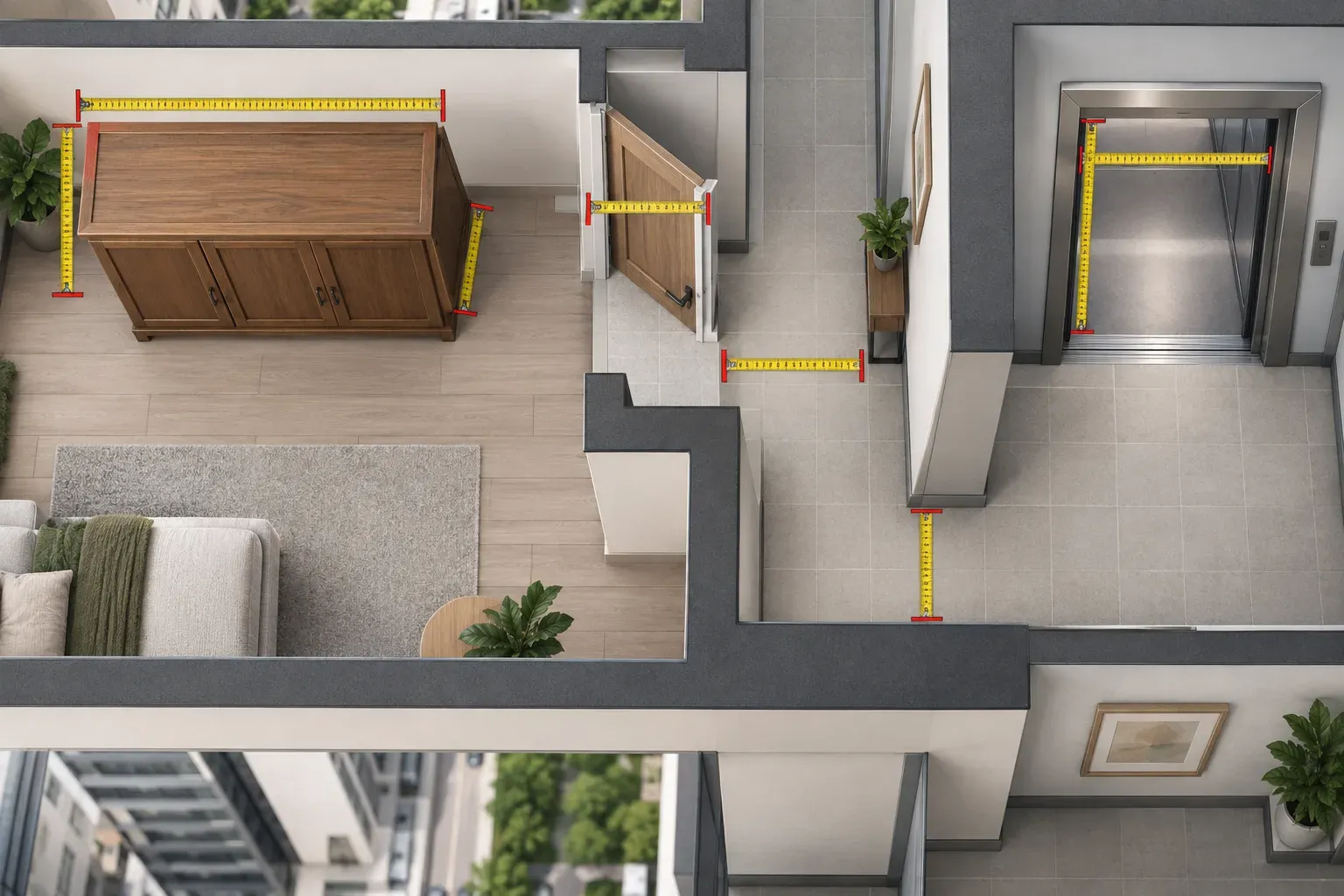
Measure the treadmill in the configuration planned for removal: operating, folded, or separated according to its designed joints. Record length, width and height. Then identify the largest rigid section that remains after any planned separation. That section, not the smallest loose part, controls the route.
Measure the room doorway at its narrowest clear opening. Account for the door leaf, handle, closer and frame. Continue through corridor turns, lobby doors and lift entrances. A width that works in a straight line may still fail at a ninety-degree turn because the long deck needs swing space.
Inside the lift, record the clear door width, cabin width, depth and usable height. Check whether the treadmill can enter and rotate without leaning on controls or damaging finishes. Confirm the approved service lift rather than relying on a passenger lift being available on the day.
For stairs, photograph the complete flight, landings, handrails, ceiling height and changes in direction. Do not plan to slide the treadmill on its deck or walking belt. If a staircase is the only route, provide that fact before the collection is accepted so the provider can decide whether the job fits the equipment and capability available.
Finish the measurement at the vehicle. Show the loading bay, basement ramp, doorway from the building, kerb or villa gate. A route is incomplete if it ends at reception. Long carrying distances, parking restrictions or height-limited loading areas affect how the machine reaches the vehicle.
Protect floors, walls and shared areas
Move small furniture, rugs, shoes and decorative objects away from the route. Open approved doors and keep them controlled. Do not prop fire doors open without building permission. Keep children and pets in a separate room while the treadmill is being moved.
Tell the crew about timber floors, polished stone, weak thresholds, glass doors and recently painted walls. Building management may require lift padding, floor sheets or corner protection. Confirm which party supplies each measure before the appointment rather than assuming it will appear automatically.
A treadmill mat may be trapped under the frame. Decide whether it is also leaving. Do not pull the mat while the machine is resting on it. If the mat stays, inspect it after the treadmill moves and lift it only when the area is safe.
In an apartment, arrange the service-lift and loading window before fixing the final collection time. The service-lift booking guide covers the questions to ask management. Entry permission, a lift reservation and a usable loading position are separate checks.
In a villa, clear internal doors, the entrance and the route across the driveway. Open gates and move resident vehicles if agreed. Do not stage the treadmill on a public footpath or road while waiting for collection.
Include the rest of the home-gym load
If an exercise bike, rowing machine, weight bench, rack or loose weights are leaving too, show them in the same inventory. Each item needs its own condition and route check. “Home gym” is not a measurable load description.
Remove loose pins, resistance bands, collars and small attachments and place them in a labelled container. Secure pedals or handles only according to the equipment’s intended design. Do not leave accessories where they can fall from a frame during carrying.
List dumbbells, plates and bars separately. A small-looking stack can be dense, and loose plates should not be hidden in an unmarked box. Use sound containers that can support their contents and disclose what is inside. The provider must be able to assess the real load without discovering unexpected dense material at pickup.
Multi-station machines need individual assessment. Photograph cables, weight stacks, frames, seats and every connection. Confirm whether the unit is free-standing and who will release any anchored part. This article does not promise removal from a commercial gym or technical dismantling of every machine; those facts must be agreed from the actual equipment and property.
Keep collection separate from technical work
Removal is not repair, electrical servicing or gym installation. If the treadmill is hard-wired, fixed to the property or connected to another system, arrange competent release before the collection stage unless a provider has explicitly accepted that work. Do not ask the crew to discover live or concealed connections after lifting starts.
Likewise, do not dismantle a functioning machine solely to make it look smaller in a quotation. Show the complete item first. Unplanned piles of frame members, cables and fasteners can be harder to assess and handle than an intact treadmill.
If the treadmill is being replaced, keep delivery and removal as separate controlled appointments unless both companies have confirmed a joint plan. Delivery teams may only handle the purchased item. Leave enough time for the old machine to leave, the route to be checked and the floor to be cleaned before the replacement arrives.
If another person is deciding whether the treadmill stays, settle that decision before collection. The crew should not arbitrate ownership or wait while a sale, donation or transfer is attempted. Mark every item clearly as staying or leaving.
Send a useful quotation brief
A good brief contains the information that changes the job:
- Full treadmill photographs from several angles.
- Maker, model and readable identification label where available.
- Folding or fixed-deck configuration.
- Damage, missing latch, loose trim or stuck incline.
- Dimensions of the machine and largest rigid section.
- Floor, stairs, lift and building-access details.
- Photographs of narrow doors, turns and thresholds.
- Loading-bay, parking or villa-gate information.
- Every additional home-gym item and loose weight group.
- Preferred collection date and any fixed building window.
Do not crop out surrounding space. A wide image often reveals the very turn or obstruction that determines the method. If the load changes after the quotation, send an updated inventory before the vehicle is dispatched.
Collection-day sequence
Keep the treadmill in its agreed safe configuration. Do not drag it to a corridor, lift lobby or pavement before the crew arrives. Early staging can block escape routes, expose the machine to uncontrolled access and breach building instructions.
Walk the route with the crew before movement starts. Confirm the item, loose accessories, planned configuration and any surface that needs protection. Point out damage and unstable components. Recheck that the lift and loading point remain available.
The crew can then use the confirmed handling equipment, including straps and a trolley where suitable, and dismantle where needed within the agreed scope. If the real machine or route differs materially from the photographs, pause and agree the revised method. More force is not an answer to a failed measurement.
After the treadmill leaves, check the room, route, lift and loading area. Collect stray fasteners and accessories. Make sure retained gym items remain complete and building doors or protection are restored.
Treadmill removal checklist
- Photograph the full machine, label, hinges, wheels and damage.
- Confirm whether the deck folds and whether its latch works.
- Switch off, unplug and remove the safety key.
- Secure loose accessories without using cables as handles.
- Measure the planned removal configuration.
- Measure every door, turn, lift, stair and loading point.
- Disclose fixed, hard-wired or unusually complex equipment.
- List benches, bikes, racks, bars and weights separately.
- Confirm the service lift or villa access before booking.
- Keep the treadmill inside until the crew walks the route.
The reliable approach is simple: identify the exact machine, prepare it without unsafe improvisation and prove that the largest rigid section has a complete path out. With that information, a household treadmill can be assessed as a real removal job instead of an unseen heavy object.