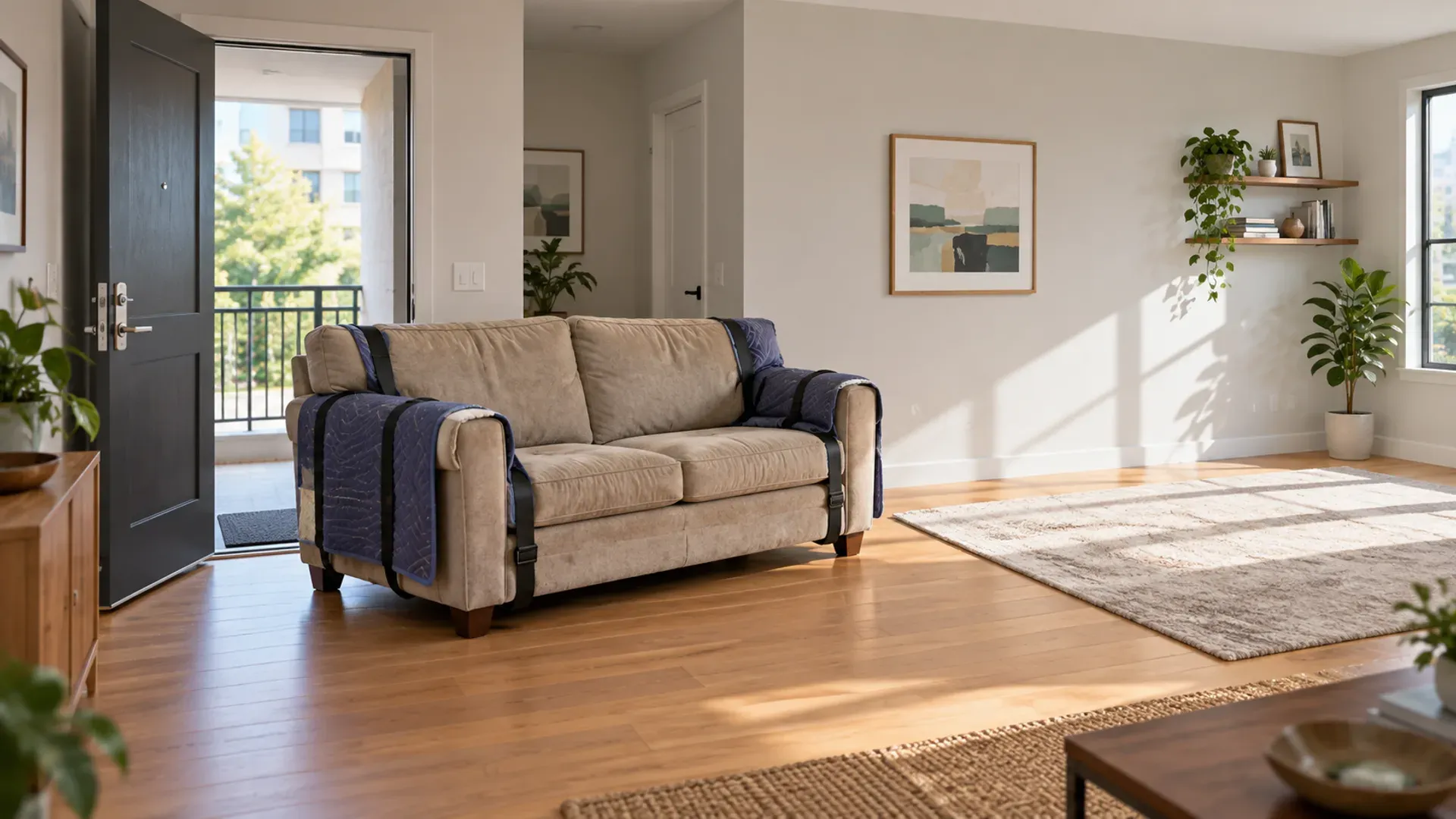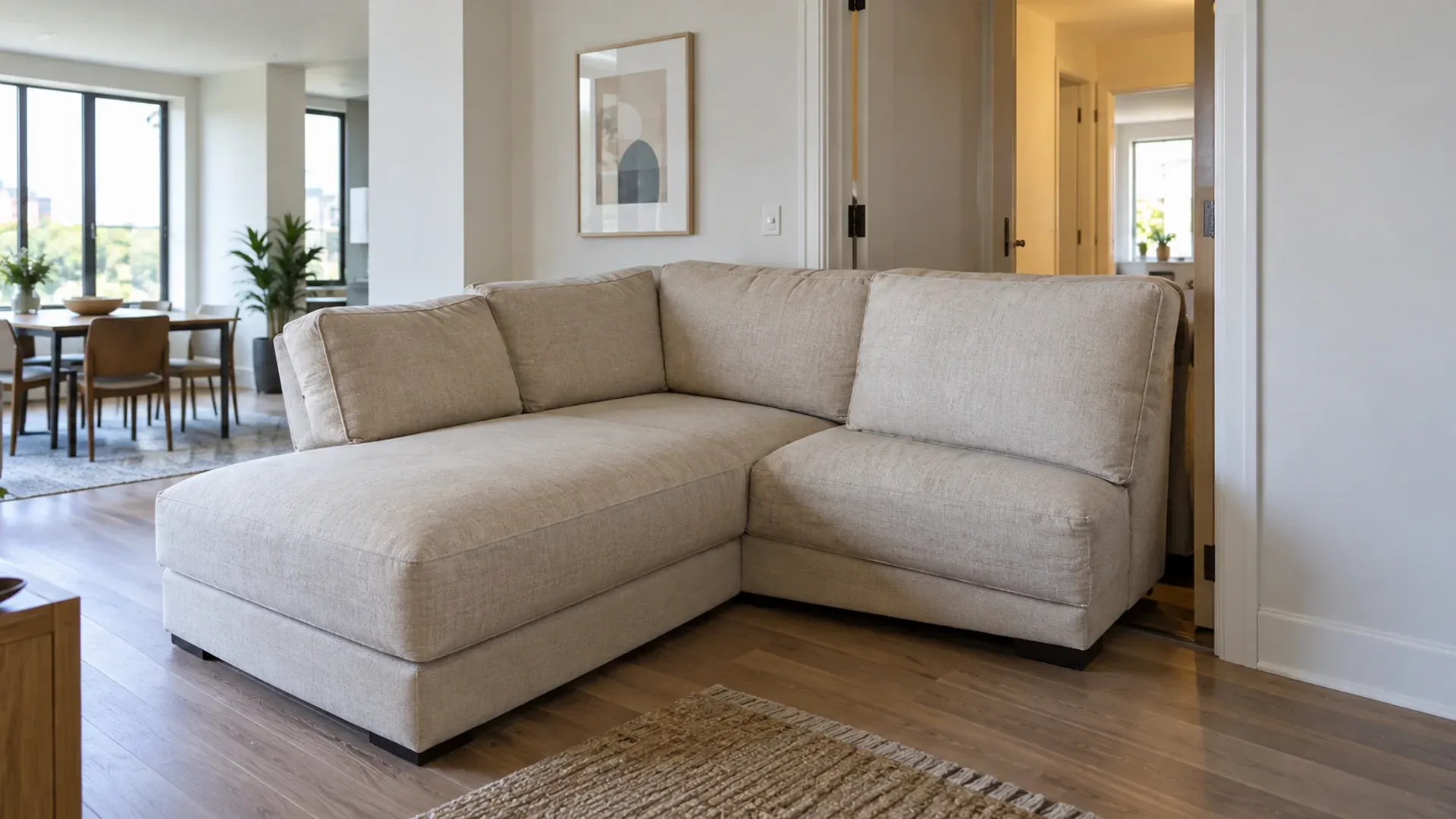
An L-shaped sofa should be planned as a set of connected sections, not as one rectangular object. Identify every module, find the intended connection points, measure the largest rigid section and trace it through every turn from the room to the collection vehicle before anything is pulled apart.
The useful question is not simply whether the complete sofa fits through the door. It is whether the sofa separates as designed, what each released section measures, and whether those sections can turn through the approved building route without damage or unsafe improvisation.
Record the complete sofa before moving it
Start with wide photographs from the front, both ends and behind the sofa. Include the wall, nearby furniture and the route out of the room. Record whether the return is on the left or right when facing the sofa, and whether the piece includes a chaise, corner wedge, recliner, storage compartment, loose ottoman or sofa-bed mechanism.
Count visible sections rather than calling the item “one corner sofa.” A typical arrangement might have a two-seat unit, a corner unit and a chaise, but appearances can mislead. Upholstery can hide a single continuous frame, while a sofa that looks fixed may use hooks, bolts or manufacturer clips between modules.
Note the condition before handling. Photograph torn fabric, loose legs, cracked timber, bent brackets, protruding staples and any section that sags when lifted. If the sofa has been affected by water, pests or heavy contamination, disclose that before collection rather than after the crew arrives.
Settle reuse and ownership first
Decide whether the sofa is being removed for disposal, transferred to another property or kept in reusable condition for a confirmed recipient. That decision changes the method. A disposal item may allow agreed destructive dismantling; a reusable item needs controlled release, labelled fittings and protection for upholstery and finished surfaces.
In a furnished rental, check that the sofa belongs to the person authorising removal. In a shared property, confirm that every owner agrees. If a replacement delivery is involved, make sure the outgoing and incoming items are not confused and that both routes have been measured.
Do not promise donation or reuse without a recipient who has accepted the sofa’s size and condition. The old-furniture disposal guide compares realistic routes without assuming that an item will be accepted elsewhere.
Find the intended separation points
Remove loose cushions and look between sections, beneath the front edge and along the back. Use a torch rather than reaching into a gap blindly. Photograph visible hooks, brackets, bolts, plates and cable connections. Search for the manufacturer’s instructions if a label or model can be identified.
Common modular connections include interlocking metal hooks, lift-and-release plates, bolts beneath the frame and alignment pins. Reclining sections may also have low-voltage cables or controls linking units. These details matter because pulling the sections horizontally when they are designed to lift can bend a bracket, while lifting a powered unit without disconnecting the approved plug can damage wiring.
Do not cut upholstery to discover a connection. Do not force a joint that does not release with the documented method. If the construction remains unclear, send close photographs to the removal provider and agree who will investigate it on site.
Keep designed separation distinct from dismantling
Releasing two modules at their intended connector is not the same as dismantling a rigid frame. Removing screw-in legs or a detachable back may be normal preparation. Cutting timber, removing fixed upholstery or breaking a glued frame is destructive work and should be explicitly agreed.
The furniture dismantling guide explains how construction, condition and destination determine whether separation is appropriate. If the sofa must remain reusable, record each released part, bag the fittings and protect connector plates from bending during the carry.
Powered recliners and USB-equipped sections need extra care. Switch them off, unplug from the wall and identify detachable low-voltage connections only where the manufacturer’s method is clear. Keep transformers and controls with their section. Hard-wired or damaged electrical components require an appropriate technical decision, not guesswork by a collection crew.
Measure the largest rigid section
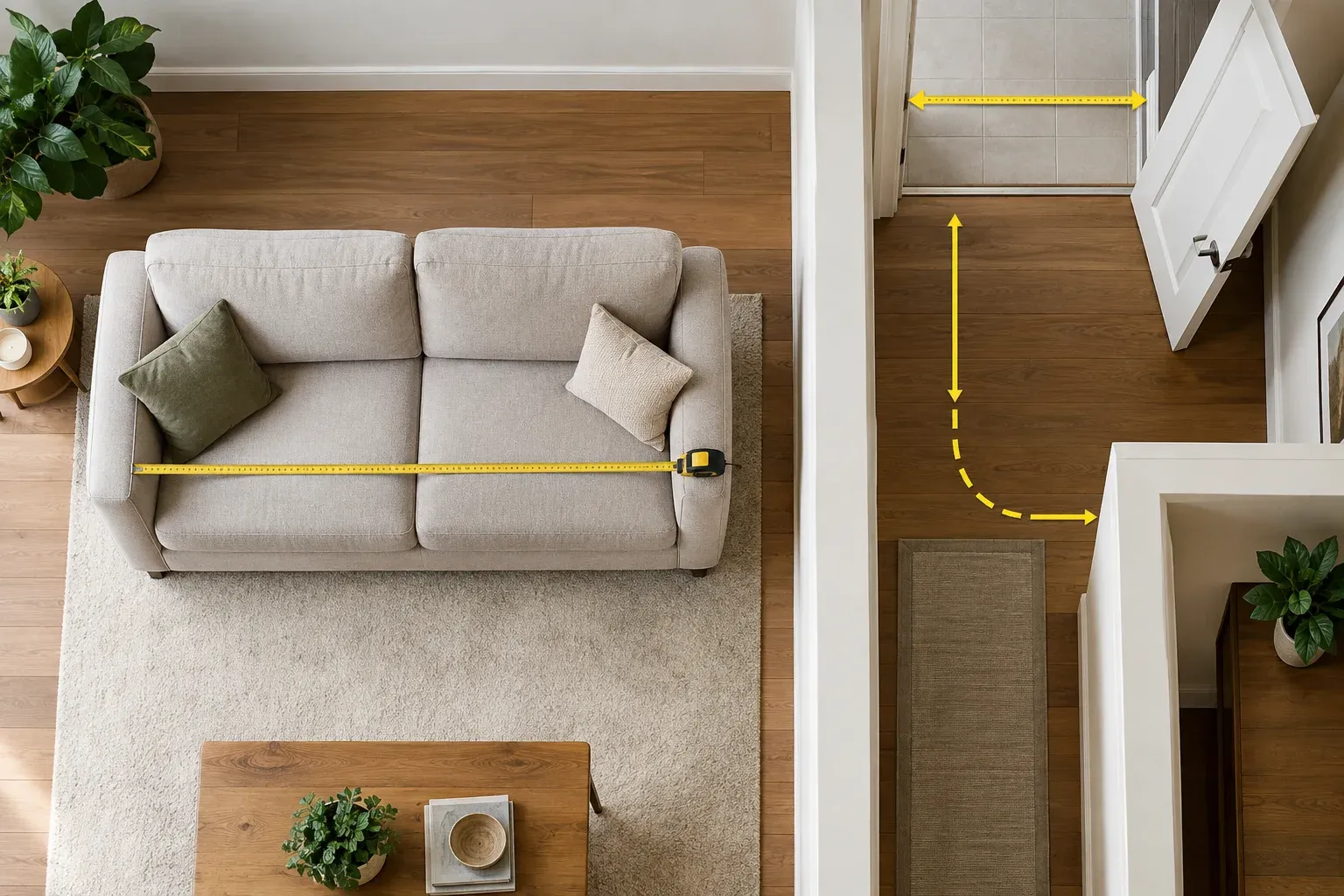
Measure every module at its longest, highest and deepest fixed points. Include arms, back corners, hinge housings and any frame that remains after cushions and approved loose parts are removed. Record the diagonal only as additional information; it does not replace the three basic dimensions.
The largest module controls the route. A long two-seat section may be harder to turn than the visually bulky corner wedge. A chaise may have hidden storage hardware that prevents it being tipped in the same way as a simple seat.
If the sofa does not separate, measure the complete fixed frame and say so clearly. Do not send only the overall wall-to-wall footprint: that tells the provider how much room it occupies, not how it can be carried.
Measure the openings and the space around them
Record the clear doorway width and height with the door open. Note hinges, handles, closers and a door leaf that cannot open fully. Then measure the approach and the landing beyond the opening. A module may pass through the door face-on but fail because there is no space to rotate before or after it.
Continue through corridors, lift doors, the lift car, lobby doors, ramps and the loading entrance. Photograph the tape at close points. If stairs are the approved alternative, record stair width, handrails, landings, ceiling height and every turn.
The sofa-won’t-fit guide covers the geometry of tight openings in depth. For an L-shaped sofa, apply that route test to the largest released section as well as the complete item.
Build one continuous route plan
Walk the exact carrying line from the sofa to the vehicle position. Clear coffee tables, rugs, lamps and boxes before the collection window. Protect retained furniture and identify delicate wall corners or floor finishes. Do not move the sofa into a hallway in advance; it may block the only working space needed to separate and rotate it.
In an apartment building, confirm the current service-lift and loading rules with management. Provide the date, time, unit, contractor and vehicle information they request. A previous delivery slot does not prove that the same access is available for removal.
For a villa, inspect gates, side passages, steps, gravel and parked vehicles. The shortest visual route may not be the workable route for a wide module. Keep pets and children away from the moving line and ensure the authorised contact can unlock every required door.
Decide the movement order
Remove cushions and loose ottomans first, then release modules only after the method is confirmed. Plan which section leaves first to create working space. Keep fittings with their parent module, and avoid leaning released backs or arms where they reduce the turning area.
If another sofa is being delivered, separate the time windows unless the building and both providers have confirmed a coordinated exchange. Shared corridors and lifts should not become holding areas. The old-sofa-before-delivery guide helps plan that deadline without assuming the delivery crew will take the outgoing piece.
At the vehicle, count the modules again. A loose connector, power supply, mattress or storage-base panel is part of the sofa inventory even if it is carried separately.
Send a quote request that shows the real job
Provide one concise package:
- Wide photographs of the complete sofa and room.
- The number and type of visible modules.
- Overall dimensions and dimensions of each confirmed section.
- Close views of connectors, legs, recliners and damaged areas.
- Whether reuse, transfer or disposal is intended.
- The largest rigid section and every close route measurement.
- Floor, lift, loading and building-access details.
- Any deadline created by a move, handover or new delivery.
Ask what preparation you should complete and what the crew expects to handle. State uncertainty honestly. “The corner appears to lift from two brackets, but it has not been released” is more useful than “it definitely comes apart.”
A sofa removal service can assess a photographed configuration and route more reliably than a message saying only “large L-shaped sofa.” If the information changes, update it before arrival.
Keep the day of collection controlled
Empty storage sections and remove personal items from beneath cushions. Close and secure recliners using the documented method. Keep children, residents and delivery teams out of the route. Have access cards, permits and keys with the person meeting the crew.
Walk the route before lifting starts. Confirm that the lift and loading position are available and that the sofa being removed matches the photographs. Let the crew choose grips and orientation; several people giving conflicting instructions around a blind corner makes the carry harder.
Stop if a module does not release as expected or a measurement differs materially. Reassessment is better than bending a connection, damaging the property or leaving a section wedged in a doorway. Balcony lowering, external lifting and unplanned use of emergency routes are not ordinary fallbacks.
After loading, check the room, corridor, lift and loading point for cushions, fittings or loose debris. If the sofa was part of a rental handover, photograph the cleared area and any pre-existing route damage.
Plan for the details unique to corner configurations
An L-shaped sofa has two orientations that are easy to confuse in photographs. Describe the return from a fixed viewpoint and mark the underside of each module after separation. If the sections are intended for reuse, a simple sketch showing the order of the units prevents a left-return arrangement being rebuilt incorrectly at another property.
Corner wedges often create the most awkward grip because their visible footprint is broad while the lower frame is narrow. Do not judge their carrying position from the cushions. Photograph the rigid underside, feet and connector plates so the crew can see where hands and protection may be needed. A loose chaise cushion is not the same as a detachable chaise frame.
Storage chaises and recliner modules should be emptied completely. Close lids and footrests using their intended mechanism and disclose any part that will not latch. Do not tape a powered control in a way that activates it during carrying. Keep remotes and transformers in a labelled bag, not inside the frame.
If the sofa is against a wall, check behind it before collection. Cables, extension leads, floor sockets, curtains and wall-mounted items can be hidden from the initial photographs. Resolve those obstacles while the sofa is still stable rather than after one module has been released.
When a route is only just large enough, agree whether approved loose parts will be removed before the crew arrives or on site. Re-measure after removal rather than subtracting a guessed leg height from the overall dimension. The actual rigid frame and real clear opening decide the route.
Finally, keep disposal sections distinguishable from retained ottomans or matching chairs. A coordinated lounge set may share upholstery, but each piece needs its own decision. Add matching items to the quote rather than assuming their visual relationship makes them part of the sofa booking.
Common questions
Do all L-shaped sofas split into sections?
No. Many are modular, but some have a continuous frame or use connections that are not obvious. Identify the model or photograph the underside and joints before assuming that it separates.
Is removing the legs enough?
It may reduce height slightly, but it will not shorten a rigid frame or create turning space. Measure the route with and without approved removable parts and focus on the largest remaining section.
Can the sofa be cut up if it is going for disposal?
Only through an agreed dismantling method in a suitable working area. The provider must know the construction and the property must authorise the work. Destructive dismantling should never be improvised in a shared corridor.
What if one section fits but the corner does not?
Send the corner module’s exact dimensions and photographs of the tight turn. The solution may involve a different orientation, an approved removable part or a revised route. Do not force it through based on the smaller sections.
What is the best first step?
Photograph the complete sofa, identify its modules and connectors, then measure the largest rigid section against every opening and turn. That creates a removal plan instead of a guess based on the room footprint.