
A bed frame is rarely one object. It is usually a set of rails, slats, legs, a headboard and fixings, and sometimes a storage base with lifting struts or a powered mechanism. The practical way to get rid of one is to identify what kind of frame it is, decide whether it leaves whole or in parts, and choose a route before the new bed arrives. A frame that came in through the bedroom door flat-packed will not necessarily go back out assembled, so check the doorway before anyone starts unscrewing.
The mattress is a separate decision with its own handling. If both are leaving, plan them together but describe them as two items, because a frame and a mattress take up space and need carrying in very different ways.
Identify the frame before you choose a route
The type of bed decides almost everything that follows: whether it can be reused, whether it needs tools, how heavy the pieces are and whether any part needs a separate disposal answer. Look underneath and behind the bed, not just at the visible headboard.
Wooden and panel frames
A solid wood frame is heavy for its size and often joined with bolts through the corners. It can usually be taken apart into a headboard, a footboard, two side rails and a set of slats. A frame made from chipboard or similar board looks similar but is held together with cam locks and dowels that weaken each time it is dismantled. If the board has swollen, cracked around the fixings or lost its edge strip, it is unlikely to be rebuilt successfully. The flat-pack furniture guide explains why board furniture survives a second move less well than solid timber.
Metal frames
Metal frames are lighter, but they come apart into long rails that can be awkward in a corridor. Some have welded sections that cannot be separated. Check for bent rails, missing feet and sharp burrs where a fitting has broken, because these make the pieces harder to hold safely.
Divan bases
A divan is a fabric-covered box base, often supplied in two halves for larger sizes. The halves usually separate, but each half is still a bulky block. Drawers can add weight and may slide open when the base is tilted. Remove them and carry them as separate pieces.
Ottoman and storage beds
An ottoman bed has a platform that lifts to reveal storage, usually supported by gas-lift struts on each side. Those struts hold the platform under pressure. Do not cut, puncture or force a strut free, and do not try to release one if you do not know how it is fitted. Empty the storage space, close the platform and tell the collector that the bed has lifting struts. A storage bed is also heavier than it looks, and the hinged platform must be kept under control when the frame is turned.
Adjustable and powered bases
A base with a motor, handset, power supply or under-bed lighting has electrical parts. Unplug it, leave the wiring attached where it belongs and mention it when asking for a quote. Whether the motor and cables need an e-waste route is a separate question from the frame itself; the e-waste guide explains how electronic items are treated differently from ordinary furniture.
Bunk beds, loft beds and headboards
Bunk and loft beds have guard rails, ladders and more fixings than a standard frame, and the upper section must be supported while it is taken down. If a bunk bed is part of a wider clear-out of a child's bedroom, the children's room clearance guide covers the sorting around it. A headboard may be bolted to the frame or fixed to the wall. A wall-mounted headboard is effectively a fitting: in rented property, check whether it belongs to the landlord before you remove it, and expect fixing holes to be part of the handover conversation.
Decide whether it leaves in one piece
An assembled frame may not be able to leave the bedroom at all. A king frame with a fixed headboard may be wider than the bedroom door when it is turned on its side, and the corridor turn can be tighter than the door. Dismantling is the obvious answer, but it is not automatically the right one.
Leave the frame assembled when it is solid, the route is wide enough, and someone intends to reuse it. Every time a frame is taken apart and rebuilt, the joints loosen, and a missing bolt can make it unsafe. If the route will not accept it whole, take it apart deliberately rather than partially. A half-dismantled bed with a loose rail swinging from one corner is more awkward to carry than either a complete frame or a neat set of parts.
Measure before you decide. Take the width and height of the headboard, the length of the side rails, and the depth of a divan or storage base. Then measure the narrowest point on the route out: the bedroom door with the door open, any tight corridor turn, the front door and, in a tower, the lift opening and internal depth.
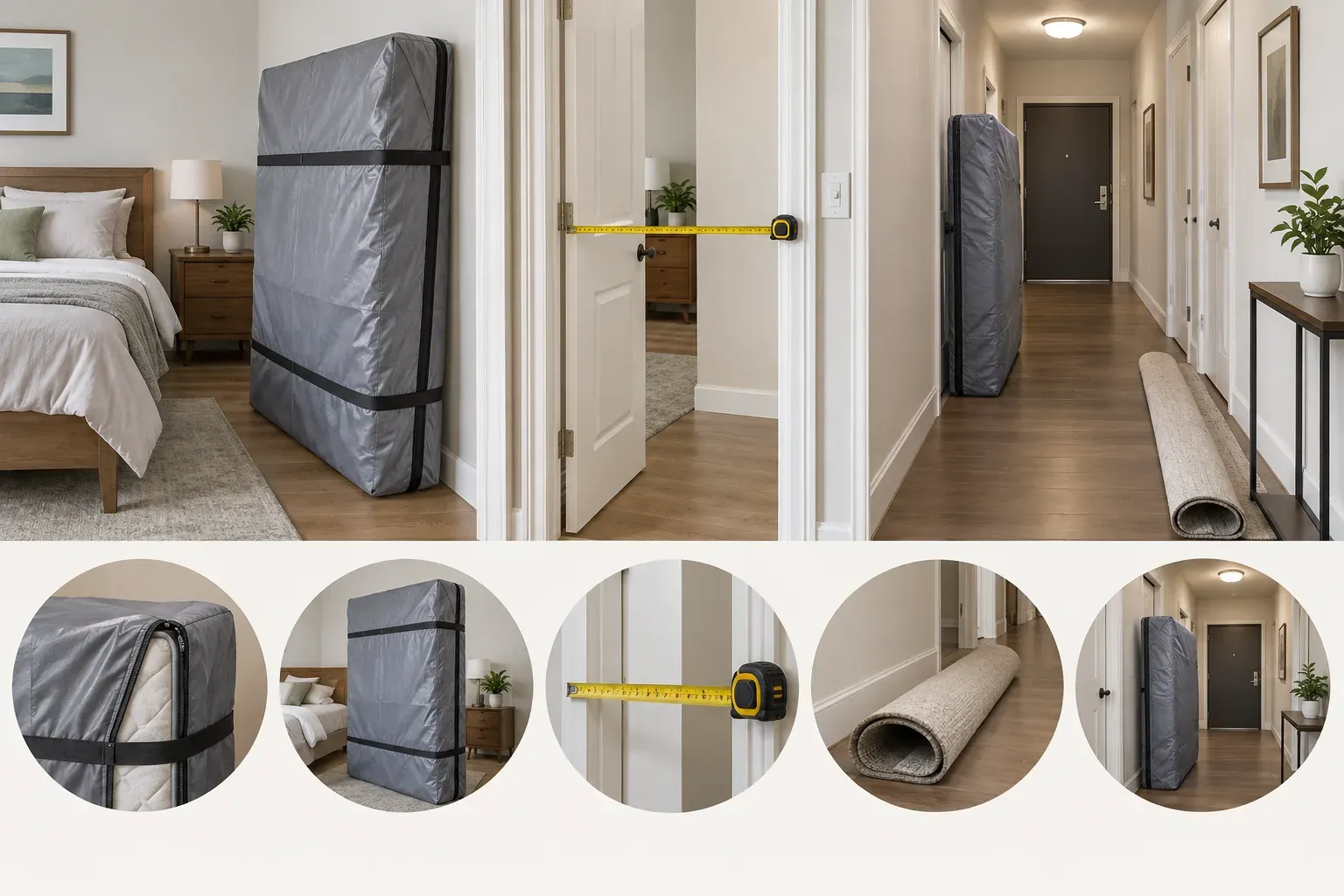
Compare the largest piece, not the whole bed, with the narrowest point. A headboard is often the deciding item. If it is wider than the door is high, or deeper than the lift, it will need to come apart or be tilted in a way that requires space on both sides. The tower bulky-item guide shows how to measure a route through doors, corridors and a lift so the answer is clear before collection day.
If you dismantle the frame yourself, work in a set order. Remove the slats first and tie them in a bundle. Take off the centre rail and support legs. Release the side rails from the headboard and footboard while someone holds the ends. Put every bolt, bracket and cap into one labelled bag and tape it to the headboard. If the frame is going for disposal rather than reuse, the hardware still needs to be contained, because loose screws on the floor of a corridor or lift are a hazard to the next person.
Choose a realistic route for the frame
There are several honest ways to get rid of a bed frame. Which one suits you depends on its condition, the access at your address and the date by which the bedroom must be clear. The general furniture disposal guide compares these routes across all kinds of furniture; the notes below apply them to a bed.
Pass it on to a confirmed recipient
A sound solid-wood or metal frame with all its parts can have a second life. Reuse depends on a specific person or organisation agreeing to take it, collecting it on a date that suits your deadline and accepting its real condition. A frame with a cracked rail, missing slats or a broken storage mechanism is unlikely to be wanted. Keep the hardware with the frame and photograph it assembled so the recipient can judge it. The furniture donation guide explains what recipients can realistically accept and why donation attempts often fail when time is short.
The Dubai Municipality bulky-waste service
Dubai Municipality lists a free service for disposing of household furniture and appliances. Its services directory states that the service is completed within three working days and that investment zones are excluded, so eligibility depends on the address. The bulky-waste service guide explains how the request is made and what preparation the Municipality asks for. Confirm the current terms with the Municipality before relying on it, and plan how the frame will reach the collection point if the service does not carry items out of the home.
A paid furniture collection
A paid collection suits a frame that has to be carried from an upper floor, taken apart in the bedroom, removed in a booked building slot or cleared alongside other furniture. When the problem is a heavy frame, a narrow door and a deadline, a furniture removal crew that dismantles the bed and carries it out answers all three in one visit. Ask for the quote to state what is included: dismantling, carrying, the mattress if it is leaving, and any items such as a powered base that may need a separate route. The cost guide explains which variables change a quote.
Whatever route you choose, do not leave the frame or its parts beside the building bins, in a stairwell or in a car park while you wait. Keep it inside your property until the agreed collection.
Plan the carrying route for your property
The same frame is a different job in a tower apartment and a villa. Plan for the property you actually have.
Apartment towers
Where a building requires a service-lift booking for bulky items, arrange it before you fix the collection time. Ask management whether furniture removal needs a notice, a form or a particular time window, and where the vehicle may load. Rules differ by building, so the building is the authority. The service-lift booking guide lists the questions to ask. Measure the lift as well as the doorway: long side rails and a tall headboard may need to stand upright or travel diagonally, which depends on the internal height and depth of the car.
Villas and townhouses
A villa often has a wider route, but stairs and landings replace the lift as the constraint. A headboard that clears every door can still catch on a turning staircase or a handrail. Clear the stairs and landings completely, protect the walls at the turns if the paintwork matters for a handover, and decide where the parts will be staged inside the house so the front door is not blocked. In a gated community, check whether the collection vehicle needs a gate pass or must arrive within set hours.
Ground-floor and garden apartments
A ground-floor apartment may have a direct route to the street, but check whether the vehicle can stop close to the entrance. A long walk across a podium or a shared garden adds carrying time and should be mentioned when you describe the job.
Time it around the new bed
A delivery date is often what sets the deadline for an old bed frame. If a new bed is arriving, the old frame has to be out of the room first, and ideally out of the home, so the delivery team has a clear floor and a clear route. Book the removal for before the delivery, not on the same afternoon with no margin. If the same service lift must be used for the removal and the delivery, ask management whether both can happen on one day or whether they need separate slots.
Check the retailer's written terms before assuming it will take the old bed away. Some delivery arrangements include removal of an old item and some do not; disconnection, dismantling or carrying from another room may also be excluded. If the terms are unclear, ask in writing. The same sequencing problem applies to a sofa, and the guide to clearing an old sofa before a new delivery walks through the order of events in more detail.
Sleep matters too. If you dismantle the old frame several days early, you will be sleeping on a mattress on the floor until the new bed arrives. That is fine for a night or two, but plan it rather than discover it.
What to send when you ask for a quote
A short, accurate description produces a quote that reflects the real job. Send:
- One photo of the whole bed in the room, with the doorway in view if possible
- Close photos of the headboard, any storage mechanism, drawers or motor
- The bed size and the headboard width and height
- Whether it is assembled or already dismantled, and whether all the parts are together
- Whether the mattress, a bedside table or other bedroom furniture is leaving too
- The floor level, lift access and any service-lift or gate-pass requirement
- Parking or loading arrangements at the building or villa
- The date by which the room must be clear, and any delivery booked for that day
Mention damage that affects handling: a cracked rail, a loose headboard, a strut that no longer holds the platform, or a frame that has been wet. A description of "one old bed" leaves both sides guessing. A description that separates the frame, the headboard, the storage base and the mattress allows the collector to bring enough space and the right tools.
Mistakes that slow down bed frame removal
Preparation problems can hold up a collection as easily as a busy lift. Avoid these:
- Taking the frame apart before checking whether it will fit whole, then losing the fixings needed to rebuild it for reuse
- Leaving the storage compartment of an ottoman bed full, so the platform is heavy and the contents spill when it is turned
- Forcing or cutting a gas-lift strut
- Assuming the new bed's delivery team will take the old one without written confirmation
- Booking the collection before the building has confirmed a service-lift slot
- Moving the parts into a shared corridor ahead of time
- Forgetting the items under the bed, which can be the last things found before handover
Check the floor once the frame has gone. Fittings fall out during dismantling, and the space under a bed can collect documents, chargers, small toys and dust. A quick sweep before the delivery arrives or the inspection begins saves an awkward discovery later.
When the frame is clear, the remaining question is usually the rest of the bedroom. If the wardrobe is also leaving, the wardrobe removal guide covers the same whole-or-dismantled decision for the largest piece in most bedrooms.
Questions about bed frame disposal
Can I put an old bed frame out with the building's rubbish?
Do not leave it beside the bins, in a corridor or in a bin room. Bulky furniture needs its own route, and the guide to dumping rules explains why leaving it in a shared space is a problem. Keep it inside your home until it is collected through the Municipality's bulky-waste service, a confirmed recipient or a booked removal.
Do I need to dismantle the bed before the crew arrives?
Not necessarily. Tell the collector what kind of frame it is and photograph it assembled. If dismantling is part of the agreed job, leaving it intact avoids lost fixings and a half-collapsed frame.
Is the mattress included if I book removal for the frame?
Only if you include it in the request. Describe the mattress as a separate item; the mattress disposal guide explains how to prepare it for the route out.
What should I do about a storage bed with gas struts?
Empty the storage space, close the platform and leave the struts alone. Mention them when you ask for a quote so the frame can be handled with the platform under control.
Can a wall-mounted headboard be removed with the bed?
It can be, if it is yours to remove. In rented property, check with the landlord first, because a fixed headboard may count as part of the property and removing it leaves fixing holes in the wall.