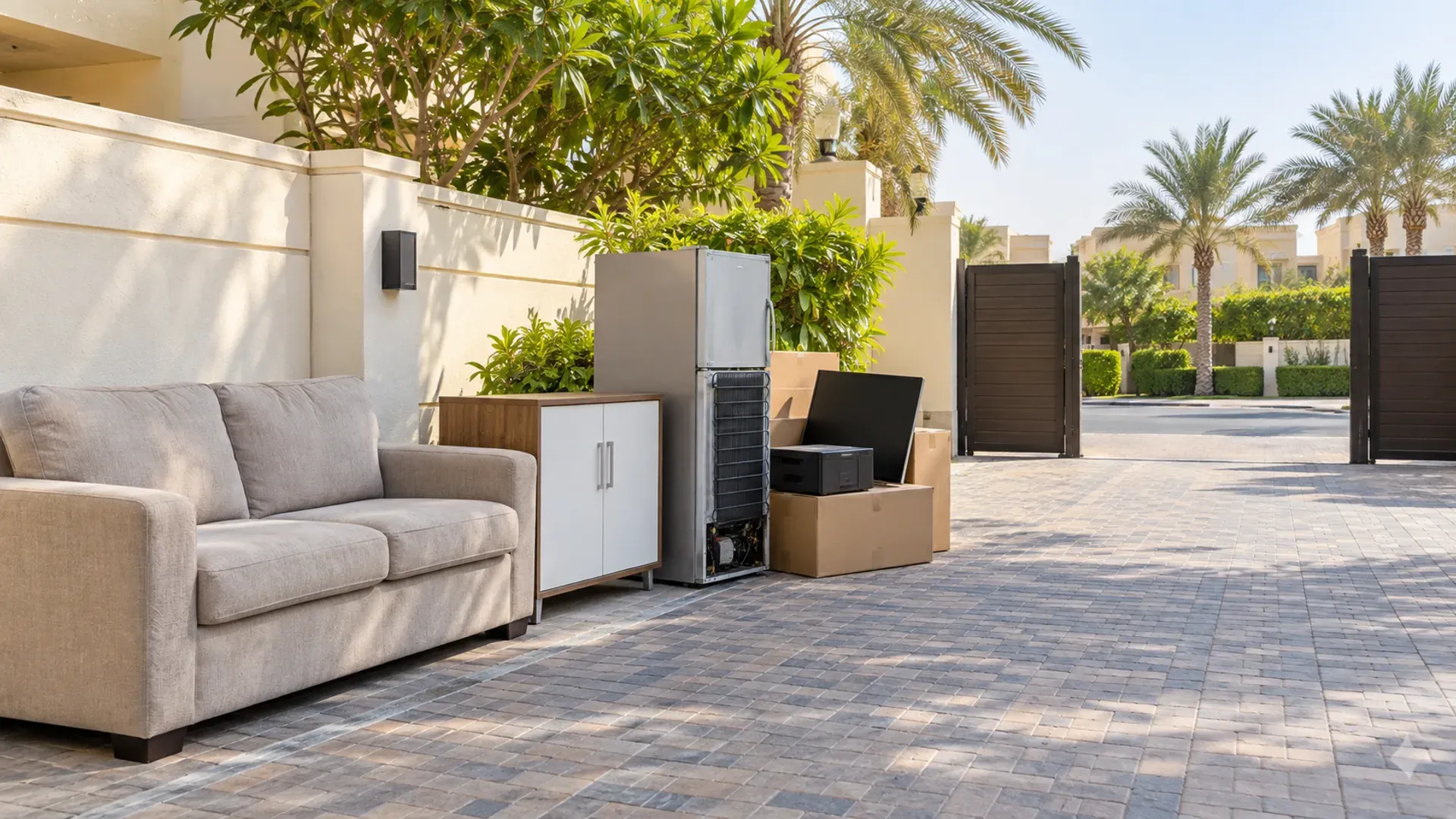
Leaving old furniture on a pavement, road, empty plot or shared corridor in Dubai is prohibited, and the law that regulates waste allows fines of up to AED 500,000, doubled for a repeat within a year. The specific amount for a particular violation is set by a separate resolution, so check the current official schedule rather than relying on a figure quoted online. The practical answer is simple: keep bulky items inside the property until a lawful collection takes them.
The rule in plain terms
Dubai’s waste law is Law No. (18) of 2024 Regulating Waste Management in the Emirate of Dubai%20of%202024%20Regulating%20Waste%20Management.html), published on the Dubai Legislation Portal. Article 6 sets out a list of prohibited acts.
Among them, no person may dump, discard, place, spill, discharge or otherwise dispose of waste in public places. The same article prohibits accumulating, collecting, storing or discarding waste in buildings, establishments or other public places, and dumping materials that may damage a waste container or a waste transport vehicle.
An old sofa, a broken wardrobe or a mattress left beside the road is waste being placed in a public place. That is the conduct the article addresses, whatever the intention behind it.
If you are asking about a fine for dumping furniture in Dubai, the more useful question is how to avoid committing the violation in the first place. The rest of this guide covers both.
What the law says about fines
The maximum under the 2024 law
Article 20 of Law No. (18) of 2024 states that a fine may not exceed AED 500,000. It also provides that when the same violation is repeated within one year of the previous one, the fine is doubled.
The same article gives the Chairman of the Executive Council the power to determine the prohibited acts and the fines that apply to them. In other words, the law sets the ceiling and the framework; the detailed schedule of amounts comes from an implementing resolution.
The earlier fees and fines resolution
Executive Council Resolution No. (58) of 2017%20of%202017.html) approved fees and fines for waste disposal in Dubai. Its schedule includes, for example, a fine of AED 1,000 for disposing of general waste at a place other than the waste disposal site designated for that type of waste, and AED 10,000 for conducting a waste management activity without a permit.
Under that resolution, a repeat within one year doubles the fine, up to a maximum of AED 100,000.
How the two fit together
Article 30 of the 2024 law says that bylaws, resolutions and manuals issued under the earlier legislation remain in force to the extent that they do not contradict the new law, until replaced.
That makes the precise current amount for a specific act a matter for the official schedule in force at the time. This guide does not state a per-item fine for leaving a sofa on the street, because neither source cited here sets out an entry in those exact terms. If you need the current figure, check the Dubai Legislation Portal or ask Dubai Municipality directly.
What is clear from the law itself is the direction: dumping waste in public places is prohibited, fines are capped at a high level and repetition doubles them.
What counts as dumping in practice
Places that are clearly public
Pavements, roads, road verges, empty plots, parks, beaches and areas around shared bins are public places. Bulky items left in any of them, without an arranged collection, are exposed to the prohibition in Article 6.
The same article separately prohibits dumping waste into seawater, the creek, ports or beaches, and open burning of waste.
Shared areas inside buildings
Article 6 also refers to accumulating or discarding waste in buildings and establishments. Building corridors, lift lobbies, car parks and stairwells are not places to store an unwanted sofa while you work out what to do with it. Building management may also have its own rules for these spaces.
Bin rooms and waste containers
A bin room or a large waste container is not automatically a place for furniture. Article 6 prohibits dumping materials that may damage a container or the vehicle that empties it. Ask building management whether a designated bulky-item area exists and under what conditions it may be used.
Waiting for a collection
Placing items somewhere because a collection has been confirmed and you have been instructed to stage them there is different from leaving them in the hope that someone takes them. Follow the instruction you were actually given. Until then, keep the items inside.
The compliant routes instead
Every lawful route ends with the items reaching an appropriate destination through someone permitted to handle them.
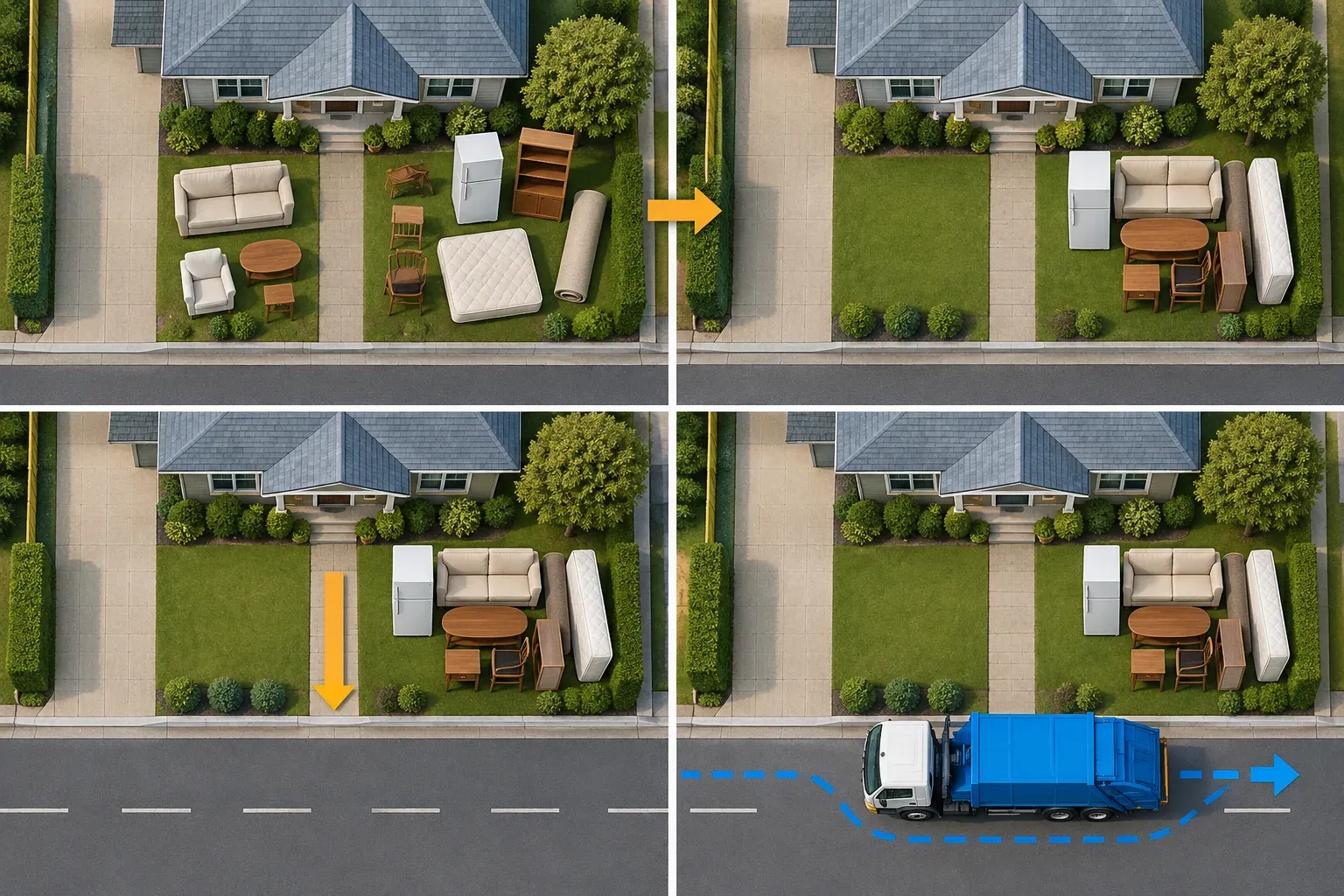
Dubai Municipality bulky-waste collection
The Dubai Municipality services directory lists a free service for disposing of household appliances and furniture, with a published service time of three working days. It excludes investment zones, and the official announcement describes exclusions for real-estate development zones and free zones.
The announcement describes the service as part of an effort to eliminate practices harmful to the environment and public health, including the accumulation of bulky waste. For eligible addresses, it is the most direct lawful alternative to leaving items outside. The official bulky-waste service guide explains how to prepare for it.
Paid removal by a permitted provider
Article 9 of the 2024 law states that no person may conduct a waste-management activity without first obtaining the relevant permit from Dubai Municipality. That is worth keeping in mind when choosing who takes your items.
Ask any provider where the load goes after collection and whether it holds the permits its activities require. A provider that cannot answer clearly is a risk, because responsibility for waste does not simply disappear when someone drives it away.
The junk removal service quotes from photos and covers labour, loading and disposal. The provider comparison checklist lists the questions worth asking any company.
Reuse before disposal
A sound item that someone genuinely wants can leave the property as a gift rather than as waste. Agree the collection date in advance so the item does not end up waiting in a corridor.
Development or community arrangements
Some managed developments and communities have their own waste and bulky-item arrangements. Ask building or community management what applies at your address, especially if it falls outside the Municipality service area.
Why people end up dumping
Dumping is not always deliberate. It can come from a gap between a deadline and an arranged collection.
A move-out deadline
Keys are due back, the flat must be empty and there is no collection booked. The sofa goes downstairs to “wait.” The end-of-tenancy planning guide sets out a timeline that avoids that last-minute gap.
A free route that did not fit
A resident assumes the free service covers their address or will arrive on a particular day, puts the items out early and then discovers the request does not fit. The comparison of free collection and a paid crew explains how to check this before relying on it.
An offer to take items cheaply
Someone offers to take a load for very little without saying where it will go. The items may end up somewhere they should not. Ask about the destination before handing anything over.
Assuming someone will take it
Leaving a usable chair outside “for anyone who wants it” is still placing an item in a public place. If nobody takes it, it becomes waste on the street.
Where this leaves you practically
Plan the collection before the deadline
Work backwards from the date the space must be empty. Check the official service for your address early, and arrange paid removal for anything it does not cover. The guide to what is genuinely free explains what each free route will and will not do.
Keep items inside until collection
Store bulky items within the property, or in an area building management has approved, until the collection arrives. This protects you and keeps shared spaces clear for neighbours and emergency access.
Prepare for a smooth collection
Empty drawers, secure loose parts and keep the route clear. The pre-arrival checklist covers what to do before any collection team arrives.
Keep a record
Keep the official request reference or the paid booking confirmation. If a question is ever raised about items left at the building, a record of the arranged collection shows what you did.
Items that need more than a bulky collection
Not everything in a clear-out is household bulky waste. Separate anything that may need its own route before booking any collection.
Chemicals, paint and gas cylinders
Paint, solvents, cleaning chemicals, gas cylinders and medical waste need specialist handling. Do not hide them inside furniture or boxes, and do not leave them beside bins. Ask Dubai Municipality or a specialist provider which route applies.
Renovation and fit-out material
Tiles, plasterboard, timber offcuts and other building material are not ordinary household furniture. Ask whether your collection covers them before adding them to the load, and keep them inside the property until it is confirmed.
Garden waste
Palm fronds, branches and soil are a separate stream from furniture. Keep them apart and confirm the route for them on its own terms.
If items are dumped near your home
You may find furniture left outside your building or villa that is not yours. Do not move it into your own property or add it to your collection request without understanding the situation.
Tell building or community management first, since they may already know who left it or have a process for shared areas. For public places, use Dubai Municipality’s official channels to report the problem rather than arranging removal of someone else’s waste privately.
Keep your own items clearly separate, so there is no confusion about whose load is whose on collection day.
Mistakes to avoid
- Putting furniture outside “just for tonight” before collection is confirmed.
- Leaving items beside shared bins or in a bin room without permission.
- Storing a sofa in a corridor, lift lobby or car park.
- Assuming the free service covers your address without checking.
- Handing items to someone who will not say where they go.
- Quoting a fine figure from an unofficial website as current law.
- Leaving a usable item on the pavement for passers-by.
Keep the source date visible
The legislation and official service details in this guide were checked on 1 October 2026 against the Dubai Legislation Portal and Dubai Municipality’s own pages. Laws, implementing resolutions and fine schedules can change. The current official text controls.
The rule to remember is short: bulky items stay inside the property until a lawful collection takes them. The law allows heavy fines and doubles them for repetition, but the far better outcome is never testing that. Check the official service for your address, arrange paid removal for anything it does not cover and plan the collection before the deadline rather than after it.
Questions about dumping and fines
Is it illegal to leave old furniture on the street in Dubai?
Article 6 of Law No. (18) of 2024 prohibits dumping, discarding or placing waste in public places. Furniture left on a pavement or road without an arranged collection falls within that prohibition.
How much is the fine for dumping furniture in Dubai?
The 2024 law caps fines at AED 500,000 and doubles them for a repeat within one year. The specific amount for a particular act is set by the implementing resolution in force, so check the current official schedule rather than an unofficial figure.
Can I put furniture next to the building bins?
Not without permission. Bin areas are not automatically bulky-item points, and Article 6 prohibits dumping materials that may damage containers or collection vehicles. Ask building management whether an approved area exists.
Is it dumping if I leave a usable item out for someone to take?
It can be. An item left in a public place without an arranged collection is still placed there. Give usable items directly to a confirmed recipient instead.
Am I responsible if the company I hire dumps my items?
This guide cannot give legal advice on liability. What the law does make clear is that waste-management activities need a Municipality permit, so ask any provider where the load goes and whether it holds the permits its work requires.