When a clearance truck drives away from a Dubai apartment building or villa, the items in the back do not simply vanish, nor are they dumped together in an unregulated heap. In a modern city operating under strict environmental and municipal regulations, waste management is a structured, multi-stage process governed by legislation, dedicated waste transfer facilities and specialist recycling streams.
Knowing where does junk go after removal in Dubai is a question of environmental responsibility, consumer trust and legal compliance. Whether you are clearing out an entire property before a move, disposing of broken furniture or replacing outdated electrical appliances, understanding the journey of collected items helps you make informed decisions about who you hire and how your belongings are handled.
This guide provides an honest, step-by-step breakdown of what happens to household junk, furniture, electronic waste and garden material after collection in Dubai, from initial sorting to material recovery, certified transfer stations and responsible municipal disposal.
The legal framework governing waste in Dubai
Waste management across Dubai is strictly regulated to protect public health, prevent environmental contamination and maximise resource recovery. The handling, transport and disposal of all domestic, commercial and bulky waste are governed by primary legislation and municipal guidelines.
Under Law No. (18) of 2024 Regulating Waste Management, the transport and disposal of waste without a valid permit from Dubai Municipality is illegal. Article 6 of the law explicitly prohibits dumping, discarding, placing or accumulating waste in public places, open land, residential corridors or undesignated disposal sites. The law imposes severe financial penalties, with statutory fines reaching up to AED 500,000 for unauthorised dumping, doubling in the event of a repeat violation within one year.
In addition, Dubai Municipality's Waste Segregation Guide and Technical Guideline No. 5 set clear standards for separating waste at source into distinct categories. Professional, licensed clearance operations are required to follow these regulations, ensuring that collected loads are documented, transported safely and transferred only to approved facilities.
Stage 1: Assessment and segregation at collection
The journey of collected junk begins inside the customer's property, long before the vehicle reaches a processing facility. Effective waste diversion and materials recovery depend on clean separation, and segregation starts when the crew begins loading.
Preventing load contamination
When different waste streams are thrown together carelessly into a truck bed, materials that could otherwise be salvaged or recycled become contaminated. For instance, if liquid from an old freezer or food debris from a kitchen unit leaks onto clean cardboard cartons or upholstered cushions, the cardboard and fabric become unrecyclable. Similarly, sharp shards from shattered mirrors or broken ceramics embed into foam mattresses, making handling dangerous and destroying any potential for material reclamation.
A trained clearance crew assesses the inventory before moving it, grouping items by material and structural condition.
Strategic vehicle loading
Items are loaded onto the clearance vehicle in planned sections rather than at random:
- Solid timber pieces, clean furniture panels and intact household goods are placed where they remain clean and protected from crushing.
- Ferrous and non-ferrous metals, such as metal bed frames, curtain rods, aluminium tracks and steel shelving, are grouped together for straightforward offloading at metal recovery depots.
- White goods and electrical appliances are positioned upright and strapped securely to avoid puncturing refrigerant pipes or damaging internal electrical components.
- Bagged general household bric-a-brac and loose miscellaneous items are loaded to fill gaps without compromising the bulkier, recoverable items.
This structured loading saves time at the transfer yard and ensures each material stream can be directed to its appropriate destination without unnecessary double-handling.
Stage 2: Second life and reusable household goods
The most sustainable form of waste management is reuse. Keeping a functional item in use eliminates the energy, water and raw materials required to manufacture a replacement, while simultaneously preventing unnecessary landfill tipping.
Evaluating items for reuse
Not everything collected by a junk removal crew is broken or obsolete. During estate clearances, tenant relocations, office upgrades and home renovations, property owners frequently discard high-quality furniture, working appliances and sound household goods simply because they no longer fit the layout, colour scheme or schedule of the departing occupant.
At the sorting facility, items in sound physical condition are inspected:
- Solid wood dining tables, study desks, coffee tables and bookshelves
- Metal bed frames, clean wooden headboards and intact chests of drawers
- Functioning small domestic appliances that pass visual safety checks
- Sturdy office chairs, filing cabinets and modular shelving units
Where items are complete, sturdy and clean, they are separated from the disposal stream and prepared for secondary use.
Donation and community re-homing
Reusable furniture and domestic goods are routed toward community channels, humanitarian initiatives or direct transfer to lower-income households and workers in need of furnishings. As outlined in the guide on where to donate furniture in Dubai, passed-on items provide practical support to individuals and families setting up living spaces.
The operational reality, however, is that reuse has strict quality boundaries. Items that are broken, structurally unstable, badly stained, infested with pests or water-damaged cannot be donated or reused. A responsible service does not make unrealistic claims such as recycling 100 percent of collected junk; items that cannot be safely reused must move on to material recovery or legal municipal disposal.
Stage 3: Scrap metal recovery and industrial recycling
Metal is one of the most readily recoverable and endlessly recyclable materials in household and commercial junk. Nearly all metals found in domestic furnishings and building fixtures can be melted down and re-engineered without losing their structural properties.
Types of metals separated
During the sorting process, metal components are dismantled and sorted into ferrous and non-ferrous categories:
- Ferrous metals (containing iron): Steel bed frames, wire box-springs, filing cabinets, desk legs, steel shelving, appliance casings, hinges and brackets.
- Non-ferrous metals (without iron): Aluminium window frames, curtain tracks, door handles, light fixture housings, copper water pipes and electrical wiring.
Non-ferrous metals, particularly copper and aluminium, carry significant industrial value and require a fraction of the energy to recycle compared to smelting virgin ores.
Processing at licensed scrap recovery yards
Separated metals are transported to licensed material recovery and scrap processing facilities situated in Dubai's industrial hubs, including Al Quoz and Jebel Ali Industrial Areas.
At these facilities, metal items are weighed on certified commercial weighbridges. Large items are shredded or sheared into manageable sizes using industrial scrap machinery, while magnetic separators pull ferrous steel away from mixed debris. The sorted metals are baled into high-density cubes and dispatched to domestic foundries and international steel mills, where they are melted into secondary billets, structural rebar and industrial manufacturing stock.
Stage 4: Cardboard, paper and packaging baling
Paper and cardboard constitute a significant volume of household and office clear-outs, especially following residential moves or delivery of new furniture and appliances.
Sorting clean cardboard
Cardboard boxes, packaging cartons and clean paper files are segregated to ensure they remain dry and free from oil, food or chemical residues. Wax-coated cardboard, composite foil drink cartons and plastic-laminated packaging are separated out, as their composite coatings interfere with standard paper pulping equipment.
Baling and paper mill supply
Clean, flattened corrugated cardboard is compacted in industrial baling machines at material recovery yards, forming dense, wire-bound bales weighing several hundred kilograms each. These bales are collected by licensed paper recycling companies operating across the UAE and broader region.
At the paper mill, the bales are soaked in large hydropulpers to separate the cellulose wood fibres from glues and print inks. The resulting pulp is cleaned, screened, dried and rolled into kraft paper, which is used to manufacture new corrugated shipping boxes, cardboard cores and packaging materials.
Stage 5: Electrical and electronic waste (e-waste)
Electronic waste (WEEE) presents unique challenges in waste management. Obsolete computers, monitors, printers, televisions, microwave ovens, kitchen appliances and electronic gadgets contain both valuable recoverable materials and hazardous chemical elements that must never enter general landfills.
Special waste classification
Under Dubai Municipality Technical Guideline No. 5 (Waste Classification), electrical and electronic equipment is classified as a special waste sub-category of household and commercial waste. It may not be mixed with standard domestic refuse, thrown into residential wheelie bins or compacted in standard municipal refuse trucks.
Electronic devices contain heavy metals such as lead in soldering, mercury in older flat-panel backlights, cadmium in rechargeable battery cells, and brominated flame retardants in circuit boards. If dumped in unlined ground or exposed to high desert temperatures, these toxins can leach into groundwater or release hazardous airborne particulates.
Specialist dismantling and precious metal recovery
When electronic items are collected during a clearance, they are transferred to authorised e-waste recycling companies that hold specific environmental permits from Dubai Municipality.
At these certified e-waste facilities:
- Technicians manually dismantle computer towers, servers and appliances, removing battery packs and hazardous capacitors for separate treatment.
- Printed circuit boards (PCBs) are isolated; these boards contain minute amounts of precious and semi-precious metals, including gold, silver, copper and palladium, which are refined through specialised chemical and thermal processes.
- Copper cabling is stripped of its PVC insulation using mechanical wire-stripping equipment to recover high-grade bright copper.
- Hard plastic outer casings (ABS and polycarbonate) are shredded into plastic flakes for compounding into lower-grade plastic goods.
For householders who wish to drop off obsolete electronic devices independently, Dubai Municipality operates Smart Sustainability Oasis centres in residential areas such as Al Twar, Quranic Garden in Al Khawaneej, Mirdif Park and Nadd Al Hamar Park. The complete procedure for preparing electronics, data wiping and choosing an e-waste channel is detailed in our e-waste disposal guide.
Stage 6: Refrigerators, air conditioners and cooling gases
Refrigeration appliances, including domestic fridges, upright freezers, portable beverage coolers and air conditioning units, require the most rigorous environmental handling of any household item due to the refrigerants and chemical blowing agents sealed inside their systems.
The danger of refrigerant emissions
Older cooling units use hydrochlorofluorocarbons (HCFCs), while modern systems typically use hydrofluorocarbons (HFCs). While HFCs do not deplete the stratospheric ozone layer, they are exceptionally potent greenhouse gases with global warming potentials hundreds to thousands of times higher than carbon dioxide.
Venting refrigerant gas into the atmosphere during informal dismantling is illegal under UAE federal and local environmental laws. In May 2023, the Ministry of Climate Change and Environment (MOCCAE) enacted Ministerial Decree No. (138) of 2023 on the Regulation of Hydrofluorocarbons (HFCs). The decree governs all entities involved in HFC-related activities across the UAE, including free zones, establishing mandatory approvals for disposal and requiring licensed recovery, recycling and containment of refrigerants.
Controlled degassing and processing
When a refrigerator or AC unit is removed by a professional clearance service:
- The compressor, piping and sealed cooling loop must remain intact during transit, preventing accidental punctures.
- The unit is delivered to an approved facility equipped with certified refrigerant recovery machines.
- Technicians extract the refrigerant gas under vacuum into sealed, pressure-rated recovery cylinders before any cutting or scrapping occurs.
- The recovered gas is either sent for industrial reclamation, purification and reuse, or dispatched to high-temperature thermal destruction plants.
- Once degassed and certified, the remaining steel cabinet, copper compressor motor and aluminium evaporator coils are processed for scrap metal recovery.
Specific procedures for decommissioning and preparing cooling equipment are covered in our guides on how to dispose of a fridge in Dubai and old AC unit disposal in Dubai.
Stage 7: Timber and composite wood processing
Furniture clearance generates large volumes of wood, ranging from solid timber dining sets and pine bed frames to engineered flat-pack wardrobes, MDF shelving and particleboard desks.
Solid timber versus engineered wood
How wood is processed depends entirely on whether it is natural timber or manufactured composite board:
- Solid natural wood (untreated pine, oak, teak, mahogany): Solid wood boards and pallets can be re-sawn for secondary carpentry, used in crating, or chipped into landscape mulch and wood pellets for industrial fuel.
- Composite engineered wood (MDF, chipboard, particleboard, melamine): Engineered boards are made of wood fibres or wood chips bonded under pressure with synthetic formaldehyde-based resins and covered in plastic or paper foil veneers.
Engineered composite board cannot easily be recycled back into fresh furniture because the cured resin binders cannot be separated from the wood fibres efficiently. Furthermore, chipped particleboard is unsuitable for garden mulch due to chemical glues. Consequently, damaged composite furniture represents one of the most challenging waste streams and typically forms bulky municipal solid waste destined for controlled energy recovery or engineered landfilling.
Stage 8: Municipal transfer stations and engineered landfills
Items that cannot be salvaged for reuse, separated for scrap metals, pulped for paper or processed for e-waste make up the residual fraction of a clearance load. This fraction includes heavily worn composite furniture, damaged upholstery, synthetic foam cushions, heavily soiled mattresses, broken mirrors and mixed non-recyclable domestic debris.
Dubai Municipality waste transfer stations
Residual waste is transported in covered, licensed clearance vehicles to Dubai Municipality approved waste transfer and disposal facilities, such as the major waste management complexes at Al Qusais, Jebel Ali and Warsan.
At these municipal transfer stations:
- Vehicles enter through automated weighbridges where gross vehicle weight is recorded.
- Clearance loads are inspected by municipal gate officers to verify that the waste matches permitted categories and contains no excluded hazardous chemicals, medical waste or liquid sludges.
- Commercial tipping fees are charged based on the net weight of the discarded material.
- The waste is tipped in dedicated transfer bays where heavy machinery and wheeled compactors crush bulky items to reduce volume before transport to modern engineered landfills or the Dubai Waste Management Centre (the municipal waste-to-energy facility in Warsan).
Modern engineered landfills in Dubai are designed with impermeable composite liners, leachate collection networks and methane gas extraction systems to ensure that decomposing waste does not contaminate surrounding soil or air.
Why hiring unlicensed informal operators is a major risk
Residents seeking to clear unwanted items quickly are sometimes tempted by informal "man-with-a-pickup" advertisements or unsolicited flyers left on villa gates offering cheap clearance. Engaging an unlicensed operator carries severe legal, financial and environmental risks.
The reality of fly-tipping
A legitimate clearance business incurs real operational costs: licensed commercial vehicles, trained and insured labour, protective packing materials, commercial sorting yards and municipal tipping fees at official transfer stations.
An informal operator offering to clear a large truckload for an unrealistically low price cannot pay municipal tipping fees and remain profitable. In many documented instances, informal hauliers drive a short distance away and fly-tip the entire load in open desert areas, beside construction sites, in dark alleys or next to communal community bin stations.
Your legal liability as the waste producer
Under Dubai environmental and waste regulations, the responsibility for waste does not automatically end when an unregulated haulier drives off. If fly-tipped items contain personal documents, tenancy agreements, delivery boxes with address labels or recognisable belongings, municipal inspectors trace the load back to the property of origin.
Article 6 and Article 20 of Law No. (18) of 2024 empower authorities to penalise anyone responsible for discarding or accumulating waste in public places. The statutory fines of up to AED 500,000, combined with community violation notices and loss of tenancy deposits, far outweigh any perceived savings from an informal service. As outlined in the illegal dumping fines guide, protecting yourself requires using an authorised, transparent service that guarantees legal disposal.
What a professional clearance service will and will not take
To ensure that waste streams remain legal and manageable, professional clearance providers maintain strict acceptance boundaries. Knowing what can and cannot be collected ensures that your clearance proceeds smoothly.
Accepted items
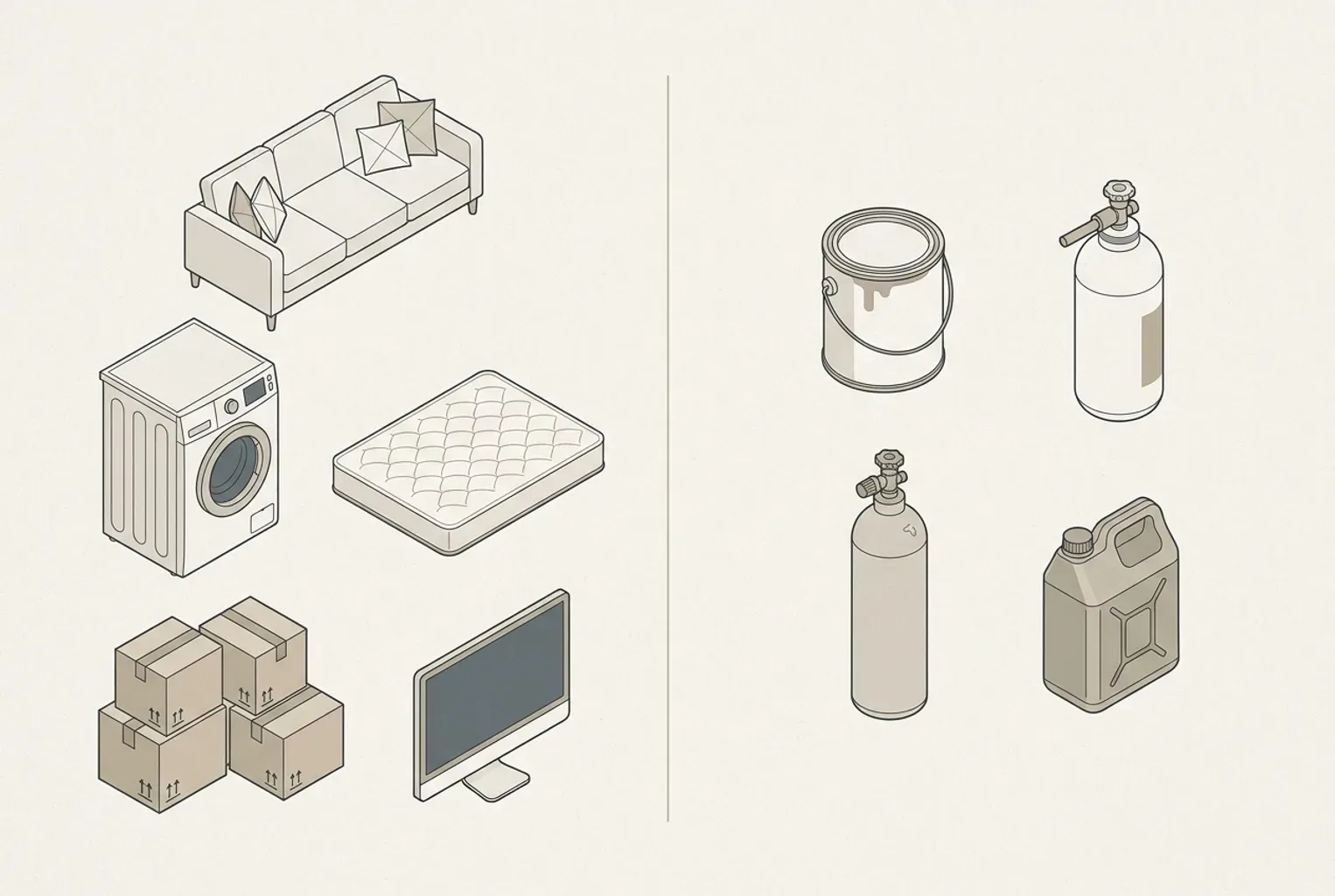
A comprehensive junk removal service handles the full spectrum of standard household, commercial and garden items:
- Sofas, armchairs, sofa beds and recliners
- Wardrobes, chests of drawers, bookcases and cabinets
- Bed frames, mattresses, divans and headboards
- Dining tables, chairs, coffee tables and outdoor patio sets
- Kitchen white goods (fridges, freezers, washing machines, cookers)
- Televisions, computers, monitors, printers and household electronics
- Boxed personal effects, kitchenware, books, clothing and toys
- Garden cuttings, bagged soil, branches and plant pots
- Office desks, filing cabinets, partitions and reception seating
Excluded hazardous materials
Under municipal regulations and safety laws, standard clearance crews cannot accept hazardous, toxic or regulated materials, including:
- Wet paints, wood stains, chemical solvents and thinners
- Industrial chemicals, acids, pool chlorine and pesticides
- Gas cylinders (LPG cooking cylinders, butane canisters, refrigerant tanks)
- Medical waste, pharmaceuticals, sharps and biological materials
- Explosives, ammunition and pyrotechnics
- Unbound friable asbestos or raw hazardous industrial by-products
These hazardous categories require specialist hazardous waste treatment companies licensed by Dubai Municipality's Environment Department. For a complete review of accepted materials and excluded categories, see our guide on what junk removal companies take in Dubai.
Practical tips for responsible household disposal
If you are planning a clear-out, moving home or renovating a property in Dubai, following these practical steps ensures that your unwanted items are handled responsibly:
- Separate your items into clear categories before booking: items in good condition that can be donated or gifted, items containing metal or electronics that can be recycled, and pure disposal items.
- Check community rules and book any required building permits, service lifts and loading bays well ahead of time.
- Avoid leaving unwanted items beside communal wheelie bins or in building corridors, which violates municipal cleanliness rules, as explained in what you cannot throw in Dubai bins.
- Take clear photographs of everything you need removed and request a written, fixed quote from a reputable clearance provider that outlines labour, vehicle capacity and disposal fees.
- Verify that your clearance provider transports items to approved municipal transfer stations or materials recovery facilities, giving you peace of mind that your junk is handled legally and responsibly.