
Estimating how much space your unwanted belongings will occupy inside a removal vehicle is one of the most common challenges when planning a property clearance in Dubai. When looking at a room filled with disassembled bed frames, rolled carpets, mismatched cardboard boxes, and an old three-seater sofa, it is difficult to translate that three-dimensional clutter into truck volume. Homeowners and tenants frequently worry that they will book a vehicle that is far too small, leaving half their belongings stranded on the pavement, or pay for a massive transport lorry when they only had a modest pile of household items.
In Dubai’s waste management and property clearance sector, professional removal companies solve this uncertainty by standardizing their fleet operations around specific commercial vehicle classes and modular load fractions. Instead of guessing arbitrary dimensions, understanding the physical volume of a standard collection truck, how different household items pack together, and the difference between volume capacity and legal weight limits will help you visualize your load with complete confidence.
The standard vehicle: why the 3-ton covered box truck dominates Dubai
If you observe commercial traffic moving through residential districts across Dubai, from high-density high-rise communities like Dubai Marina and Jumeirah Lake Towers to suburban villa developments like Arabian Ranches and The Springs, you will notice a remarkably consistent vehicle type: the three-ton covered box truck. This specific truck size is not an accidental preference; it is the direct operational response to Dubai’s architectural, regulatory, and climatic conditions.
The most critical factor dictating vehicle selection is underground basement and loading bay clearance heights. The vast majority of residential and commercial towers constructed across Dubai feature dedicated service access located in underground basement parking levels. These loading docks are reached via steep spiral ramps with strict overhead clearance barriers, typically ranging between 2.4 meters and 3.5 meters. Oversized ten-ton commercial transport lorries and high-capacity municipal compactor trucks cannot physically enter these subterranean loading docks. Attempting to bring an oversized truck to an apartment tower forces the vehicle to park on active municipal thoroughfares hundreds of meters away, creating dangerous pedestrian obstructions, violating traffic regulations, and triggering immediate municipal parking fines. A standard three-ton box truck is engineered with a compact cab-over chassis that maneuvers safely down underground ramps, fits neatly beneath low sprinkler pipework, and docks directly adjacent to the building’s service lift entrance.
Enclosed cargo protection is another absolute necessity under UAE transport laws. Dubai’s Federal Traffic Law and municipal environmental directives strictly prohibit the transport of loose waste or uncontained household goods in open-bed pickup trucks on major arterial highways like Sheikh Zayed Road and Mohammed Bin Zayed Road. Open trucks carrying mattresses, cardboard cartons, and lightweight plastics create severe road hazard risks if highway crosswinds dislodge items at high speeds. A fully enclosed, rigid-walled box truck ensures that every item remains completely sheltered from high winds and extreme summer temperatures, preventing roadway littering and keeping municipal access routes clean.
Gated residential communities also enforce strict vehicle restrictions. Master community developers such as Emaar, Nakheel, and Dubai Silicon Oasis Authority enforce community bylaws that restrict large multi-axle heavy goods vehicles from navigating narrow residential cul-de-sacs and internal suburban roads. A three-ton box truck complies with community weight thresholds, does not crack decorative interlocking driveway pavers, and can easily turn around within suburban dead-ends without blocking neighborhood traffic.
Physical dimensions and volumetric capacity of a 3-ton truck
To visualize how your belongings will fit, it helps to understand the exact physical measurements of a standard three-ton box truck cargo container. While slight variations exist between different vehicle manufacturers, the interior dimensions of the enclosed cargo box are largely uniform across professional fleets.
The interior cargo box of a standard three-ton clearance truck measures approximately 4.2 meters in length, 2.1 meters in width, and 2.1 meters in height. When converted into volumetric terms, this enclosed space provides approximately 18.5 cubic meters of gross volume, which translates to roughly 14 to 16 cubic yards or 400 to 450 cubic feet of usable loading space.
To put this volume into everyday perspective, a full three-ton cargo box can hold approximately one hundred and fifty to one hundred and eighty standard medium-sized cardboard moving boxes stacked ceiling-high. Alternatively, it can absorb three to four complete standard bedroom furniture sets, including disassembled bed frames, headboards, mattresses, bedside chests, and flat-pack wardrobes. It also comfortably accommodates the complete dense contents of an average furnished one-to-two-bedroom apartment, excluding built-in kitchen cabinetry and sanitary fixtures.
Professional removal companies do not expect customers to hire an entire vehicle if they only have a few surplus furnishings to discard. Instead, the cargo bay is divided into standardized load fractions: single item, quarter-load, half-load, three-quarter load, and full truckload. As outlined in how junk removal works in Dubai, professional quoting calculates the exact fraction of the truck your belongings will consume, ensuring you only pay for the vehicle space and crew labor your specific job requires.
The single-item minimum load: what counts as an individual pickup
Many clearance requests across Dubai do not involve clearing entire properties; residents frequently need to discard a single awkward, heavy item that cannot be left in the building refuse chute or carried in a passenger elevator. Professional services accommodate these focused requests under single-item minimum load pricing.
A single-item pickup generally occupies roughly one-eighth of a truck’s physical volume or less, but requires the full dispatch of a two-person crew, fuel, building parking arrangements, and authorized municipal disposal fees. Common single-item collections include a standard three-seater living room sofa or a pair of armchairs, one large domestic appliance such as an American-style double-door refrigerator-freezer or heavy washing machine, one king-sized mattress accompanied by its wooden base, a large dining table with its legs dismantled, or a multi-door freestanding flat-pack wardrobe that has been collapsed into flat timber panels.
Even though a single mattress or washing machine leaves over eighty percent of the truck cargo box empty, dispatching a vehicle specifically to collect that item involves the same transit time, building security clearances, and disposal paperwork as a larger load. If you have secondary items, such as discarded electronics, broken lamps, balcony chairs, or surplus moving boxes, it is almost always significantly more cost-effective to group them into the same visit rather than booking multiple individual collections over time.
The quarter-load: small room clear-outs and bulky pairings
A quarter-load represents approximately 3.5 to 4 cubic yards of cargo space, which equals roughly 100 cubic feet. This volume tier is the most common size for tenants refreshing a specific living zone, clearing out a cluttered balcony, or discarding a couple of large coordinated furniture sets.
In physical terms, a quarter-load comfortably accommodates a complete living room seating arrangement consisting of one three-seater sofa, one armchair, a central coffee table, and an entertainment TV console. Alternatively, it holds a complete laundry and kitchen refresh, such as a washing machine, a tumble dryer, a freestanding microwave, and ten to twelve sealed storage boxes of kitchenware.
For outdoor areas, a quarter-load absorbs a typical balcony clearance, including a four-seater synthetic rattan dining set, two sun loungers, an outdoor storage chest, and several potted planters. For children's bedrooms, it easily holds a single wooden bed frame and mattress, a small study desk with chair, a toy organizer rack, and six to eight bags of outgrown clothes and toys.
When packed by an experienced two-person crew, a quarter-load occupies the front bulkhead section of the truck, stacked tightly from floor to ceiling and secured with cargo straps so it does not shift backward during transit across city highways.
The half-load: studio apartments and complete bedroom suites
A half-load provides approximately 7 to 8 cubic yards of volume, or roughly 200 cubic feet, filling half the total length of the cargo container. This tier represents a substantial quantity of household furnishings and is the standard baseline volume required for a complete studio apartment cleanout or the thorough clearance of a large master bedroom suite.
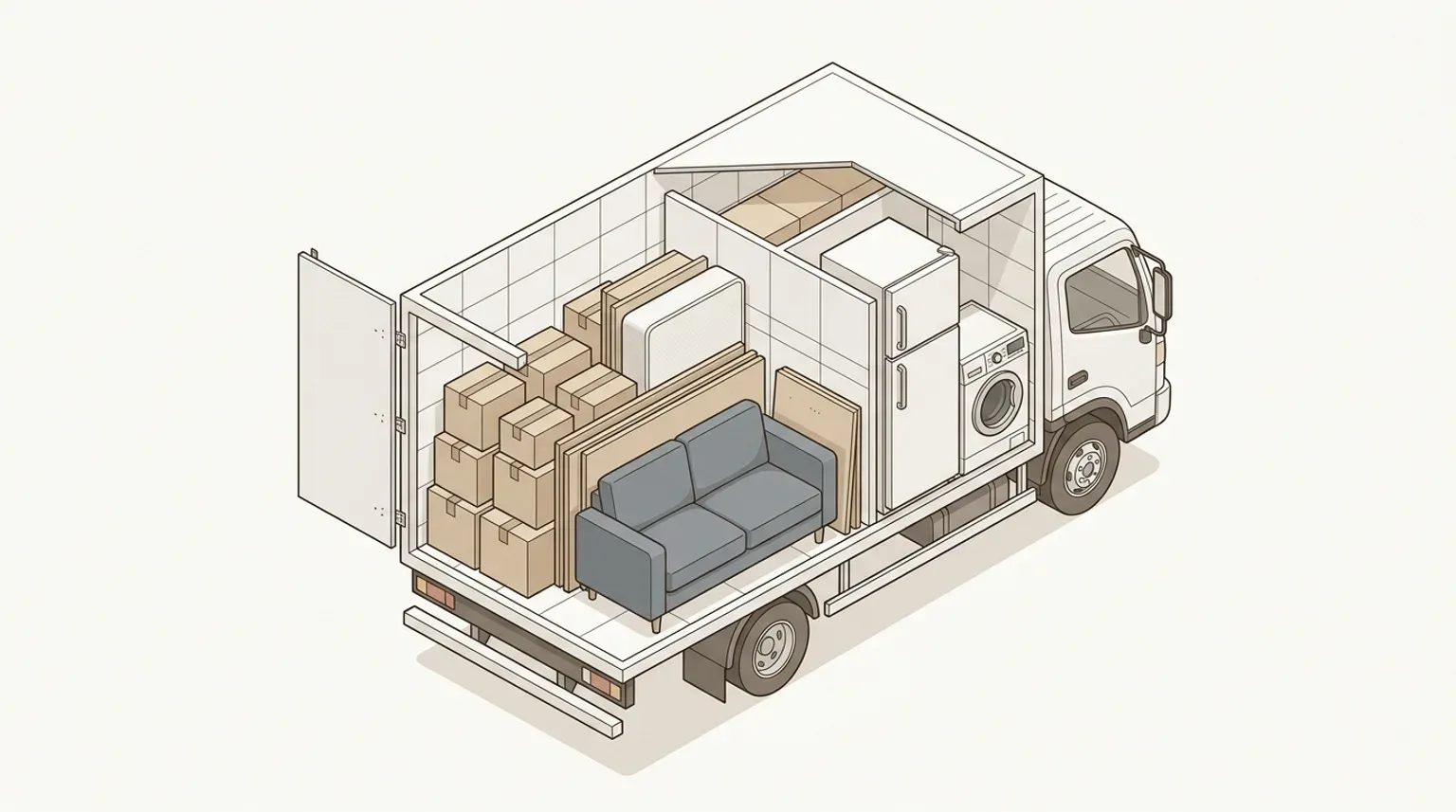
A half-load capacity realistically absorbs a complete master bedroom suite, including one dismantled king-sized bed frame, headboard, thick mattress, two bedside tables, a six-drawer dresser with mirror, and a dismantled four-door wardrobe, alongside ten to fifteen storage cartons or suitcases.
For furnished studio apartments, a half-load clears a queen bed and mattress, a two-seater sofa, a small dining table with two chairs, a TV unit, a coffee table, a microwave, an ironing board, a clothes drying rack, and roughly fifteen to twenty moving boxes of personal clutter. For commercial offices downscaling staff, it absorbs four complete open-plan workstations, four ergonomic task chairs, two low metal filing cabinets, a desktop printer, two monitors, and several archive storage boxes.
Reaching a half-load volume often marks the threshold where handling requires careful coordination with building management. Moving this volume of belongings down service elevators typically occupies forty-five minutes to an hour of lift time, making advance service lift reservations essential to avoid conflicts with other building residents.
The three-quarter load: furnished one-bedroom apartments
A three-quarter load encompasses roughly 10.5 to 12 cubic yards of cargo space, which translates to approximately 300 to 350 cubic feet. At this volume, only the rear tail section of the vehicle remains unoccupied. This load tier is typical for tenants vacating a fully furnished one-bedroom apartment or homeowners undertaking an extensive whole-home redecoration.
A three-quarter truckload holds the combined primary furnishings of a one-bedroom apartment, such as a complete living room suite, a full dining table with four to six chairs, a complete queen or king bedroom set, major kitchen white goods including refrigerator and washing machine, balcony chairs, and twenty to thirty assorted boxes and bags of household goods.
For suburban properties, a three-quarter load easily clears a major villa garage and outdoor storage space, accommodating three sets of heavy metal industrial shelving, several bicycles, garden tools, patio furniture sets, a dismantled barbecue grill, sports equipment, camping gear, and dozens of plastic storage bins accumulated over years of residence.
When a clearance reaches three-quarter volume, the operational crew typically includes three workers rather than two. Having a third crew member allows one worker to remain inside the truck optimizing the three-dimensional stacking layout, while the other two team members continuously ferry items through the building corridors, dramatically accelerating the total job duration.
The full truckload: dense two-bedroom clearances and major declutters
A full truckload utilizes the entire 14 to 16 cubic yards of enclosed cargo capacity, providing 400 to 450 cubic feet of dense storage. When packed professionally, a full three-ton truck represents an enormous quantity of domestic or commercial property, packed solid from the front bulkhead all the way to the rear roller shutter.
A full load generally encompasses the complete contents of a furnished two-bedroom Dubai apartment, containing two full bedroom sets with beds, mattresses, dressers, and dismantled wardrobes, a full living room suite with a large sectional sofa, coffee table, and media unit, a dining room suite with a large table and six chairs, full kitchen and laundry appliances including refrigerator, washing machine, dryer, cooker, and dishwasher, hallway consoles, outdoor balcony sets, rugs, lighting fixtures, and thirty to fifty boxed cartons of personal belongings.
For corporate tenants, a full load absorbs eight to twelve complete employee desks, ergonomic chairs, partition privacy screens, a conference room table with ten executive chairs, metal storage cabinets, office e-waste, and corporate filing archives. For villa owners, it provides a thorough pre-handover cleanout, clearing out all surplus furniture left behind across a four-bedroom villa prior to a final landlord handover inspection.
For customers planning a major domestic or commercial cleanout, understanding the financial and logistical parameters of a full truckload is crucial. To explore how volume tiers, access conditions, and disposal tariffs interact to form an upfront estimate, consult our detailed analysis of junk removal cost in Dubai.
Villa clearances: when a job requires multiple truckloads
While a single three-ton truck is sufficient for the vast majority of Dubai apartment clearances, large standalone villas, particularly three-, four-, and five-bedroom properties in communities such as Arabian Ranches, Jumeirah Golf Estates, DAMAC Hills, and Palm Jumeirah, frequently exceed the capacity of a single vehicle.
A fully furnished four-bedroom family villa with an external maid's room, double garage, landscaped garden, and private majlis typically contains between thirty and fifty cubic yards of total clearance material. This volume equates to two, three, or occasionally four full truckloads.
When handling multi-truck villa clearances, professional companies deploy one of two operational strategies depending on customer deadlines. The first approach is simultaneous multi-truck dispatch. For urgent clearances, such as end-of-tenancy lease expirations where keys must be surrendered to the landlord within twenty-four hours, the company dispatches two or three three-ton trucks simultaneously alongside an expanded crew of four to six workers. This allows the entire property, garden, and outbuildings to be cleared in a single intensive half-day operation.
The second approach utilizes consecutive shuttle runs. For flexible clearances where the customer has several days before handover, a single vehicle and crew can complete consecutive runs. The team loads the first full truck in the morning, transports the load to the segregation depot, empties the vehicle, and returns in the afternoon to complete the second load. This approach minimizes vehicle congestion in quiet suburban driveways and provides the homeowner with more time to review belongings between loads.
For tower residents facing strict moving deadlines, access coordination can be just as demanding as volume planning. Reviewing our logistical guide on getting bulky items out of a Dubai tower will help you organize freight lift permits and loading dock bookings alongside your vehicle volume estimates.
The science of professional packing: 3D stacking vs loose dumping
A common point of surprise for customers watching professional junk removal crews at work is seeing just how much material can fit into a single vehicle. If an untrained homeowner or casual laborer were to toss furniture randomly into a truck, the cargo box would fill up within fifteen minutes, appearing completely full while holding only a fraction of its true potential capacity.
Professional junk removal crews treat truck loading as an exercise in three-dimensional engineering. Heavy white goods like refrigerators, washing machines, and dryers are strapped solidly against the front bulkhead. Flat-pack panels from dismantled wardrobes and desks are stacked flat across the cargo floor. Mattresses and bed bases are secured vertically against the side interior rails using heavy-duty webbing straps. Disassembled tables and sofa components are positioned on edge and nested together, while medium moving boxes are stacked in the upper voids. Finally, soft bags, cushions, and rolled rugs are tucked into small cavity gaps.
Dismantling is the single most effective technique for maximizing volume. An assembled four-door wardrobe is essentially a massive wooden box enclosing empty air; carrying it into a truck whole wastes over three cubic meters of vehicle space. By unbolting the hinges, removing the shelves, and taking down the side gables, that entire three-cubic-meter wardrobe collapses into a neat, dense stack of flat timber panels less than thirty centimeters thick. Dining table legs are unbolted so the tabletop can slide vertically against the truck wall. Chairs are nested seat-to-seat in pairs.
Void filling represents the second key technique. In any load, large furnishings naturally create irregular gaps and recesses. A professional crew never leaves these air pockets empty. Stackable moving boxes are placed underneath tables; rolled rugs and curtain poles are slotted into narrow vertical crevices; soft bags of clothing, bedding, and cushions are wedged into upper ceiling corners. This dense, interlocked packing technique not only doubles the quantity of junk that fits inside the truck, but also prevents items from shifting, rubbing, or collapsing during transit.
Volume versus weight limits: the dense material trap
While volumetric space is the primary measurement for standard household clearances, legal vehicle weight limits represent an absolute physical ceiling that cannot be ignored. In Dubai, commercial vehicles are strictly regulated by the Roads and Transport Authority and Federal Transport Authority, which enforce maximum gross vehicle weight ratings and perform random axle-weight inspections on commercial transport routes.
A standard three-ton commercial box truck has a maximum payload carrying capacity of approximately three thousand kilograms of cargo. For standard household furniture, appliances, and electronic waste, reaching this weight limit is virtually impossible because household furnishings are voluminous but relatively light. Even a fully packed truck loaded ceiling-high with sofas, wardrobes, beds, and refrigerators rarely exceeds one thousand eight hundred to two thousand two hundred kilograms of total payload.
However, the balance flips dramatically when dealing with dense, heavy materials such as garden landscaping waste, renovation rubble, and masonry. If a customer is clearing garden waste and includes dozens of heavy ceramic planters filled with wet, compacted soil, or bags of garden sand and gravel, the vehicle will hit its three-thousand-kilogram legal weight limit long before the cargo box is half full. Similarly, broken bathroom floor tiles, cement mortar, plasterboard, and concrete blocks are exceptionally dense. Loading concrete rubble into a box truck until it is visually full would load six to eight tons into a three-ton chassis, instantly cracking the vehicle's leaf springs, blowing out tires, and making braking dangerously unpredictable.
For this reason, reputable removal companies distinguish between volumetric bulky waste and dense materials. If your clearance contains heavy soil bags, masonry rubble, or dense metal machinery, the quote will be calculated based on payload weight rather than cubic truck volume. For broader details on what types of materials are approved for general collection versus specialized industrial disposal, refer to our comprehensive directory on what junk removal companies take in Dubai.
How to estimate your load accurately from photos
In modern Dubai, you no longer need to wait for a surveyor to visit your property in person to receive an accurate estimate of your required truck volume. Thanks to high-resolution smartphone cameras and instant messaging platforms, professional removal services can assess vehicle requirements and calculate fixed quotes entirely from photos.
To ensure your photo quote is completely accurate and avoids mid-job adjustments, follow these practical steps:
- Stand in the corner or doorway of each room and capture a wide-angle photograph that shows all the items in relation to the surrounding space. Wide shots allow the estimator to understand the overall scale, ceiling height, and quantity of items far better than extreme close-ups.
- If your job includes clearing out built-in wardrobes, kitchen cupboards, balcony storage closets, or maid rooms, open the doors and photograph the interior contents. Hidden contents inside storage rooms are the primary cause of unexpected volume overruns on collection day.
- If you have an oversized American fridge, a solid marble dining table, an iron safe, or a commercial gym machine, capture dedicated photographs of these pieces and mention their materials in your message.
- State whether large furniture pieces are already disassembled or whether you require our crew to bring tools and dismantle them on site.
- Mention whether you live in an apartment tower or a villa, the floor level, whether a freight elevator is operational, and whether your building requires contractor gate passes or move-out permits.
By sharing clear visual evidence upfront, our logistics team can instantly determine the exact truck fraction required, calculate an honest, all-inclusive price, and dispatch the right vehicle with an experienced crew to clear your property in a single organized visit.