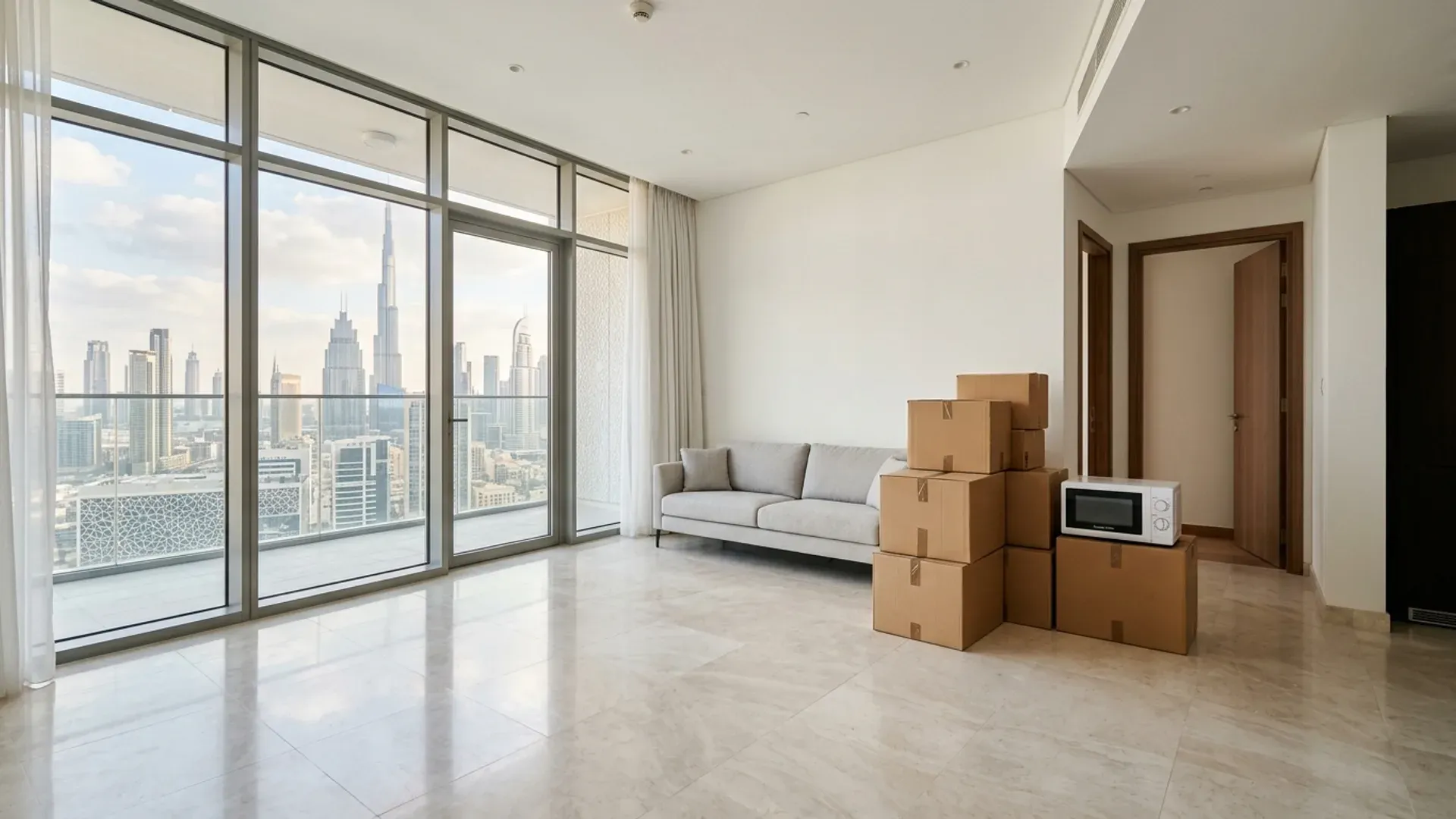
Start with the things that take up floor space and have no daily job: the spare chair nobody sits on, the second bookcase, the boxes kept since the last move, the folded exercise bench behind the bedroom door. In a small apartment, a few of those pieces cost more room than every drawer of small items combined. Clear them first, and the rest of the decluttering has somewhere to go.
The second rule is to decide where each item is heading before you start sorting. Decluttering stalls when the "no" pile becomes a new obstacle in the hallway. Pick the exits first: what you will keep, what can be passed on, what goes in the bin and what needs a collection. Then work room by room.
Why small apartments fill up so quickly
A one-bedroom or studio apartment has limited built-in storage, and the storage it has can be deep rather than accessible. Built-in wardrobes, the cupboard beside the kitchen, the space above the wardrobe and the gap under the bed fill with things that are hard to see and easy to forget.
Moves add to it. Items that suited a previous home arrive without a natural place in the new one. Spare furniture, extra bedding, kitchen equipment for a bigger kitchen and boxes that were never fully unpacked settle into corners. Deliveries add packaging, and packaging can linger because flattening and removing it is another job.
The result is clutter that is mostly about volume, not about the number of possessions. A small apartment with modest belongings can still feel full if two or three large items are in the wrong place. That is why the order of work matters more than the method.
Decide what you want back
Before opening a single drawer, decide what success looks like. Pick one or two specific outcomes:
- A clear walkway from the door to the balcony.
- An empty spare room or study corner that can be used again.
- A wardrobe where everything is visible on the rails.
- A balcony with space to sit.
- A kitchen counter with nothing stored on it.
A specific outcome turns vague decluttering into a series of decisions about what blocks that outcome. It also tells you when you are finished, which is important in a small space where the temptation is to keep rearranging the same items.
Set up four exits before you sort
Sorting goes faster when every item has a destination the moment you pick it up. Set up four clear groups.
Keep
Items you use, need or genuinely want, and that have a place to live. If an item is a keep but has no home, it is not finished yet. Either something else leaves to make room, or the item becomes a candidate for another group.
Pass on
Items in good, usable condition that someone else can take: clean furniture, working small appliances, books, kitchenware and children's equipment. The guide to donating furniture explains what condition donated pieces need to be in and why some items are refused. Be realistic: anything that is broken, stained or incomplete is not a donation.
Dispose
Ordinary household waste that can go in the building's bins, bagged properly. Not everything qualifies. Electronics, batteries, chemicals and bulky items have their own routes, and the guide to what Dubai bins won't take sets them out.
Collect
Bulky items and mixed loads that need carrying out of the apartment: furniture, mattresses, appliances, large boxes of household items. Group these together in one place so they can leave in a single collection rather than one piece at a time.
Keep a fifth, small box for genuinely undecided items. Write a date on it. If nothing in it has been needed by that date, it moves to pass on or collect without being reopened.
Work from large to small
In a small apartment, clear large items first. Removing a single unused armchair or a bulky storage unit frees space you can use to sort everything else. Starting with a drawer of cables produces a satisfying hour and no visible difference.
A useful order:
- Unused furniture and large pieces.
- Boxes that were never unpacked.
- Wardrobes and built-in storage.
- Kitchen cupboards.
- Bathroom and personal items.
- Papers, cables and small items.
Large items are also the ones most likely to need help leaving. Deciding on them early gives you time to arrange a collection while you work on the smaller categories.
Room by room in a small apartment
Entrance and hallway
Shoes, bags, delivery boxes and things waiting to go out collect here. Keep only what is used every week by the door. Move everything else to its proper place or into one of the exit groups. A clear hallway also matters on collection day, because it is the route every bulky item has to take.
Living room
Look at furniture first. Count seats against the people who actually use them. Check side tables, shelving and media units that hold little. Large items such as a second sofa or an oversized coffee table are the biggest gains in floor space. Then deal with what is on surfaces and shelves.
Bedroom and wardrobes
Empty one section of the wardrobe at a time onto the bed so you have to deal with it before you sleep. Clothes that do not fit, are damaged or have not been worn for a long time go to the relevant group. Spare bedding and pillows can take a lot of space; keep what you need for the beds you have and for expected guests. The space under the bed should hold items you use, not items you have forgotten.
Kitchen
Duplicate utensils, appliances used once a year and mismatched containers can fill a small kitchen. Keep the set you use. Small appliances that still work can be passed on. Broken ones are electrical waste and should not go in the household bin.
Bathroom
Expired medicines, old cosmetics and empty bottles take up cabinet space. Dispose of them according to the product's instructions; do not pour medicines or chemicals down the drain. Keep only what is in use.
Balcony
A balcony in a small apartment can become storage for things with nowhere else to go: old chairs, broken plant pots, boxes and equipment. Some buildings have rules about what may be kept on balconies, so check yours. Clearing the balcony can return a whole usable space. Garden material and pots need their own planning; the guide to soil, sand and pots covers the heavy end of that.
Storage cupboard or maid's room
If your apartment has a storage cupboard or a small spare room, it may be the fullest space in the home. Empty it completely onto a clear floor, sort everything into the groups, and only put back what is a genuine keep.
Work corner
Old monitors, printers, cables and chargers accumulate around a desk. Back up and wipe any device before it leaves. Electrical items go to an electronic waste route rather than the household bin, and the e-waste guide explains the options.
Papers, cables and small items
Leave these until last, when the larger groups have gone and there is space to work. Small items take the most decisions per minute, so they are easier with a clear table and a fresh session.
Papers need care. Keep tenancy contracts, identity documents, warranties you still need and financial records in one labelled folder. Anything with personal details that you no longer need should be shredded or torn up before it goes in the bin, not thrown away whole.
Cables and chargers gather in drawers long after the devices they belonged to have gone. Match each cable to a device you still own. The rest are electrical waste.
Small items such as stationery, decorative objects, spare keys and old keyrings are best handled with a single rule: if it has no place and no use, it goes. A small apartment has no room for a drawer of things kept only because they were never sorted.
Handling the items that are hard to let go
Some items are difficult for reasons that have nothing to do with their size.
Gifts can be passed on without guilt. The gift was the gesture; the object does not have to stay forever.
Items kept "in case" are worth testing. Ask whether you could borrow, rent or cheaply replace the item if the rare need arose. If so, the space it occupies every day costs more than the occasional inconvenience.
Sentimental items deserve a different approach. Keep a selection rather than everything. Photograph items you want to remember but do not need to store. Give some to family members who will value them.
Expensive items that are no longer used can feel wasteful to let go. The money was spent when the item was bought; keeping it unused does not recover it. Passing it on to someone who will use it is a better outcome than storing it.
Getting bulky items out of a small apartment
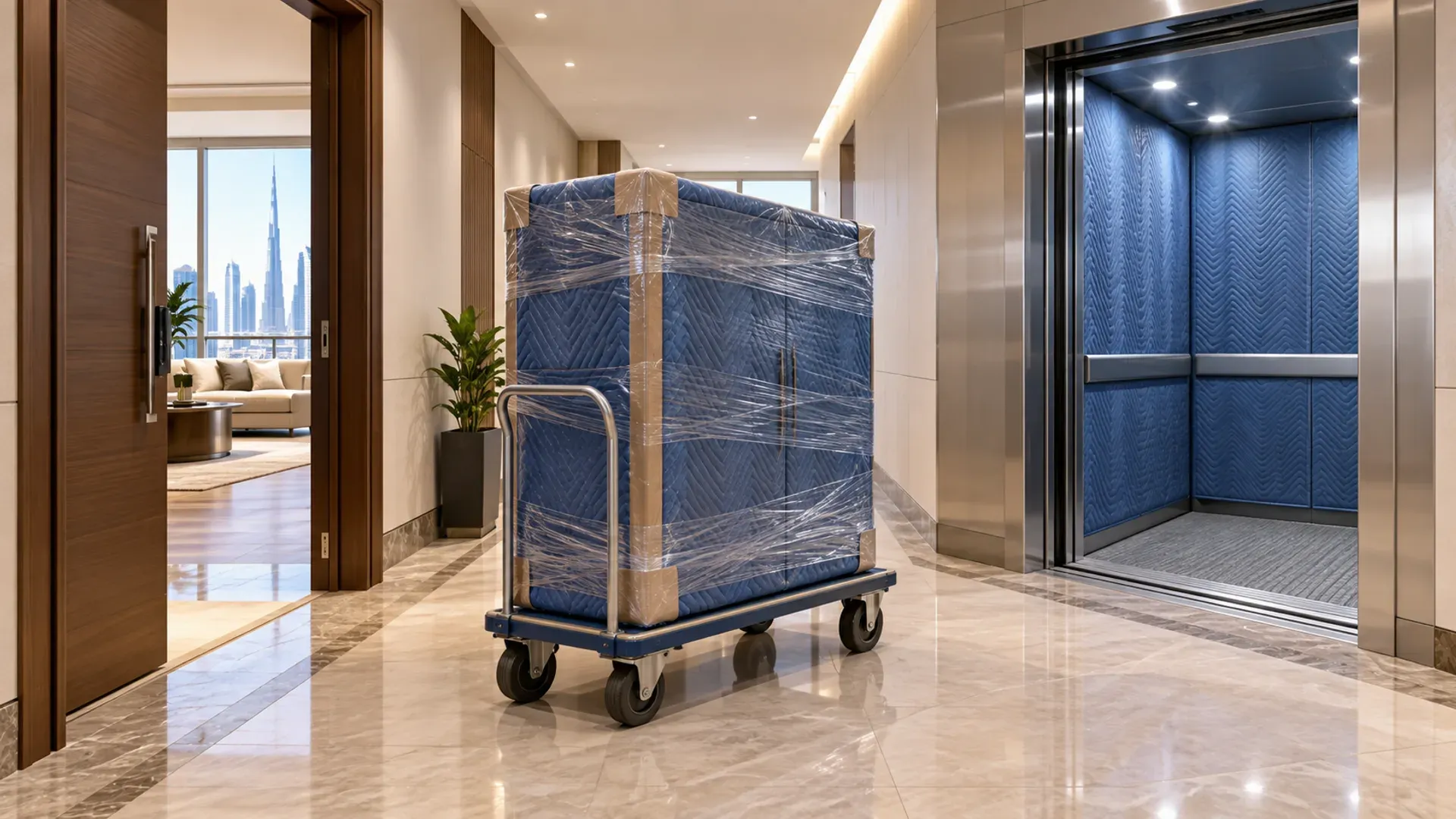
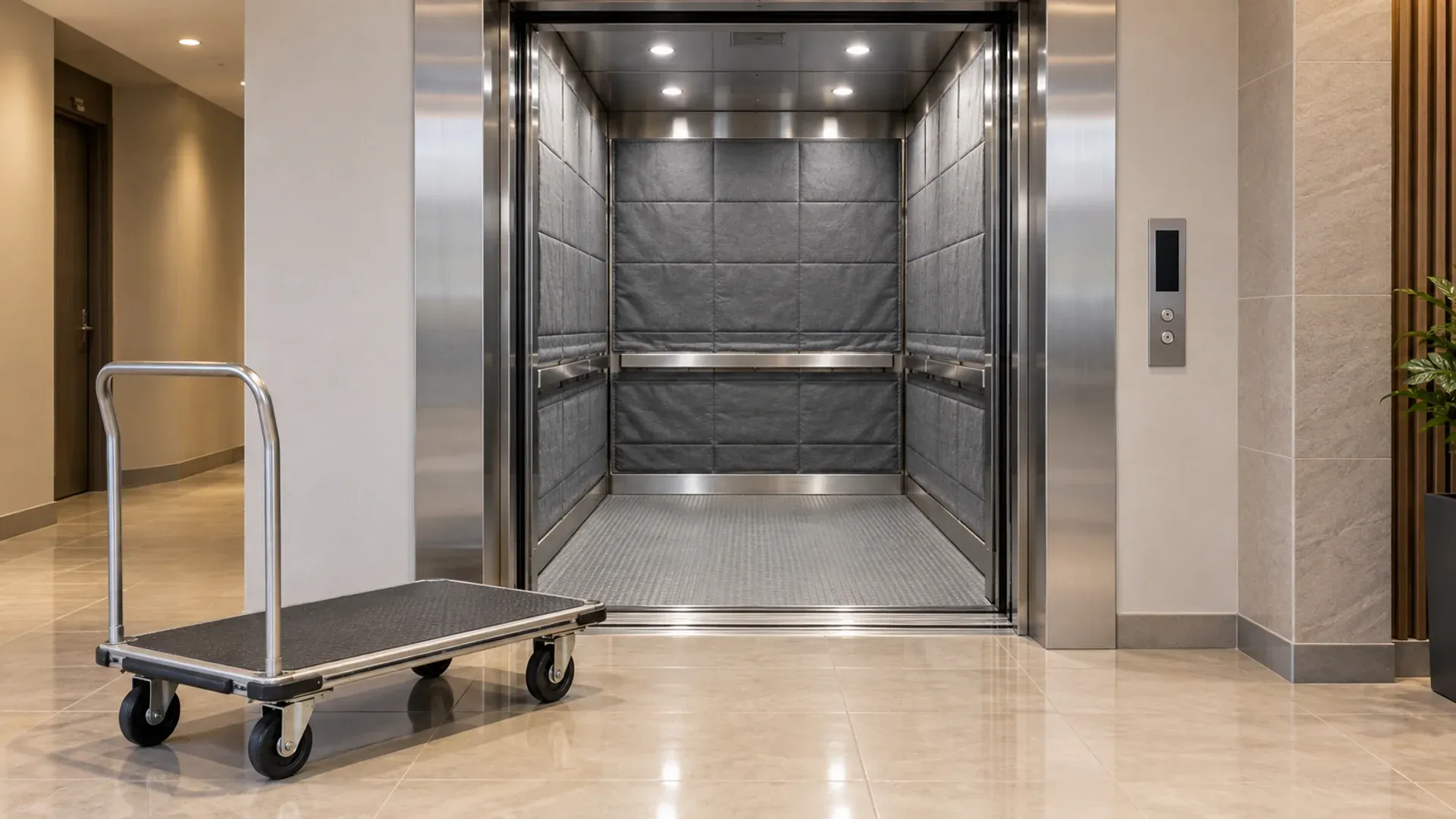
Once the collect group is assembled, the remaining question is how it leaves the building. In a tower, that usually involves the lift, the corridor and the loading area, and sometimes the building's rules about timings and lift bookings.
Group the items inside the apartment, away from the door, so the route to the corridor stays clear. Do not stack furniture in the shared corridor or the lift lobby. Note anything that may not fit through doors or the lift in one piece, such as a large wardrobe, a corner sofa or a bed frame, because those may need dismantling.
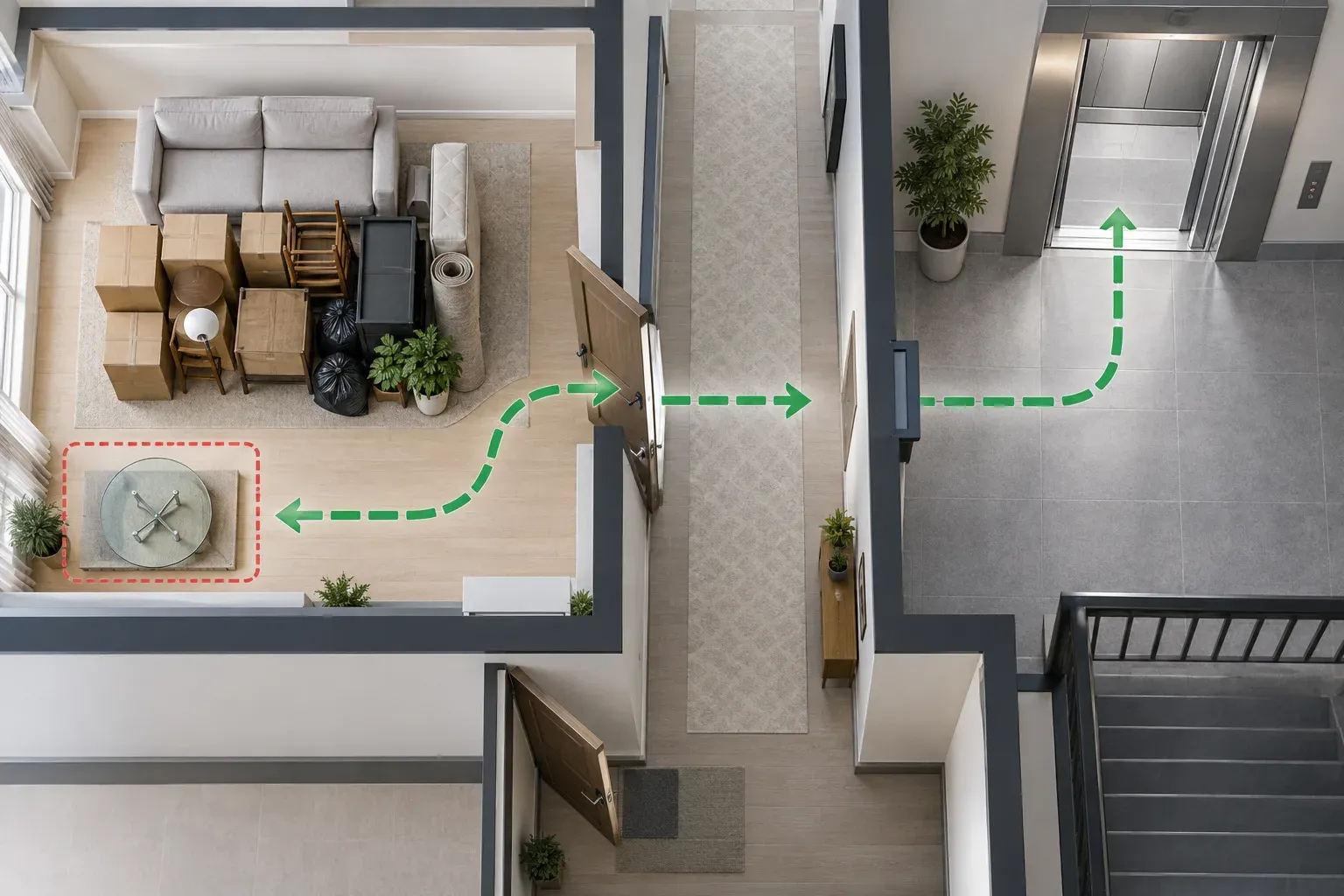
The plan above shows the principle: everything leaving is grouped in one part of the room, the item staying is clearly separate, and the route from the room to the lift is open. Getting the apartment to this point is the main preparation. The guide to getting bulky items out of a tower explains the building side in more detail.
You have three realistic routes for the collect group.
Pass it on yourself
If the items are in good condition, a friend, colleague or recipient may collect them. This works when the recipient can arrange their own transport and carrying, and when you have time to wait for them.
Use the Municipality bulky-waste service
Dubai Municipality offers a bulky-waste collection for household furniture and appliances. The guide to the Municipality bulky-waste service explains how it works, who it covers and what it does not do, including the carrying that a small apartment in a tower may need.
Book a collection that carries it out
A residential junk removal crew carries the items out of the apartment, dismantles what needs dismantling and loads everything in one visit. Where the tower requires a service-lift booking, it is arranged as part of the job. A single item or one room's worth is a two-person job that usually takes under an hour. The quote comes from a photo, at a fixed price covering labour, loading and disposal, and the space is swept before the crew leaves.
Keeping a small apartment clear
The clear-out is easier to maintain than to repeat.
- When something new comes in, something similar leaves.
- Flatten and remove packaging the day a delivery arrives.
- Give every item a home; if it has none, it is a sign something should go.
- Keep one small box for items to pass on, and empty it when it is full.
- Review the storage cupboard and balcony every few months, because they fill silently.
- Deal with broken items when they break, rather than storing them for repair.
A small apartment does not need to be minimal. It needs to have room for the things that are used, and no room taken by things that are not.
Frequently asked questions
Where should I start decluttering a small apartment?
Start with large unused items, such as spare furniture and unpacked boxes. Removing a few big pieces frees the space you need to sort everything else and makes the most visible difference.
Can I leave old furniture in the corridor or by the bins for collection?
No. Shared corridors are controlled by building management, and Dubai's waste law prohibits discarding waste in public places; the dumping fines guide explains the rules. Use the Municipality bulky-waste service, pass the items on to someone who will collect them, or book a crew that carries them out.
Can a crew take just a few items rather than a full clearance?
Yes. Single items and one-room loads are collected as well as full clearances. Send a photo of what is going and the quote comes back at a fixed price.
What should I do with old electronics found during a clear-out?
Back up and wipe anything that stores data, then send it through an electronic-waste route. Electrical items should not go in the household bin.