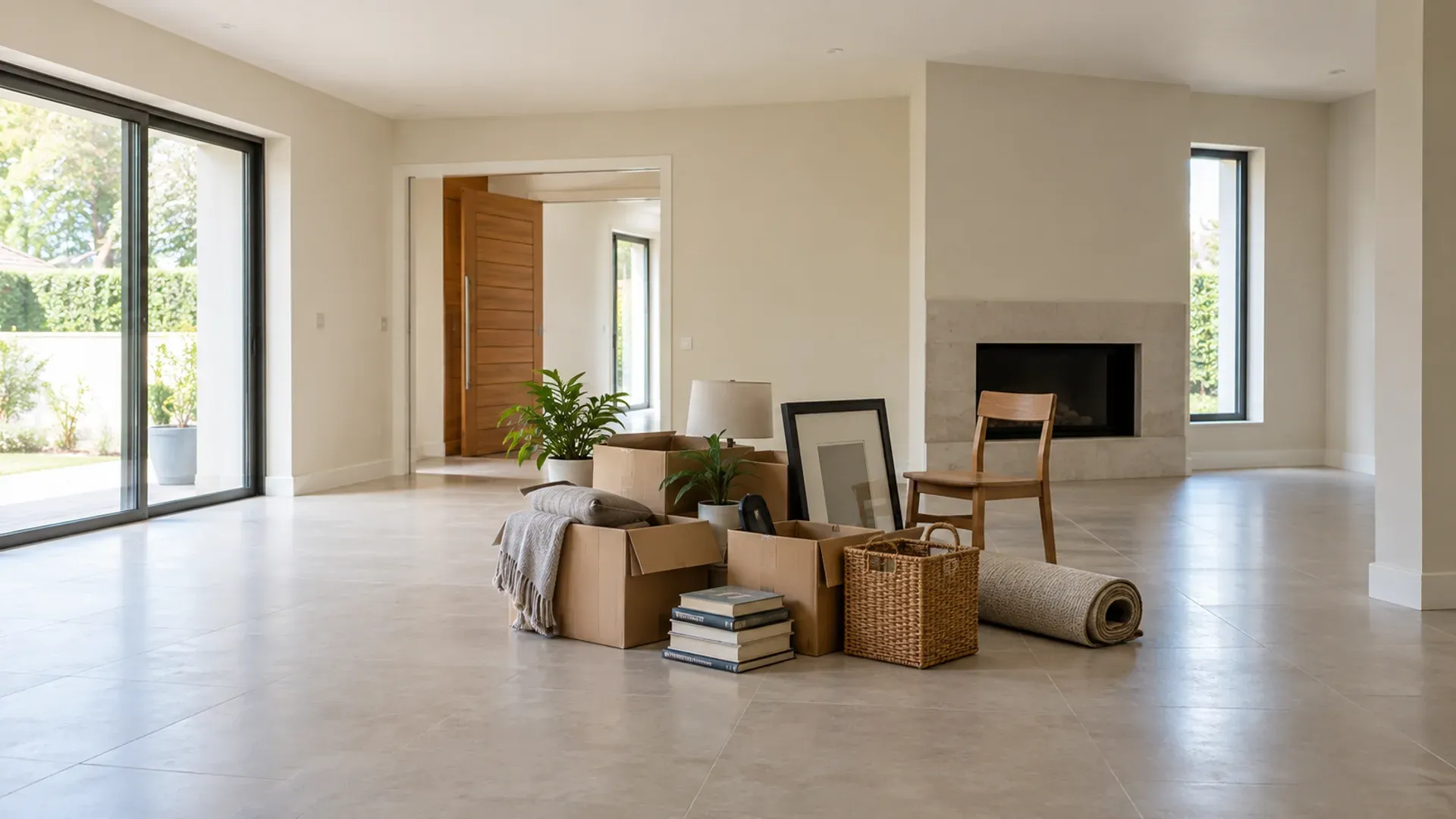
A full villa clearance is planned as anything from half a day to two days, with a crew of four or more and more than one truckload. Where a job falls in that range depends less on the number of bedrooms than on what is actually inside: how full the storage room is, how much is in the garden, whether furniture needs dismantling and how far the crew has to carry each item to the vehicle.
That range is a planning figure, not a promise for every property. A sparsely furnished villa with an open driveway sits at the short end. A long-occupied family home with a packed garage, a majlis, a maid's room and a garden full of planters can need the second day. The rest of this guide explains what moves a clearance from one end of the range to the other, and how to plan your dates so the deadline holds.
Why villas take longer than apartments
A villa is not an apartment with extra rooms. It has spaces that collect years of material without anyone seeing them every day: the storage room under the stairs, the garage, the roof terrace, the maid's room, the outdoor store and the garden itself. Each of those adds volume that may not show up in a quick photo of the living room.
Volume is the first driver. More material means more carrying and more loads. A crew can only move items as fast as the route allows, and the vehicle has to leave, unload and return when it is full. Two loads take longer than one even if the carrying is quick.
Access is the second. A driveway helps, but the route from the furthest room to the vehicle can still be long. Stairs, narrow internal doors, side passages and gates all add time to every trip. A first-floor wardrobe that must be dismantled before it leaves the bedroom takes longer than a ground-floor sofa that goes straight out of the front door.
The third is the outside of the property. Gardens, terraces and outdoor stores produce mixed material: furniture, planters, cut branches, soil, tools and play equipment. Some of it is heavy for its size, some of it is awkward, and some needs a decision before it can go.
The factors that decide the duration
Use this list to judge where your villa is likely to land.
How much is leaving
A villa that has already been partly emptied by movers is a very different job from a fully furnished home. List what is staying, what the movers are taking and what is left for clearance. The clearance plan is built on the last group only.
How many separate spaces are involved
Each room, store and outdoor area adds walking, sorting and handling. A villa where everything to go is gathered in a few rooms clears faster than one where items are spread across every floor, the garage and the garden.
What has to be dismantled
Fitted wardrobes, large beds, bunk beds, dining tables and some outdoor furniture may need taking apart before they fit through doors or into the vehicle. Dismantling is included in the work, but it takes time and the plan should allow for it.
The carry route
Measure the distance from the furthest item to where the vehicle can stop. Note stairs, tight turns, side gates and any surface that needs protection. A clear, short route speeds every trip. A long route with steps and a narrow side passage slows all of them.
Garden and outdoor material
Outdoor loads can be bulky and dense. Bagged soil, filled planters, branches and broken pots behave differently from household furniture. If the garden is substantial, include it in the photos and plan it as a separate part of the day. The guide to soil, sand and pots explains how to prepare heavy garden material so it does not stall the job.
Decisions still to be made
Clearances move fastest when every decision has been made beforehand. If family members are still choosing what to keep, or valuable items have not been identified, the crew will wait. Decide first, then book.
Community rules and timing
Where a villa sits inside a gated community, the community may set its own contractor access and working hours. If the community only admits contractors during certain hours, the working day is shorter than the clock suggests. Tell us the community when you book so gate access is arranged and the crew's arrival is planned around its rules.
Typical shapes of a villa clearance
These are planning patterns, not quotes. Your property will be assessed from your photos.
A partly emptied villa before handover
The movers have taken most of the furniture. What remains is a few beds, a sofa, some outdoor furniture, the contents of the storage room and the garden material. This is the kind of job that can fit at the short end of the range, provided access is straightforward and nothing is left undecided.
A fully furnished villa being cleared completely
Every room is still furnished, the garage holds years of storage, and the garden has furniture and planters. This is the kind of job that may need both days, with the plan saying which parts of the villa are cleared on which day.
A clearance with a mixed outcome
Some items are going with the family, some to friends and some to clearance. The duration depends on how clearly those groups are separated. Labelled rooms or zones keep the crew moving. Mixed groups slow everything.
A garden-heavy clearance
The house is nearly empty but the garden is full: planters, soil bags, cut branches and old outdoor sets. A garden-only load is a different service, but within a full villa clearance, the outdoor part may take a considerable share of the time.
How the plan comes together
The duration estimate comes from photos rather than a site visit. Send photos of every space, including the garage, roof terrace, maid's room, storage and garden. Close-ups of large items and wide shots of each room are both useful. Add the floor plan or a short description of the carry route and where the vehicle can stop.
With that, the quote comes back with a fixed price and a plan: how many crew, how many loads are expected and whether the job is scheduled as one long day or split across two. When it is split, the plan says which parts of the villa are cleared on which day so you can prepare in the right order.
The price stays fixed unless the load turns out to be different from the photos. If extra items appear on the day, the crew lead raises them before loading so the change is agreed, not assumed.
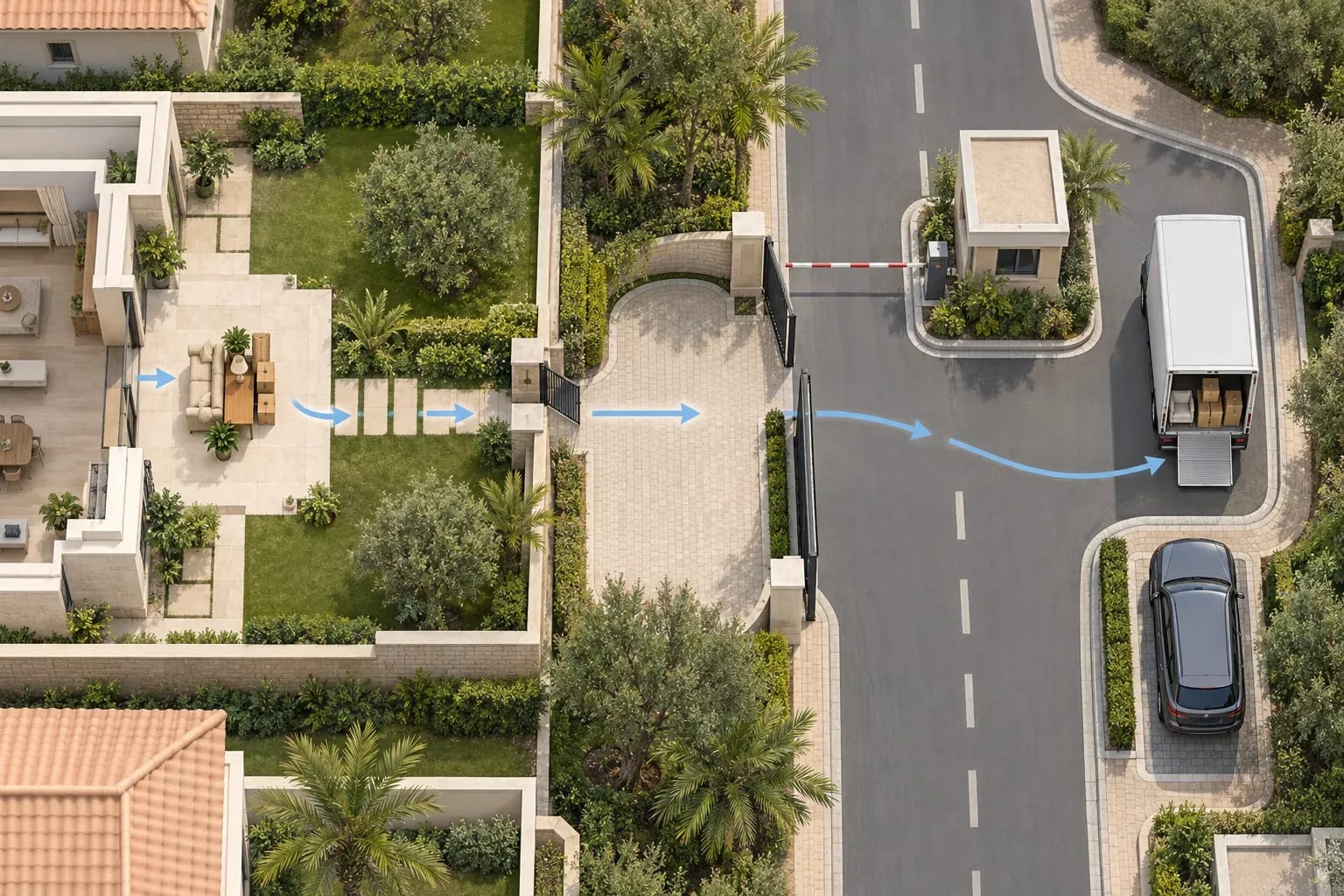
The plan works best when the route is clear from the start: items grouped inside the property boundary, a single carry path through the gate and an agreed stopping position for the vehicle. That arrangement shortens every trip, and on a large clearance the trips add up quickly.
Working backwards from your deadline
When a clearance is tied to a date, such as a handover, an inspection, a sale completion or new tenants arriving, plan backwards from that date rather than forward from today.
- Choose the date by which the villa must be empty, and leave a buffer before any inspection.
- Confirm when the movers are taking the items you are keeping. The clearance should happen after that, not alongside it.
- Decide what stays, what goes and what is being collected by friends or family. Label rooms or areas accordingly.
- Photograph every space and request the quote, mentioning the deadline.
- Check community rules for contractor hours and access, and book any required permits or gate passes.
- Confirm whether the clearance runs over one day or two, and prepare the areas due on the first day.
- Keep the final day before the deadline free for handover tasks such as cleaning, repairs and meter readings.
For handovers specifically, the villa handover guide covers the spaces that tend to be forgotten before an inspection.
What slows a villa clearance down
These delays are preventable. Watch for them:
- Items still being sorted or claimed by family members when the crew arrives.
- Movers and the clearance crew working in the same rooms on the same day.
- Rooms or stores locked with no key available.
- The garage or storage room left out of the photos and discovered on the day.
- Garden material that was not disclosed, especially soil, filled planters or large branches.
- A vehicle stopping position that the community does not permit.
- Contractor access windows that start later or end earlier than expected.
- Hazardous material such as paint, chemicals or gas cylinders mixed into the load, which must be separated because it cannot be taken.
The last point matters for timing as well as safety. Hazardous chemicals, paint solvents, gas cylinders and medical waste are not accepted, so check the garage and outdoor store before the crew arrives and arrange a licensed route for anything in those categories.
Preparing to keep the job inside the plan
Preparation is the cheapest way to shorten a clearance.
Empty what can be emptied
Drawers, wardrobes and cupboards should be emptied of anything you want to keep. If contents are going too, say so and pack loose items into bags or boxes so they can be carried in one trip rather than many.
Group and label
Gather items to go in clearly marked rooms or zones, away from the main carry route. Put items you are keeping somewhere obviously separate, or label them clearly. The crew lead confirms the inventory with you before loading begins, and that conversation is quicker with clear groups.
Clear the route
Remove rugs, pots, bicycles and anything else from the path between the furthest room and the vehicle. Prop internal doors open or note which doors can be removed. Secure pets away from open doors and gates.
Identify anything valuable
Point out anything valuable or sentimental before the work starts. Usable furniture from large clearances is separated at the yard and passed on rather than dumped, but anything you want returned or kept should be set aside beforehand.
Arrange the garden separately
If the garden holds a large amount of material, decide whether it belongs in the same job or in a separate garden collection. A dedicated garden waste removal visit can clear outdoor material ahead of the main day, which shortens the full clearance.
One day or two?
If you have a choice, the decision comes down to the deadline and the amount of preparation already done.
A single long day suits a villa where the load is defined, access is direct and nothing is undecided. The disruption is concentrated and the villa is empty by the evening.
Two days suit a fuller property, a longer carry route or a family still finalising what to keep. The first day can clear the outdoor areas, garage and storage while the family completes decisions inside. The second day clears the main rooms. Splitting the work can also fit better around community contractor hours.
Either way, the plan comes with the quote, and the dates are confirmed before the crew arrives.
To get a duration and a fixed price for your property, photograph every space, including the garden and storage, and send them through the villa clearance page; the plan will show whether your villa needs one day or two.
Frequently asked questions
Can a whole villa be cleared in one day?
Yes, when the volume and access allow it. Villa clearances are planned from half a day up to two days. Your photos decide which, and the plan with the quote states whether the work is scheduled for one day or split across two.
Does the clearance include the garden, garage and maid's room?
Yes, when they are included in the photos. The garden, storage room, maid's room, majlis and garage are all part of a full villa clearance, so photograph each one for the quote.
How many crew come for a villa clearance?
Villa clearances are run with four or more crew and multiple loads. The exact crew size is set from the volume and access in your photos.
What if we find more items on the day?
The crew lead raises any items that were not in the photos before loading them. The price stays fixed unless the load is different, so any change is agreed with you first.
Should the movers come before or after the clearance?
Before. Let the movers take everything you are keeping, then clear the rest. Running both in the same rooms at the same time slows both teams and makes it harder to keep items apart.