
A school-office clearance should begin with authority and records, not with moving desks. Freeze the approved unwanted inventory, protect student and staff information, separate school assets from personal property, and schedule removal inside a confirmed access window when pupils and other site users are not on the route.
The work may happen during a holiday or end-of-year change, but the calendar alone does not make the building empty or unrestricted. Facilities, safeguarding, IT, finance and the removal provider need one written scope before anything is loaded.
Name the decision-makers and the controlled areas
Appoint one project owner who can approve the clearance and one site contact for the collection window. Record who controls asset disposal, records, IT equipment, keys and building access. A teacher, administrator or contractor should not make removal decisions outside their authority.
Map the rooms in scope: reception office, leadership offices, staff workroom, meeting room, records store and any temporary staging area. Mark rooms that remain occupied or prohibited. If classrooms, laboratories, clinics, kitchens or maintenance stores are involved, treat them as separate specialist scopes rather than silently adding them to an office job.
Set the boundary in writing
The office clearance may cover loose furniture, empty shelving, approved cartons and non-sensitive general contents. It does not automatically cover fixed joinery, live services, chemicals, medical material, laboratory contents, food, confidential records or data-bearing equipment.
List every exception and assign it to the responsible school team or specialist provider. The commercial removal quotation should describe only the load it is authorised and prepared to handle.
Freeze an asset inventory before staff leave
Walk each room with the asset register or a new working inventory. Give every item a location, description, quantity, condition and decision. Record desks individually when their ownership or condition differs; use counted groups only when the items are genuinely interchangeable.
Separate these decisions:
- Keep in the same office.
- Move elsewhere on the school site.
- Transfer to another authorised location.
- Hold for an approved recipient.
- Remove through the agreed clearance route.
- Await finance, IT or leadership decision.
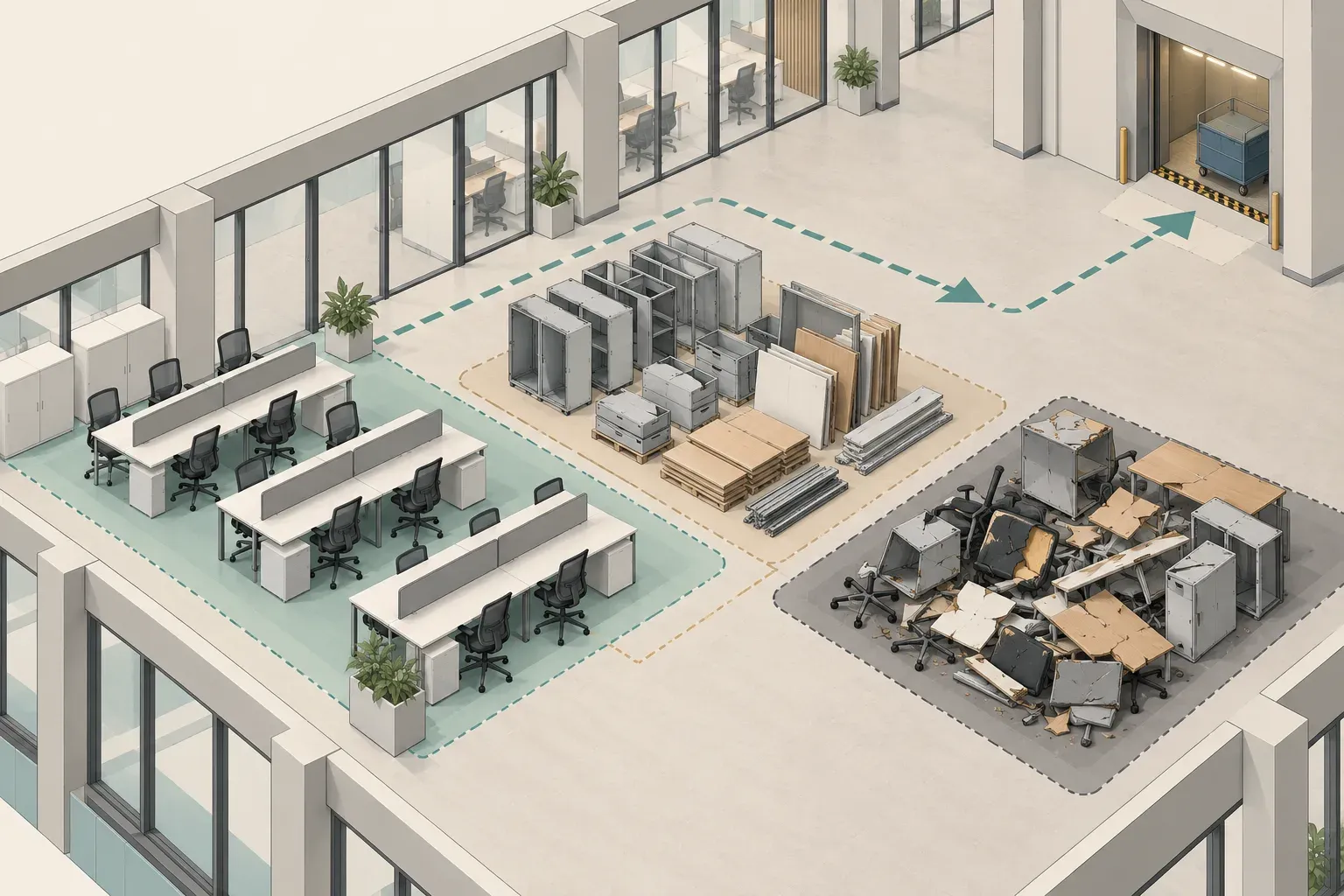
Unresolved items do not belong in the removal zone. Give them a visible hold label and a physical area away from approved waste.
Control personal and department property
Set a deadline for staff to remove personal belongings and identify department-owned resources. Check drawers, pedestals, cupboards and pinboards before furniture is approved. A label on the desk does not prove that the contents have been cleared.
Items lent by parent groups, suppliers or another campus need ownership confirmation. Leased printers, water dispensers, telecoms equipment and managed devices must follow their contract route rather than the general clearance load.
Isolate records before furniture moves
Paper on or inside a desk should be treated as a records decision, not as rubbish. The school should apply its own retention, confidentiality and destruction process. Move approved records to a controlled location before the clearance crew begins.
Check filing cabinets, archive boxes, noticeboards, trays and locked pedestals. Empty-looking furniture can still contain folders or removable media. Keep keys with the authorised records contact and do not ask a removal crew to decide whether information is sensitive.
Protect data-bearing equipment
Inventory computers, screens, drives, phones, multifunction devices and network equipment separately. The school's IT function should confirm data handling, account removal and destination. General removal is not certified data erasure.
Disconnecting ordinary loose peripherals is different from isolating live cabling, network racks or fixed electrical equipment. Assign technical work to the appropriate provider and record when it will be complete. The IT equipment disposal guide sets out the practical boundary in more detail.
Decide furniture destinations before dismantling
Keep usable desks, chairs and storage intact when a confirmed recipient or internal room is ready to receive them. Premature dismantling can mix components, lose fixings and turn a transferable item into loose material.
For the approved removal load, note joined desk systems, screens, cable trays, glass, height-adjustable parts and locked cabinets. Measure the largest pieces and compare them with doors, corridors and lifts. Photograph damage and sharp edges.
The office furniture removal guide explains the ownership, reuse and mixed-material decisions that should be settled before collection.
Keep fixed work outside the assumed scope
Reception counters, wall cabinets, partitions, floor boxes and built-in shelving may be part of the premises. Confirm ownership and reinstatement requirements before authorising work. Removal of loose office furniture does not imply strip-out, electrical isolation or surface repair.
Where a contractor will detach fixed items, define when the pieces become safe, loose and ready for collection. Do not schedule loading against an optimistic technical finish time without a contingency.
Plan around safeguarding and site operation
Choose a route and window that keep pupils, visitors and unrelated staff away from moving furniture and loading activity. A holiday may still include clubs, examinations, maintenance, deliveries or administrative work. Confirm actual occupancy with the site manager.
Define the vehicle entrance, security check, parking or loading position, internal route and restricted areas. State whether identification, permits, escorts or induction apply. Give the provider the approved instructions before arrival.
Keep emergency and shared routes open
Do not stage furniture in fire routes, stairs, reception circulation or corridors used by other teams. Create controlled room-level zones and move material into the route only as it is loaded.
If the site has several blocks or floors, clear them in a named sequence. Avoid sending crews between open teaching or public areas to chase scattered single items. One completed zone is easier to verify and secure than several half-cleared rooms.
Align the clearance with the school calendar
Work backwards from the date when the office must be ready for refurbishment, new furniture, staff return or inspection. Reserve time after removal for cleaning, repair and any fit-out work. Do not treat the last day of a closure as unlimited contingency.
Coordinate other contractors explicitly. Movers handle retained stock, IT specialists handle controlled technology, trades handle services or fixed work, and the clearance crew handles the approved unwanted load. Their vehicles, routes and staging areas should not compete for the same space without a site plan.
Use a realistic cutoff for additions
Set an inventory-freeze date. After that point, new items require approval, photographs and a quote update. This prevents departments from adding unassessed cupboards or store-room material while loading is underway.
If the school wants a phased project, issue a separate approved list for each phase. Keep completed and future zones distinct so an item intended for next week is not removed during the current visit.
Prepare the quote pack
Give the commercial junk removal service enough information to assess the real job:
- School site and authorised project contacts.
- Exact buildings, floors and rooms in scope.
- Itemised furniture, cartons and general contents.
- Separate IT, records, leased assets and specialist exclusions.
- Photographs of every room and large or damaged item.
- Dimensions of joined systems and route restrictions.
- Required dismantling that has been explicitly agreed.
- Vehicle gate, security and loading instructions.
- Approved working window and site occupancy.
- Other contractors using the route.
- Handover or documentation requirements raised by the school.
Ask what is accepted, what preparation is required and what evidence can actually be provided. Do not infer a guaranteed recycling outcome, certificate or data-destruction service from general disposal language.
Walk the route with facilities
Before the job, follow the path from each office to the vehicle. Check door widths, stairs, lift capacity where applicable, floor protection, gates and turns. Photograph existing marks on vulnerable surfaces.
Identify keys and access cards needed on the day. Confirm who opens secured rooms and who can authorise a route change. The collector should not be left to seek access through occupied or controlled parts of the school.
Label by destination, not by vague colour alone
Use written destination labels that remain legible: KEEP IN ROOM, INTERNAL MOVE, APPROVED TRANSFER, REMOVE and HOLD. If colours are used, add the words as well. Post the legend at each room entrance and give the project owner the master inventory.
Attach labels where they will stay visible during dismantling or movement. Joined furniture needs a group identifier so panels and hardware remain together. Boxes should show the destination and a count, without exposing confidential contents on the outside.
Protect the removal zone
Once a room is signed off, restrict casual additions and removals. Staff should not reclaim an item from the removal group without notifying the project owner and updating the inventory. Equally, they should not place new bags beside the load without approval.
Keep donation or staff-collection items in a separate controlled zone with a firm pickup deadline. An intended recipient is not a completed handoff.
Manage collection day room by room
Hold a short start briefing with the project owner, facilities contact and crew lead. Review the authorised inventory, restricted areas, route and emergency arrangements. Walk the first room and point out hold items and fragile surfaces.
Clear one zone, compare it with the list and obtain the site contact's confirmation before moving to the next. Record anything not removed and why. If an unlisted item appears, stop for authorisation rather than treating proximity as consent.
Coordinate changes without losing control
Building access, other contractors or room availability may change. Route all changes through the named contacts. If the vehicle position moves or an occupied corridor must be avoided, reassess the carry route before continuing.
Technical delay is not permission for a clearance crew to disconnect or make equipment safe. Hold the affected item and document the follow-up requirement.
Inspect and close the project
Open emptied cupboards and drawers, check behind doors and walk every approved room. Compare removed quantities with the signed inventory. Confirm that retained assets, records, IT equipment and keys remain in their controlled locations.
Inspect the shared route and loading point with facilities where required. Remove temporary labels and packing associated with the clearance, while leaving other contractors' material untouched. Photograph the cleared offices before new furniture or construction changes the condition.
Retain the approved lists, change record and any genuine collection documentation. These records show the scope completed; they do not replace the school's asset-accounting, data-governance or premises-handover process.
Treat departmental stores as new scopes
An office cupboard may contain ordinary stationery, while an adjacent departmental store may hold art materials, cleaning products, batteries, tools or equipment whose condition is unknown. Do not extend an office-furniture quote into those stores without a fresh inventory and acceptance check.
Ask the responsible department to remove usable supplies and identify every remaining material. Keep liquids, aerosols, chemicals, batteries, lamps, medical items and sharp tools out of the general load. The school must assign any specialist route that applies; proximity to a desk does not make an item office waste.
If empty shelving from a store is approved, quote it only after the contents are cleared and the shelf's ownership and fixing method are confirmed. Photograph the now-visible item and route, then add it through the project's change process.
Keep educational resources under authorised control
Books, displays, examination material, student work and branded resources may have reuse, records or safeguarding implications. A removal provider should receive only a final decision, not decide what the school retains. Box and label authorised transfers separately from unwanted general contents.
Where staff want to claim surplus resources, the school should set the process and deadline. Keep uncollected items on hold until the authorised owner changes their status in the inventory.
Plan multi-building sites as a sequence
For a campus with several blocks, give each building a code, contact and load list. Confirm whether the vehicle can move between loading points or must remain at one gate. Long internal carries, covered walkways, stairs and security transitions belong in the quote.
Finish and sign off one building before opening another removal zone. This reduces mixed labels and makes it easier for security and facilities teams to know where the crew is authorised to work. It also creates a clear stopping point if the approved window ends early.
If different buildings have different occupancy or access rules, do not force them into one generic schedule. The master plan can coordinate the project while each building retains a usable route and verified time window.
A school-office clearance becomes manageable when authority is visible at every step. Freeze the assets, remove records and data from the general load, separate technical work, protect the site route and verify rooms one at a time. That keeps a short closure window from turning into an uncontrolled clear-out.
Questions about school-office clearance
Can a clearance happen during a school holiday?
Yes, if the provider confirms availability and the school confirms access, occupancy and safeguarding arrangements. A holiday does not automatically mean the whole site is empty or unrestricted.
Can old computers be included with office furniture?
List them separately. The school should control the asset and data decisions, and any required sanitisation or specialist route, before collection. General removal is not certified data erasure.
Who decides whether furniture can be donated or transferred?
The authorised school decision-maker does. Confirm the recipient and deadline, update the asset records as required, and keep transfer items outside the removal zone.
Does office clearance include fixed counters and cabinets?
Do not assume it does. Confirm ownership, landlord or facilities approval, disconnection needs and reinstatement responsibilities. Loose furniture removal and strip-out are separate scopes.
What should be ready before the crew arrives?
The approved inventory, destination labels, cleared drawers, isolated records and IT, completed technical preparation, confirmed security access and a clear vehicle route should all be in place.